



Question: Phys151: Applied Physics Lab 4: Acceleration The Rate of Change of the Rate of Change of Position In Lab 3, we were able to create
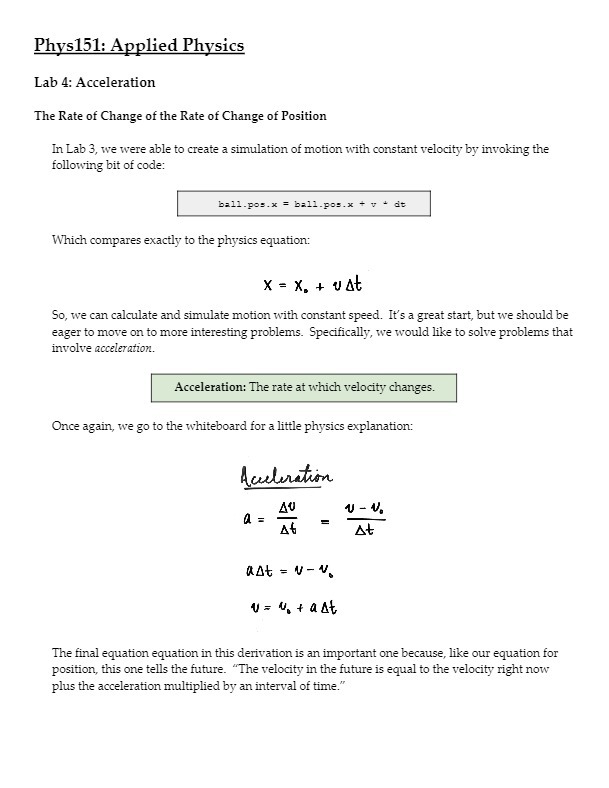
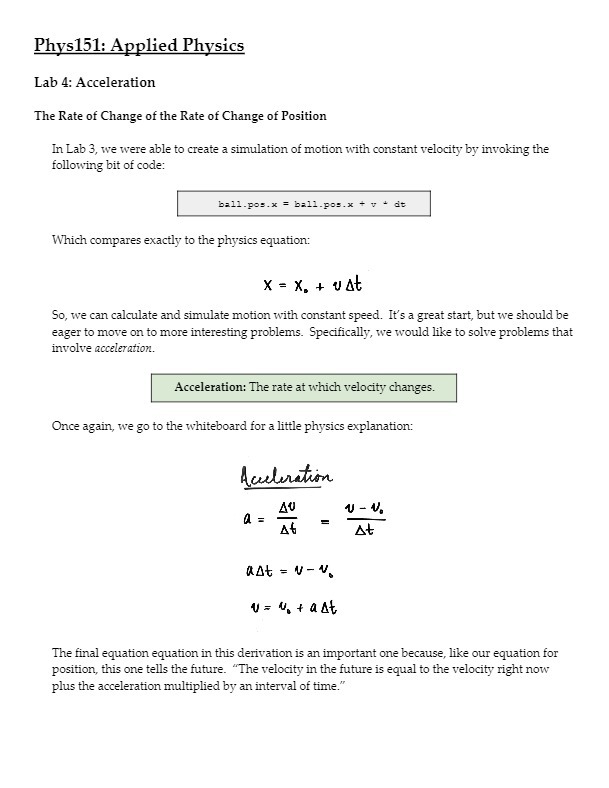
Phys151: Applied Physics Lab 4: Acceleration The Rate of Change of the Rate of Change of Position In Lab 3, we were able to create a simulation of motion with constant velocity by invoking the following bit of code: ball . pos.x = ball.pos.x + v + at Which compares exactly to the physics equation: X = X. + vat So, we can calculate and simulate motion with constant speed. It's a great start, but we should be eager to move on to more interesting problems. Specifically, we would like to solve problems that involve acceleration. Acceleration: The rate at which velocity changes. Once again, we go to the whiteboard for a little physics explanation: Acceleration 40 V - V. = At = At AAt = V - V. V = V. + ant The final equation equation in this derivation is an important one because, like our equation for position, this one tells the future. "The velocity in the future is equal to the velocity right now plus the acceleration multiplied by an interval of time."
Step by Step Solution
There are 3 Steps involved in it

Get step-by-step solutions from verified subject matter experts