







Question: Physical Pendulum ( 4 points ) Learning Objectives: Get familiar with physical pendula and their oscillations. A thin homogeneous stick of length L = 1.40
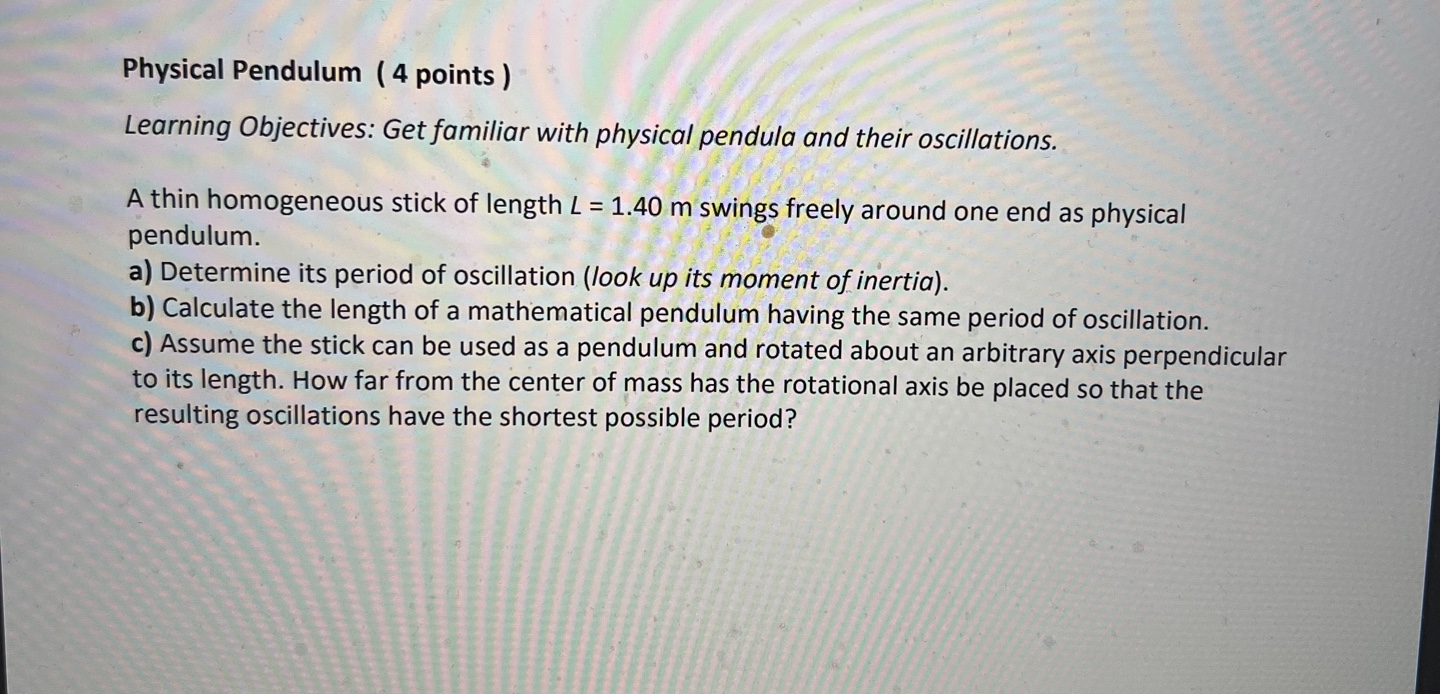
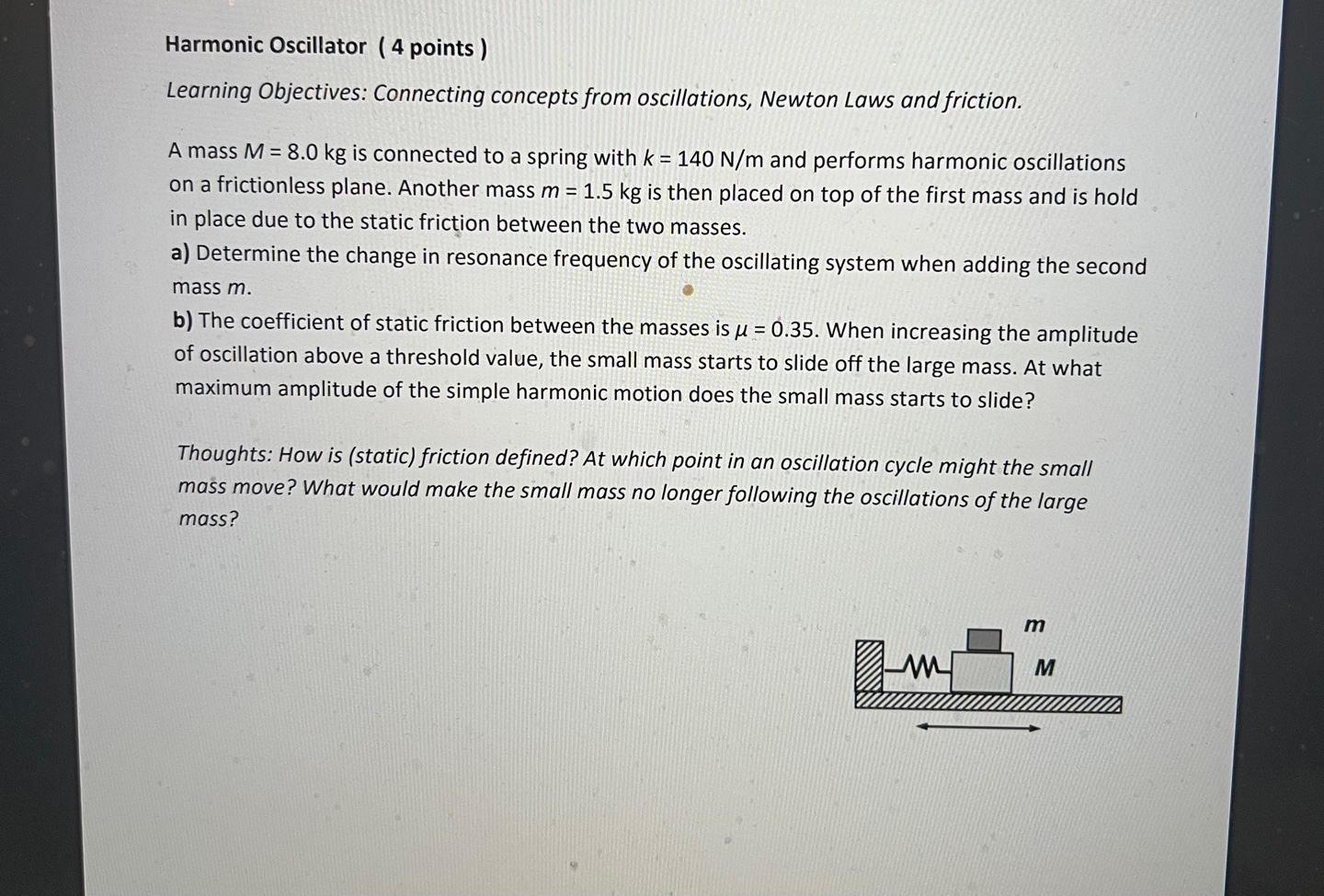
Physical Pendulum ( 4 points ) Learning Objectives: Get familiar with physical pendula and their oscillations. A thin homogeneous stick of length L = 1.40 m swings freely around one end as physical pendulum. a) Determine its period of oscillation (look up its moment of inertia). b) Calculate the length of a mathematical pendulum having the same period of oscillation. c) Assume the stick can be used as a pendulum and rotated about an arbitrary axis perpendicular to its length. How far from the center of mass has the rotational axis be placed so that the resulting oscillations have the shortest possible period?Harmonic Oscillator (4 points 1 Learning Objectives: Connecting concepts from oscillations, Newton Laws and friction. A mass M = 8.0 kg is connected to a spring with k = 140 N/m and performs harmonic oscillations on a frictionless plane. Another mass m = 1.5 kg is then placed on top ofthe first mass and is hold in place due to the static friction between the two masses. a) Determine the change in resonance frequency of the oscillating system when adding the second mass m. a b) The coefficient of static friction between the masses is u = 0.35. When increasing the amplitude of osdllation above a threshold value, the small mass starts to slide off the large mass. At what maximum amplitude of the simple harmonic motion does the small mass starts to slide? Thoughts: How is (static) friction defined? At which point in an oscillation cycle might the small mass move? What would make the small mass no longer Jfollowing the oscillations of the large mass
Step by Step Solution
There are 3 Steps involved in it

Get step-by-step solutions from verified subject matter experts
 Study Help