







Question: Physics 1 2 3 : Lab 9 Light from hydrogen atoms Concept: The electron in a hydrogen atom can occupy any one of a number
Physics : Lab
Light from hydrogen atoms
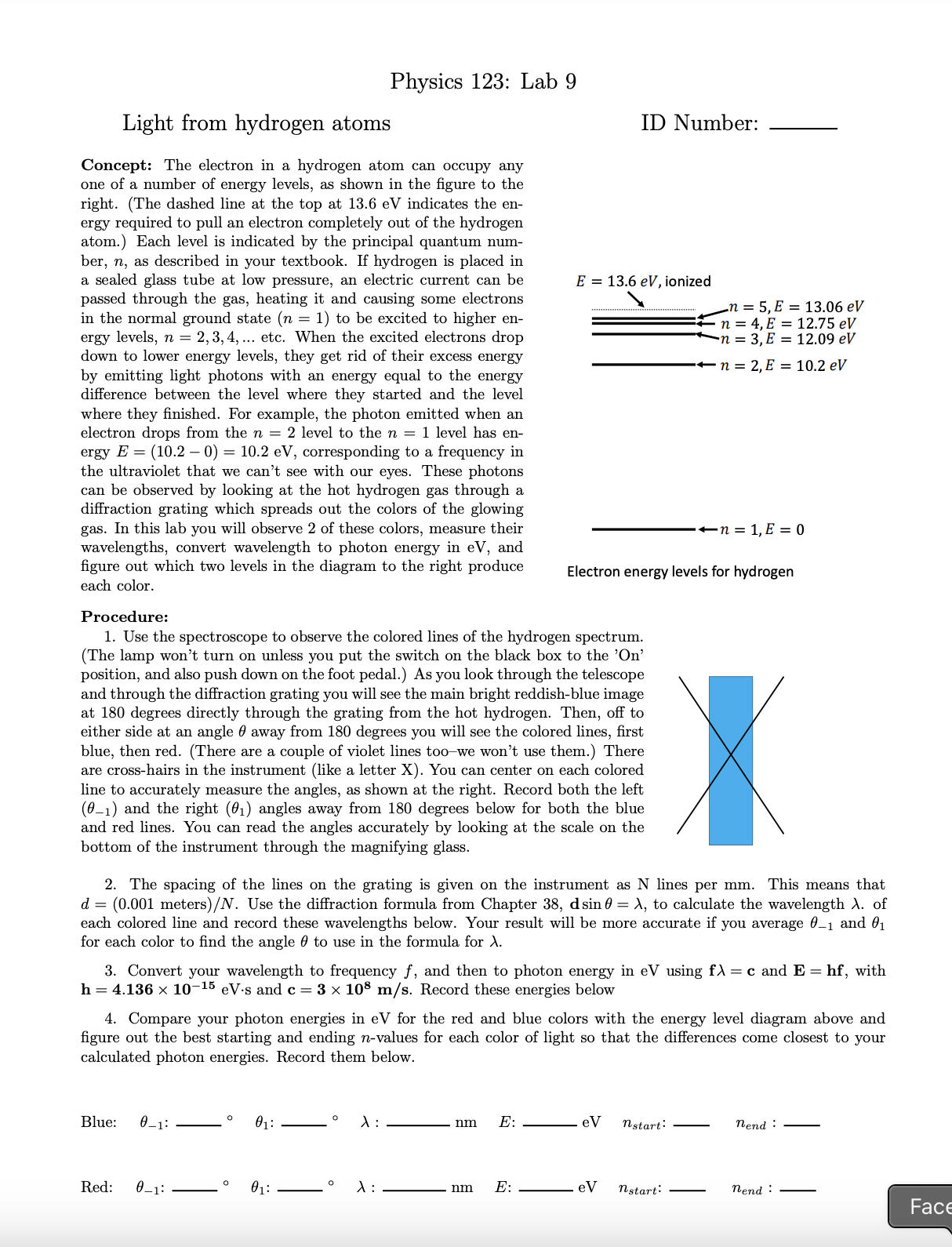
Concept: The electron in a hydrogen atom can occupy any one of a number of energy levels, as shown in the figure to the right. The dashed line at the top at eV indicates the energy required to pull an electron completely out of the hydrogen atom. Each level is indicated by the principal quantum number, n as described in your textbook. If hydrogen is placed in a sealed glass tube at low pressure, an electric current can be passed through the gas, heating it and causing some electrons in the normal ground state n to be excited to higher energy levels, nldots etc. When the excited electrons drop down to lower energy levels, they get rid of their excess energy by emitting light photons with an energy equal to the energy difference between the level where they started and the level where they finished. For example, the photon emitted when an electron drops from the n level to the n level has energy EmathrmeV corresponding to a frequency in the ultraviolet that we can't see with our eyes. These photons can be observed by looking at the hot hydrogen gas through a diffraction grating which spreads out the colors of the glowing gas. In this lab you will observe of these colors, measure their wavelengths, convert wavelength to photon energy in eV and figure out which two levels in the diagram to the right produce each color.
ID Number:
Procedure:
Use the spectroscope to observe the colored lines of the hydrogen spectrum. The lamp won't turn on unless you put the switch on the black box to the On position, and also push down on the foot pedal. As you look through the telescope and through the diffraction grating you will see the main bright reddishblue image at degrees directly through the grating from the hot hydrogen. Then, off to either side at an angle theta away from degrees you will see the colored lines, first blue, then red. There are a couple of violet lines toowe won't use them. There are crosshairs in the instrument like a letter X You can center on each colored line to accurately measure the angles, as shown at the right. Record both the left leftthetaright and the right leftthetaright angles away from degrees below for both the blue and red lines. You can read the angles accurately by looking at the scale on the bottom of the instrument through the magnifying glass.
The spacing of the lines on the grating is given on the instrument as N lines per mm This means that d meters N Use the diffraction formula from Chapter mathbfdsin thetalambda to calculate the wavelength lambda of each colored line and record these wavelengths below. Your result will be more accurate if you average theta and theta for each color to find the angle theta to use in the formula for lambda
Convert your wavelength to frequency f and then to photon energy in eV using mathbfflambdamathbfc and mathbfEmathbfh f with mathbfhmathbftimes mathbfmathbfmathrmeVcdot mathrms and mathbfcmathbftimes mathbfmathbfmathbf~ mmathrms Record these energies below
Compare your photon energies in eV for the red and blue colors with the energy level diagram above and figure out the best starting and ending n values for each color of light so that the differences come closest to your calculated photon energies. Record them below.
Blue:
Step by Step Solution
There are 3 Steps involved in it
1 Expert Approved Answer
Step: 1 Unlock

Question Has Been Solved by an Expert!
Get step-by-step solutions from verified subject matter experts
Step: 2 Unlock
Step: 3 Unlock
 Study Help