







Question: The human heart pushes blood with a force of over 16,000 N for every square meter of artery wall. (This is a gauge pressure.)

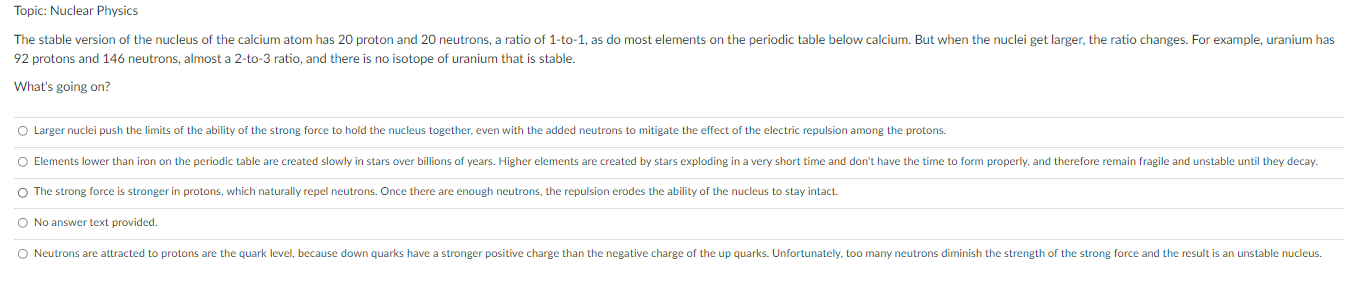
The human heart pushes blood with a force of over 16,000 N for every square meter of artery wall. (This is a gauge pressure.) How does that compare to atmospheric pressure? O This "value" is less than 1 atm, but this is a "gauge pressure", measuring pressure in addition to atmospheric pressure; blood vessel walls work to keep the blood in. O This value is greater than atmospheric pressure; blood vessel walls work to keep the blood in. O This value is less than atmospheric pressure: blood vessel walls work to keep the atmosphere out. O Have you ever stepped on one of those little ketchup packets they give out at McDonalds? Eeewww! O This value has to be exactly the same as the atmospheric pressure; blood vessels only work to push blood though and do not have to contend with a pressure difference unless the individual's pressure is too high. Topic: Nuclear Physics The stable version of the nucleus of the calcium atom has 20 proton and 20 neutrons, a ratio of 1-to-1, as do most elements on the periodic table below calcium. But when the nuclei get larger, the ratio changes. For example, uranium has 92 protons and 146 neutrons, almost a 2-to-3 ratio, and there is no isotope of uranium that is stable. What's going on? O Larger nuclei push the limits of the ability of the strong force to hold the nucleus together, even with the added neutrons to mitigate the effect of the electric repulsion among the protons. O Elements lower than iron on the periodic table are created slowly in stars over billions of years. Higher elements are created by stars exploding in a very short time and don't have the time to form properly, and therefore remain fragile and unstable until they decay. O The strong force is stronger in protons, which naturally repel neutrons. Once there are enough neutrons, the repulsion erodes the ability of the nucleus to stay intact. O No answer text provided. O Neutrons are attracted to protons are the quark level, because down quarks have a stronger positive charge than the negative charge of the up quarks. Unfortunately, too many neutrons diminish the strength of the strong force and the result is an unstable nucleus.
Step by Step Solution
3.47 Rating (160 Votes )
There are 3 Steps involved in it
1The value is greater than atmospheric pressure blood vessels walls work to keep ... View full answer

Get step-by-step solutions from verified subject matter experts
Document Format (2 attachments)

636611b50d046_240277.pdf
180 KBs PDF File

636611b50d046_240277.docx
120 KBs Word File
 Study Help