



Question: PHYSICS 1: CIRCUITS EXPLORATION ACTIVITY Ohm's Law 4- Circuit Eiernents Purpose 0 Students will explore the variables in Ohm's Law: potential difference, current, and resistance
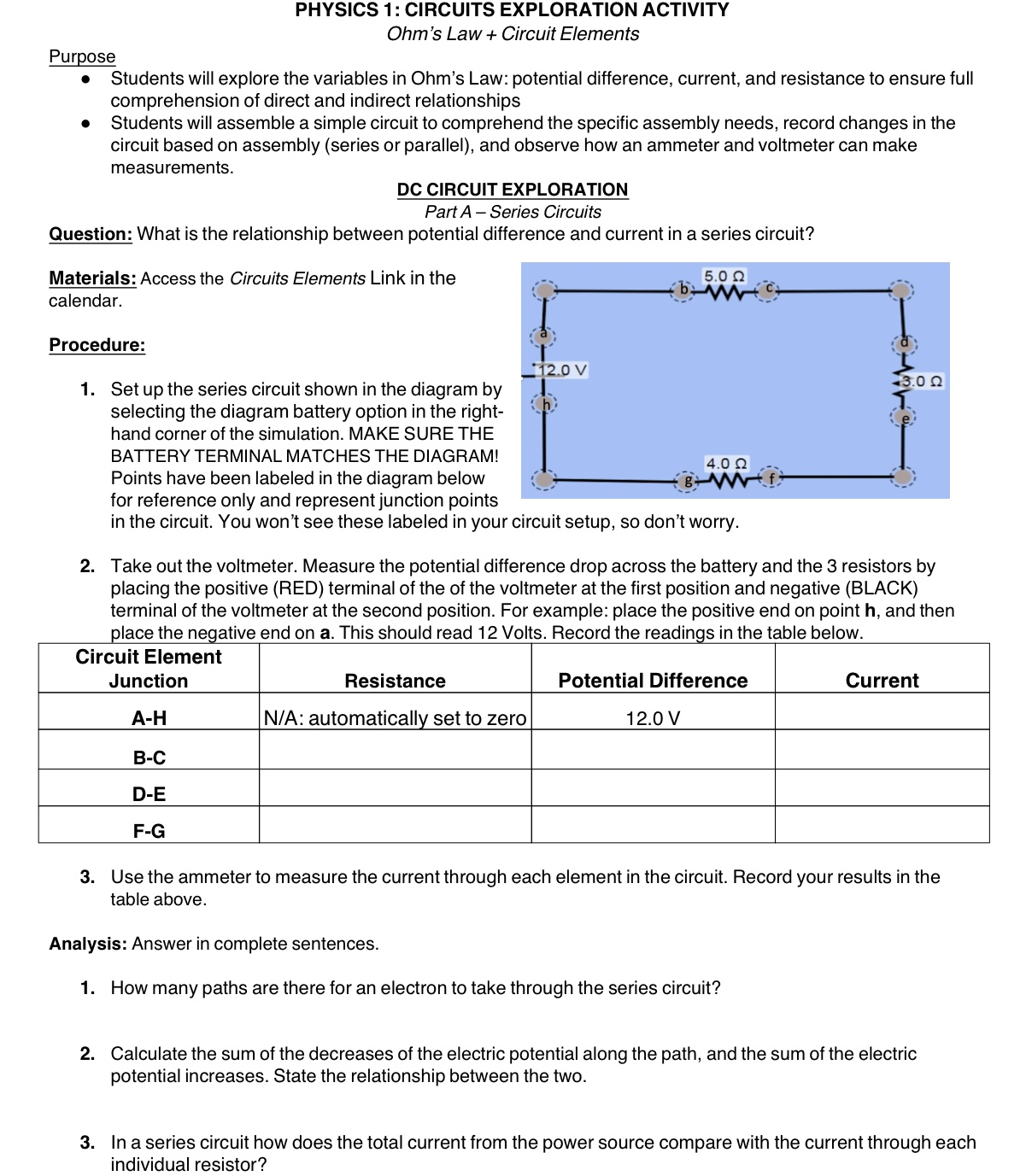
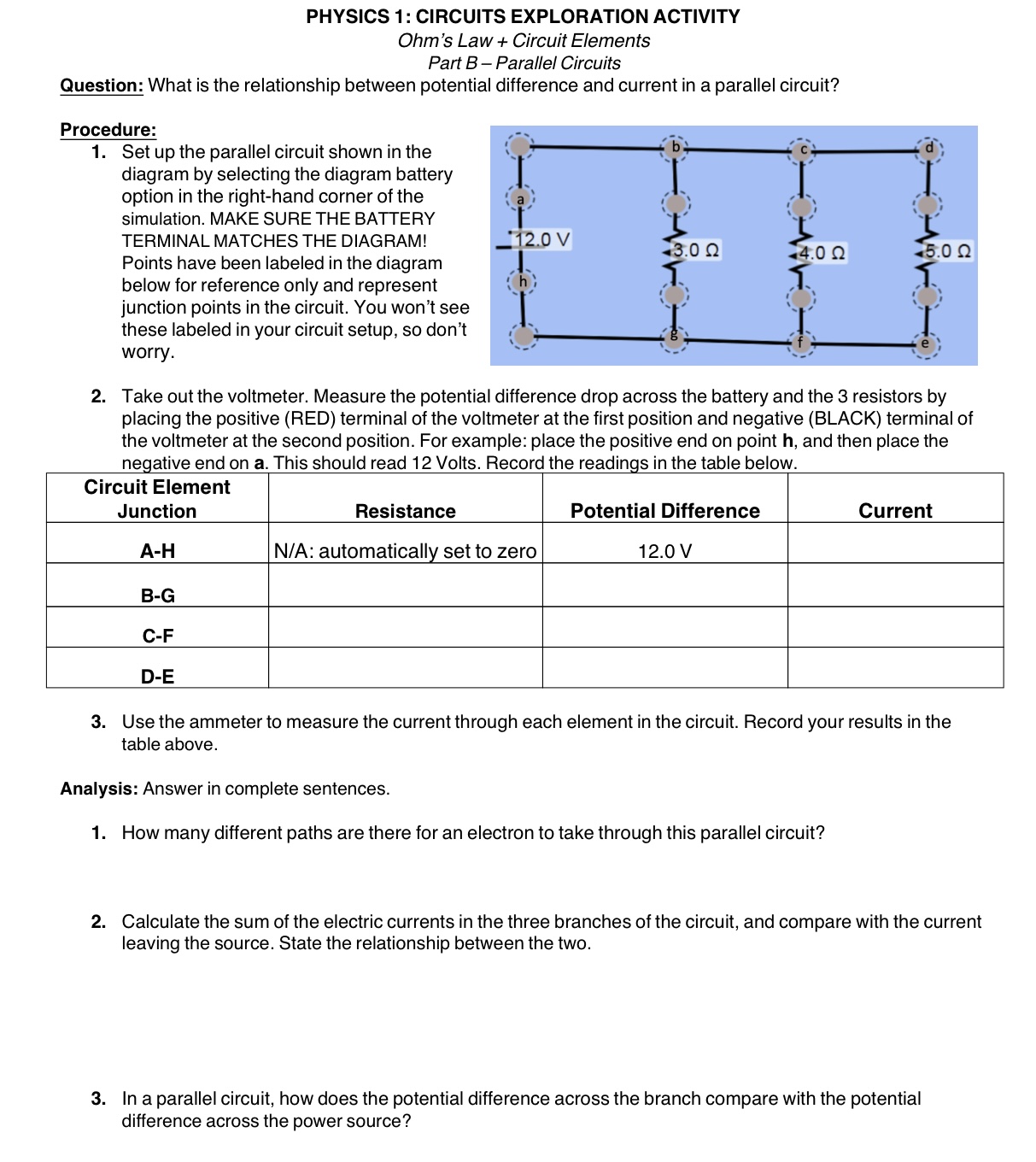
PHYSICS 1: CIRCUITS EXPLORATION ACTIVITY Ohm's Law 4- Circuit Eiernents Purpose 0 Students will explore the variables in Ohm's Law: potential difference, current, and resistance to ensure full comprehension of direct and indirect relationships 0 Students will assemble a simple circuit to comprehend the specific assembly needs, record changes in the circuit based on assembly (series or parallel), and observe how an ammeter and voltmeter can make measurements. DC CIRCUIT EXPLORATION PartA Series Circuits Question: What is the relationship between potential difference and current in a series circuit? Materials: Access the Circuits Elements Link in the calendar. Procedure: 1. Set up the series circuit shown in the diagram by selecting the diagram battery option in the right- hand cornerof the simulation. MAKE SURE THE BATTERY TERMINAL MATCHES THE DIAGRAM! Points have been labeled in the diagram below for reference only and representjunction points in the circuit. You won't see these labeled in your circuit setup, so don't worry. 2. Take out the voltmeter. Measure the potential difference drop across the battery and the 3 resistors by placing the positive (RED) terminal of the ofthe voltmeter at the first position and negative (BLACK) terminal of the voltmeter at the second position. For example: place the positive end on point h, and then . lace the n - - ative end on a. This should read 12 Volts. Record the readin - s in the table below. Junction Resistance Potential Difference \" NiA: automaticall set to zero 12 0 V 3. Use the ammeter to measure the currentthrough each element in the circuit. Record your results in the table above. Analysis: Answer in complete sentences. 1. How many paths are there for an electron to take through the series circuit? 2. Calculate the sum of the decreases of the electric potential along the path, and the sum of the electric potential increases. State the relationship between the two. 3. In a series circuit how does the total current from the power source compare with the current through each individual resistor? PHYSICS 1 : CIRCUITS EXPLORATION ACTIVITY Ohm's Law + Circuit Elements Extension: 1. Using the 12.0 V battery, construct a complex circuit that uses at leasttwo resistors in series and at least two resistors in parallel that has an overall current of 5.50 A. Paste a screenshot of the circuit here with all the appropriate labels showing how you achieved this circuit. PHYSICS 1: CIRCUITS EXPLORATION ACTIVITY Ohm's Law 4- Circuit Elements Part B Paraiiei Circuits Question: What is the relationship between potential difference and current in a parallel circuit? Procedure: 1. Set up the parallel circuit shown in the diagram by selecting the diagram battery option in the right-hand corner of the simulation. MAKE SURE THE BATTERY TERMINAL MATCHES THE DIAGRAM! Points have been labeled in the diagram below for reference only and represent junction points in the circuit. You won't see these labeled in your circuit setup, so don't worry. 2. Take out the voltmeter. Measure the potential difference drop across the battery and the 3 resistors by placing the positive (RED) terminal of the voltmeter at the first position and negative (BLACK) terminal of the voltmeter at the second position. For example: place the positive end on point h, and then place the ne-ative end on a. This should read 12 Volts. Record the readin- s in the table below. Junction Resistance Potential Difference \"MANN..." mom 3. Use the ammeter to measure the currentthrough each element in the circuit. Record your results in the table above. Analysis: Answer in complete sentences. 1. How many different paths are there for an electron to take through this parallel circuit? 2. Calculate the sum of the electric currents in the three branches of the circuit, and compare with the current leaving the source. State the relationship between thetwo. 3. In a parallel circuit, how does the potential difference across the branch compare with the potential difference across the power source
Step by Step Solution
There are 3 Steps involved in it

Get step-by-step solutions from verified subject matter experts