







Question: Physics 20 Chapter 5 Circular Motion Worksheet 1. Draw a sketch that shows an object moving in a circle (nothing fancy!). For any one position
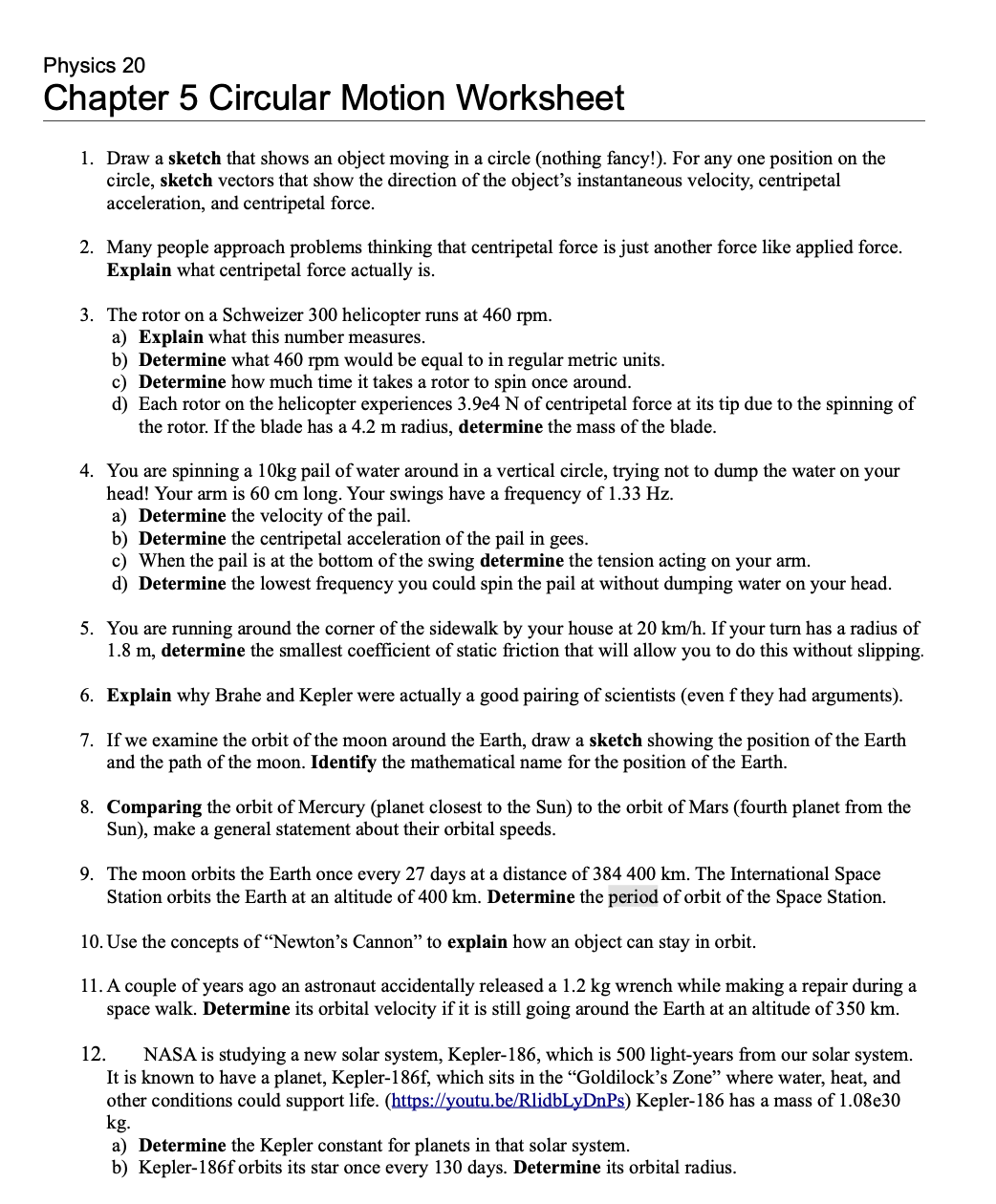
Physics 20 Chapter 5 Circular Motion Worksheet 1. Draw a sketch that shows an object moving in a circle (nothing fancy!). For any one position on the circle, sketch vectors that show the direction of the obj ect's instantaneous velocity, centripetal acceleration, and centripetal force. 2. Many people approach problems thinking that centripetal force is just another force like applied force. Explain what centripetal force actually is. 3. The rotor on a Schweizer 300 helicopter runs at 460 rpm. a) Explain what this number measures. b) Determine what 460 rpm would be equal to in regular metric units. c) Determine how much time it takes a rotor to spin once around. d) Each rotor on the helicopter experiences 3.9e4 N of centripetal force at its tip due to the spinning of the rotor. If the blade has a 4.2 m radius, determine the mass of the blade. 4. You are spinning a 10kg pail of water around in a vertical circle, trying not to dump the water on your head! Your arm is 60 cm long. Your swings have a frequency of 1.33 Hz. a) Determine the velocity of the pail. b) Determine the centripetal acceleration of the pail in gees. c) When the pail is at the bottom of the swing determine the tension acting on your arm. d) Determine the lowest frequency you could spin the pail at without dumping water on your head. 5. You are running around the corner of the sidewalk by your house at 20 kmr'h. If your turn has a radius of 1.8 m, determine the smallest coefcient of static iction that will allow you to do this without slipping. 6. Explain why Brahe and Kepler were actually a good pairing of scientists (even f they had arguments). 7. If we examine the orbit of the moon around the Earth, draw a sketch showing the position of the Earth and the path of the moon. Identify the mathematical name for the position of the Earth. 8. Comparing the orbit of Mercury (planet closest to the Sun) to the orbit of Mars (fourth planet from the Sun), make a general statement about their orbital speeds. 9. The moon orbits the Earth once every 27 days at a distance of 384 400 km. The lntemational Space Station orbits the Earth at an altitude of 400 km. Determine the period of orbit of the Space Station. 10. Use the concepts of \"Newton's Cannon" to explain how an object can stay in orbit. 11. A couple of years ago an astronaut accidentally released a 1.2 kg wrench while making a repair during a space walk. Determine its orbital velocity if it is still going around the Earth at an altitude of 350 km. 12. NASA is studying a new solar system, Kepler-186, which is 500 light-years from our solar system. It is known to have a planet, Kepler-186f, which sits in the \"Goldilock's Zone\" where water, heat, and other conditions could support life. (WES) Kepler-186 has a mass of 1.08e30 kg. a) Determine the Kepler constant for planets in that solar system. b) Kepler-186f orbits its star once every 130 days. Determine its orbital radius
Step by Step Solution
There are 3 Steps involved in it

Get step-by-step solutions from verified subject matter experts
 Study Help