







Question: Physics 2204 Worksheet #5 Freefall-Acceleration due to Gravity The equations of kinematics for uniform acceleration also apply to the special case of an object that
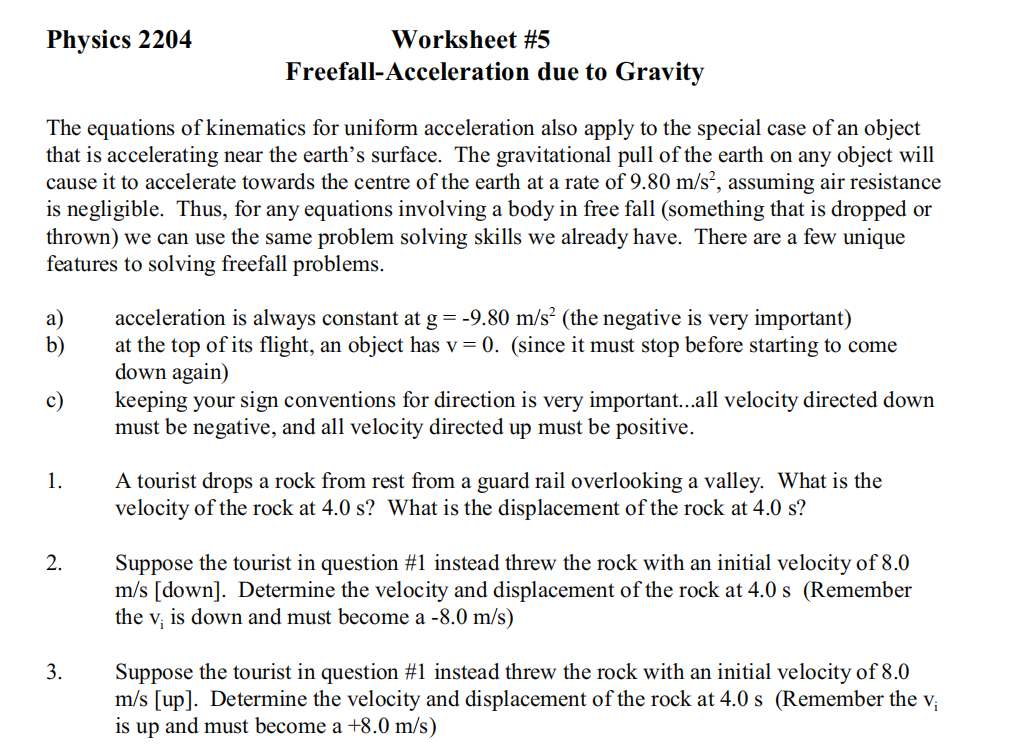
Physics 2204 Worksheet #5 Freefall-Acceleration due to Gravity The equations of kinematics for uniform acceleration also apply to the special case of an object that is accelerating near the earth's surface. The gravitational pull of the earth on any object will cause it to accelerate towards the centre of the earth at a rate of 9.80 mfsz, assuming air resistance is negligible. Thus, for any equations involving a body in free fall (something that is dropped or thrown) we can use the same problem solving skills we already have. There are a few unique features to solving freefall problems. a) b) C) acceleration is always constant at g = -9.80 1111's2 (the negative is very important) at the top of its ight, an object has v = 0. (since it must stop before starting to come down again) keeping your sign conventions for direction is very important. . .all velocity directed down must be negative, and all velocity directed up must be positive. A tourist drops a rock from rest from a guard rail overlooking a valley. What is the velocity of the rock at 4.0 s? What is the displacement of the rock at 4.0 3? Suppose the tourist in question #1 instead threw the rock with an initial velocity of 3.0 mls [down]. Determine the velocity and displacement of the rock at 4.0 s (Remember the vi is down and must become a -3.0 mfs) Suppose the tourist in question #1 instead threw the rock with an initial velocity of 8.0 mls [up]. Determine the velocity and displacement of the rock at 4.0 s (Remember the vi is up and must become a +8.0 mfs)
Step by Step Solution
There are 3 Steps involved in it

Get step-by-step solutions from verified subject matter experts
 Study Help