







Question: Physics Lab #6 - Combining Forces Problem: Do the rules of vector addition apply to combining forces? Materials Needed: Force table, 3 spring scales, ruler,
Physics
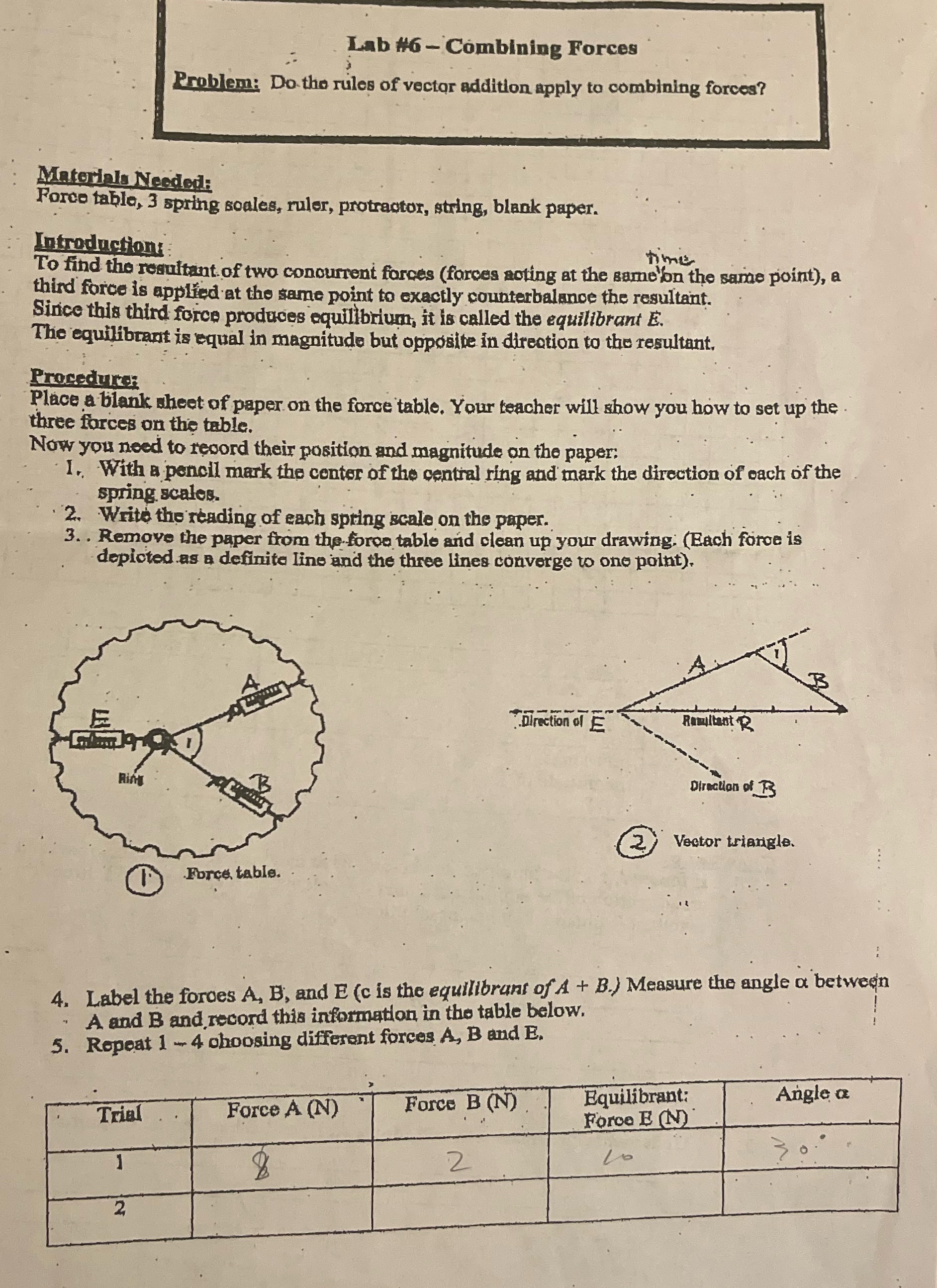
Lab #6 - Combining Forces Problem: Do the rules of vector addition apply to combining forces? Materials Needed: Force table, 3 spring scales, ruler, protractor, string, blank paper. Introduction: To find the resultant. of two concurrent forces (forces acting at the same on the same point), a third force is applied at the same point to exactly counterbalance the resultant. Since this third force produces equilibrium, it is called the equilibrant E. The equilibrant is equal in magnitude but opposite in direction to the resultant. Procedurei Place a blank sheet of paper on the force table. Your teacher will show you how to set up the three forces on the table. Now you need to record their position and magnitude on the paper: 1. With a pencil mark the center of the central ring and mark the direction of each of the spring scales. 2. Write the reading of each spring scale on the paper. 3. . Remove the paper from the force table and clean up your drawing. (Each force is depicted as a definite line and the three lines converge to one point). A .Direction of Ramiltant Direction of 3 2 Vector triangle. Force table. 4. Label the forces A, B, and E (c is the equilibrant of A + B.) Measure the angle a between A and B and record this information in the table below. 5. Repeat 1 - 4 choosing different forces A, B and E. Equilibrant: Angle a Trial Force A (N) Force B (N) Force E (N) 2 2
Step by Step Solution
There are 3 Steps involved in it

Get step-by-step solutions from verified subject matter experts
 Study Help