







Question: Physics Project Part 2. This is a great website to use to help construct and draw the circuit: http://phet.colorado.edu/sims/html/circuit-construction-kit-dc-virtual-lab/latest/circuit-construction-kit-dc-virtual-lab_en.html ] Only complete Part 2 please.
Physics Project Part 2. This is a great website to use to help construct and draw the circuit: http://phet.colorado.edu/sims/html/circuit-construction-kit-dc-virtual-lab/latest/circuit-construction-kit-dc-virtual-lab_en.html ]
Only complete Part 2 please.
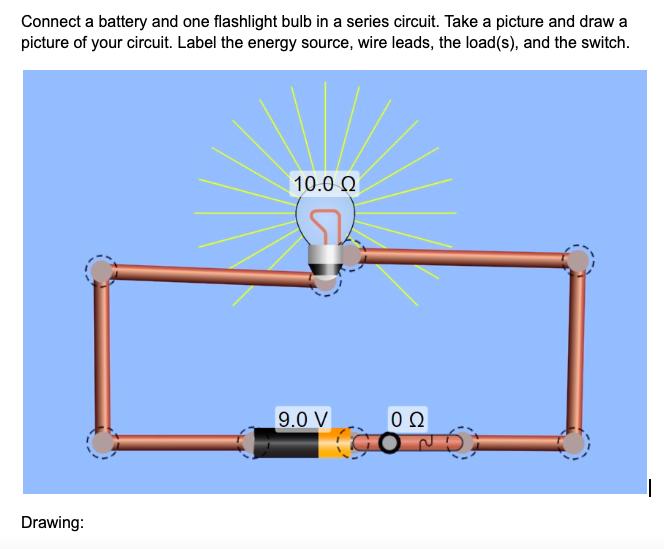
These are the examples from part 1
![help construct and draw the circuit: http://phet.colorado.edu/sims/html/circuit-construction-kit-dc-virtual-lab/latest/circuit-construction-kit-dc-virtual-lab_en.html ]Only complete Part 2 please.These](https://dsd5zvtm8ll6.cloudfront.net/si.experts.images/questions/2024/09/66f6d18305bd7_52266f6d182d046d.jpg)

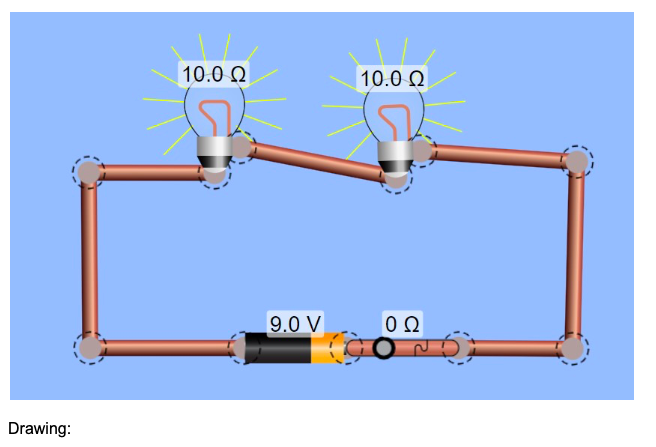
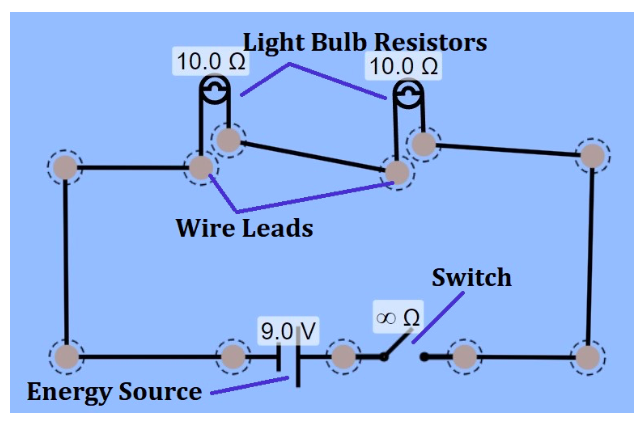
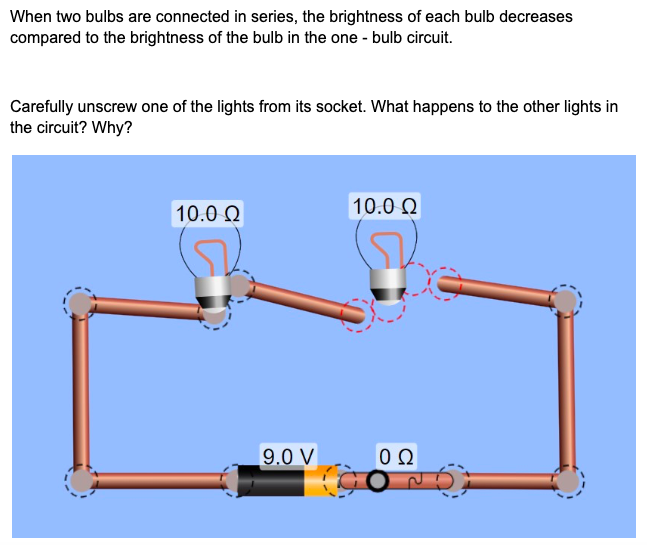

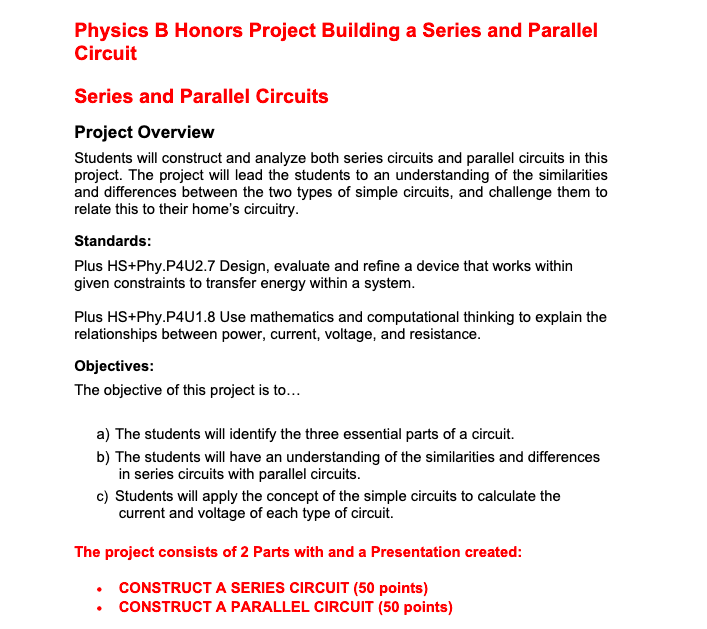
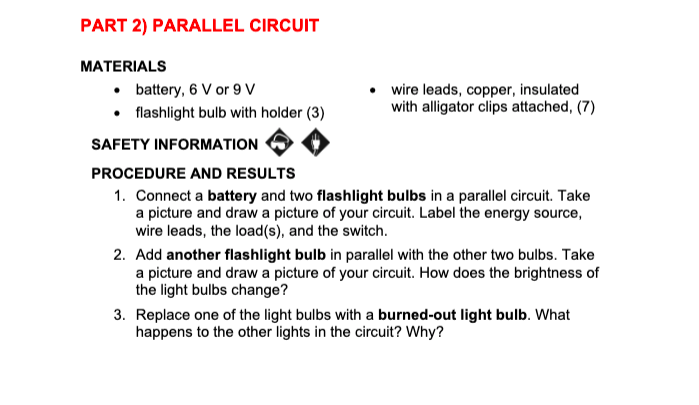
Connect a battery and one flashlight bulb in a series circuit. Take a picture and draw a picture of your circuit. Label the energy source, wire leads, the load(s), and the switch. 10.0 0 9.0 V Drawing:\fAdd another flashlight bulb in series with the other bulb. Take a picture and draw a picture of your circuit. How does the brightness of the light bulbs change?\f\fWhen two bulbs are connected in series, the brightness of each bulb decreases compared to the brightness of the bulb in the one - bulb circuit. Carefully unscrew one of the lights from its socket. What happens to the other lights in the circuit? Why? 10.0 0 10.0 0 9.0 V 0nWhen one bulb connected in series is unscrewed, the other bulb is turned off. This happens because the unscrewed bulb breaks the circuit and the current in the circuit stops flowing.Physics B Honors Project Building a Series and Parallel Circuit Series and Parallel Circuits Project Overview Students will construct and analyze both series circuits and parallel circuits in this project. The project will lead the students to an understanding of the similarities and differences between the two types of simple circuits, and challenge them to relate this to their home's circuitry. Standards: Plus HS+Phy.P4U2.7 Design, evaluate and refine a device that works within given constraints to transfer energy within a system. Plus HS+Phy.P4U1.8 Use mathematics and computational thinking to explain the relationships between power, current, voltage, and resistance. Objectives: The objective of this project is to... a) The students will identify the three essential parts of a circuit. b) The students will have an understanding of the similarities and differences in series circuits with parallel circuits. c) Students will apply the concept of the simple circuits to calculate the current and voltage of each type of circuit. The project consists of 2 Parts with and a Presentation created: CONSTRUCT A SERIES CIRCUIT (50 points) CONSTRUCT A PARALLEL CIRCUIT (50 points)PART 2) PARALLEL CIRCUIT MATERIALS . battery, 6 V or 9 V wire leads, copper, insulated . flashlight bulb with holder (3) with alligator clips attached, (7) SAFETY INFORMATION PROCEDURE AND RESULTS 1. Connect a battery and two flashlight bulbs in a parallel circuit. Take a picture and draw a picture of your circuit. Label the energy source, wire leads, the load(s), and the switch. 2. Add another flashlight bulb in parallel with the other two bulbs. Take a picture and draw a picture of your circuit. How does the brightness of the light bulbs change? 3. Replace one of the light bulbs with a burned-out light bulb. What happens to the other lights in the circuit? Why
Step by Step Solution
There are 3 Steps involved in it

Get step-by-step solutions from verified subject matter experts
 Study Help