


Question: Physics/BioPhysics 150 Studio 15: Fluid flow; Work and Energy Warm-up Problem 1: An office worker pushes a 30 kg crate, initially at rest, a distance
Physics/BioPhysics 150 Studio 15: Fluid flow;Physics/BioPhysics 150 Studio 15: Fluid flow;
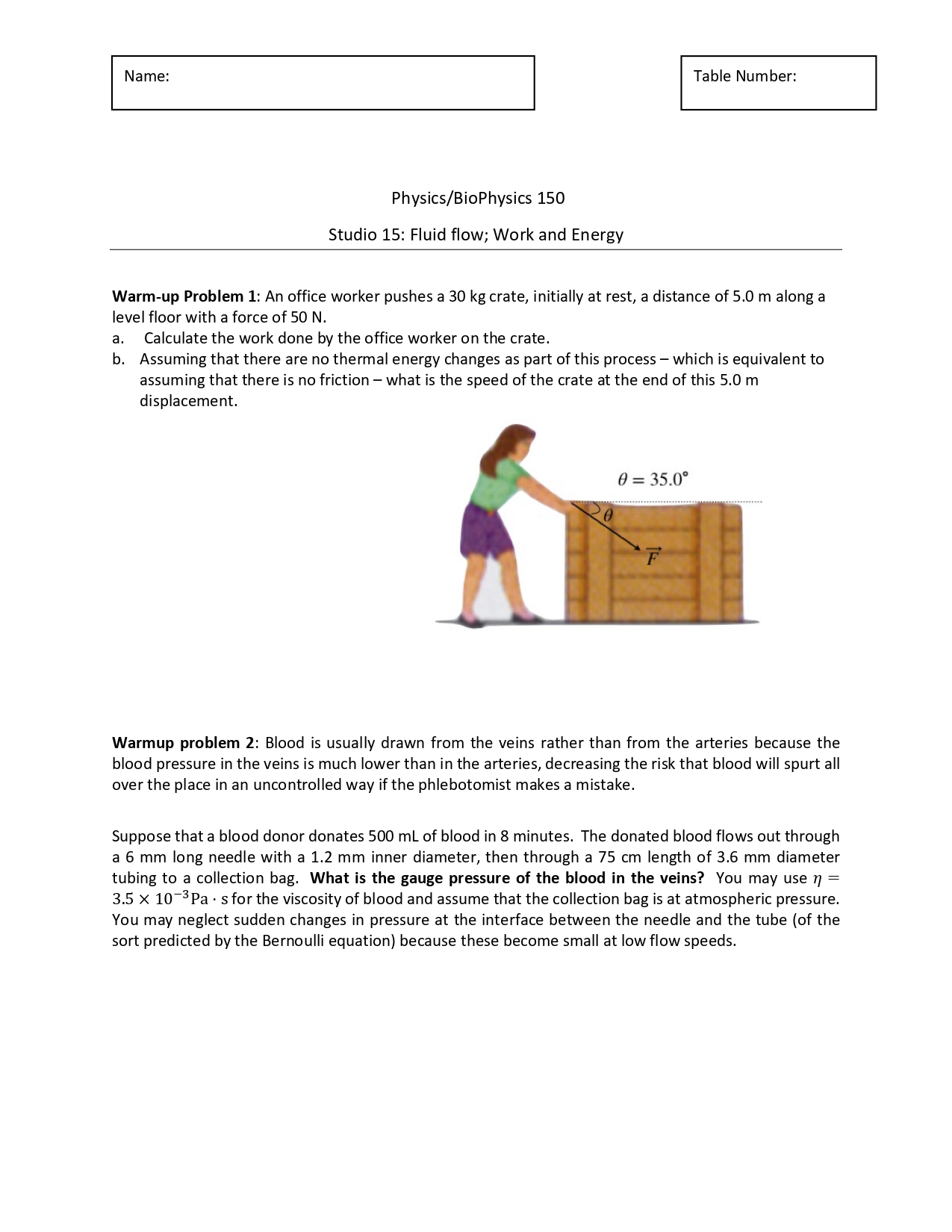
Physics/BioPhysics 150 Studio 15: Fluid flow; Work and Energy Warm-up Problem 1: An office worker pushes a 30 kg crate, initially at rest, a distance of 5.0 m along a level floor with a force of 50 N. a. Calculate the work done by the office worker on the crate. b. Assuming that there are no thermal energy changes as part of this process which is equivalent to assuming that there is no friction what is the speed of the crate at the end of this 5.0 m displacement. Warmup problem 2: Blood is usually drawn from the veins rather than from the arteries because the blood pressure in the veins is much lower than in the arteries, decreasing the risk that blood will spurt all over the place in an uncontrolled way if the phlebotomist makes a mistake. Suppose that a blood donor donates 500 mL of blood in 8 minutes. The donated blood flows out through a 6 mm long needle with a 1.2 mm inner diameter, then through a 75 cm length of 3.6 mm diameter tubing to a collection bag. What is the gauge pressure of the blood in the veins? You may use 7 = 3.5 xX 10-?Pa-s for the viscosity of blood and assume that the collection bag is at atmospheric pressure. You may neglect sudden changes in pressure at the interface between the needle and the tube (of the sort predicted by the Bernoulli equation) because these become small at low flow speeds. 1. Model the brachial artery (the one in the upper arm) as a tube of length 20 cm and radius 2 mm. Blood moves through the artery at an average speed of 9 cm/s, and the viscosity of blood is about 3.5103 Pa-s. a. What is the pressure difference between the two ends of the 20 cm artery? | | b. How does this compare to a typical human blood pressure of about 100 mm Hg measured at the brachial artery? Do viscous pressure drops introduce a significant difference between the pressure measured at different parts of the brachial artery? 2. The buildup of fatty plaques on the inside of arteries can cause them to narrow, restricting blood flow through them. Suppose that plaque decreases the radius of a section of artery by 25%. By what factor does the volume flow rate Q through that artery decrease, assuming the pressure drop across it is unchanged (which is a reasonable first guess, since there are physiological limits on how large a pressure the heart can exert by pumping), as are any other relevant parameters? | |

Step by Step Solution

There are 3 Steps involved in it

1 Expert Approved Answer
Step: 1 Unlock blur-text-image

Question Has Been Solved by an Expert!

Get step-by-step solutions from verified subject matter experts

Step: 2 Unlock
Step: 3 Unlock

Students Have Also Explored These Related Accounting Questions!