







Question: pic 1 data ends at 422, it continues with 428,415 and 416 Please use the accompanying Excel data set or accompanying Text file data set
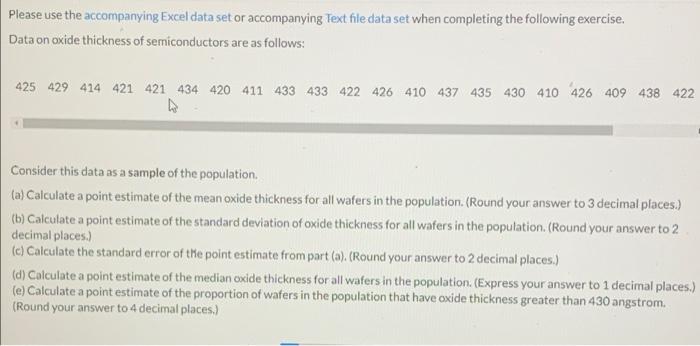
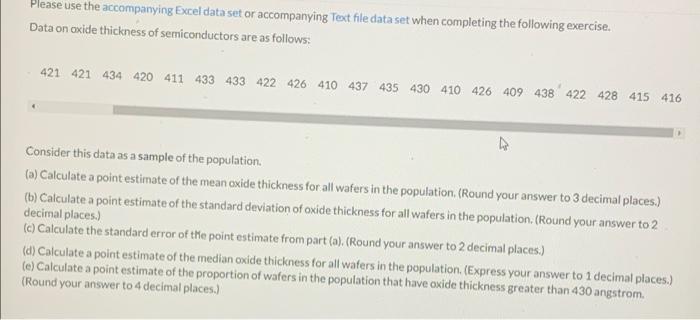
Please use the accompanying Excel data set or accompanying Text file data set when completing the following exercise. Data on oxide thickness of semiconductors are as follows: 425 429 414 421 421 434 420 411 433 433 422 426 410 437 435 430 410 426 409 438 422 Consider this data as a sample of the population. (a) Calculate a point estimate of the mean oxide thickness for all wafers in the population. (Round your answer to 3 decimal places.) (b) Calculate a point estimate of the standard deviation of oxide thickness for all wafers in the population. (Round your answer to 2 decimal places.) (c) Calculate the standard error of the point estimate from part (a). (Round your answer to 2 decimal places.) (d) Calculate a point estimate of the median oxide thickness for all wafers in the population (Express your answer to 1 decimal places.) (e) Calculate a point estimate of the proportion of wafers in the population that have oxide thickness greater than 430 angstrom. (Round your answer to 4 decimal places.) Please use the accompanying Excel data set or accompanying Text file data set when completing the following exercise. Data on oxide thickness of semiconductors are as follows: 421 421 434 420 411 433 433 422 426 410 437 435 430 410 426 409 438 422 428 415 416 Consider this data as a sample of the population. (a) Calculate a point estimate of the mean oxide thickness for all wafers in the population, (Round your answer to 3 decimal places.) (b) Calculate a point estimate of the standard deviation of oxide thickness for all wafers in the population. (Round your answer to 2 decimal places.) (c) Calculate the standard error of te point estimate from part (a). (Round your answer to 2 decimal places.) (d) Calculate a point estimate of the median oxide thickness for all wafers in the population (Express your answer to 1 decimal places.) (e) Calculate a point estimate of the proportion of wafers in the population that have oxide thickness greater than 430 angstrom (Round your answer to 4 decimal places.)
Step by Step Solution
There are 3 Steps involved in it

Get step-by-step solutions from verified subject matter experts
 Study Help