







Question: PIN to a database entry to either allow or deny access to the system of memory. The debugger y As a computer scientist, you know
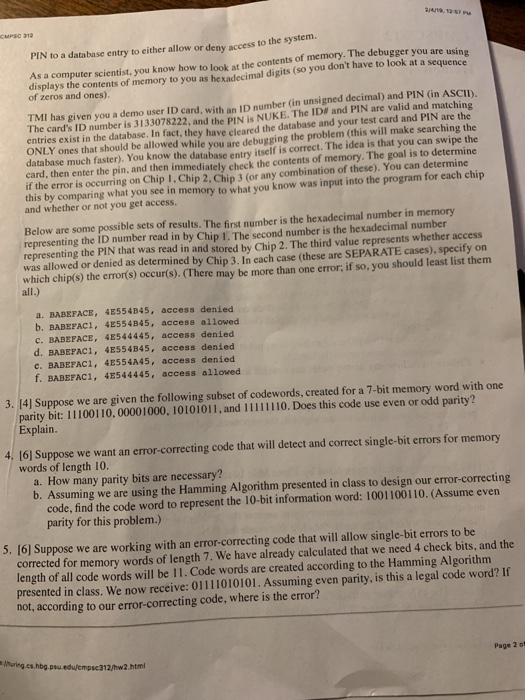
PIN to a database entry to either allow or deny access to the system of memory. The debugger y As a computer scientist, you know how to look at the contents displays the contents of of zeros and ones) ou are using memory to you as hexadecimal digits (so you don't have to look at a nsigned decimal) and PIN (in ASCII). E. The ID# and PIN are valid and matching d PIN are the TMI has given you a demo user ID card, with an ID number (in u The card's ID number is 3133078222, and the PIN is NUK entries exist in the database. In fact, they have cleared the database and your test card an ONLY ones that should be allowed while you are debugging the problem (this will make searching the database much faster). You know the database entry card, then enter the pin, and then immediately check the contents of memory. The goal is to determine if the error is occurring on Chip I, Chip 2, Chip 3 (or any combination of these). You can determine this by comparing what you see in memory to what you know was input into the program for each chip itself is correct. The idea is that you can swipe the and whether or not you get access Below are some possible sets of results. The first number is the hexadecimal number in memory representing the ID number read in by Chip 1. The second number is the hexadecimal number representing the PIN that was read in and stored by Chip 2. The third value represents whether access was allowed or denied as determined by Chip 3. In each case (these are SEPARATE cases), specify on which chip(s) the error(s) occur(s). (There may be more than one error; if so, you should least list them all.) a. BABEFACE, 4E554B45, access denied b. BABEFAC1, 4E554B45, access allowed .BABEFACE, 4E5 44445, access denied d. BABEFAC1, 4E554B45, access denied e. BABEFAC1, 4E554A45, access denied f. BABEFAC1, 4E544445, access allowed 3. 14] Suppose we are given the following subset of codewords, created for a 7-bit memory word with one parity bit: 11100110,00001000, 10101011, and I11110. Does this code use even or odd parity? Explain. 16] Suppose we want an error-correcting code that will detect and correct single-bit errors for memory words of length 10 4. a. How many parity bits are necessary? b. Assuming we are using the Hamming Algorithm presented in class to design our error-correcting code, find the code word to represent the 10-bit information word: 1001100110. (Assume even parity for this problem.) S. [6] Suppose we are working with an error-correcting code that will allow single-bit errors to be corrected for memory words of length 7. We have already calculated that we need 4 check bits, and the length of all code words will be 11. Code words are created according to the Hamming Algorithm presented in class. We now receive: 01111010101. Assuming even parity, is this a legal code word? If not, according to our error-correcting code, where is the error? Whurieg.cs.hbg.psu.edu/cmpsc312/hw2.html Page 2 of
Step by Step Solution
There are 3 Steps involved in it

Get step-by-step solutions from verified subject matter experts
 Study Help