Question: PITFALLS IN THE DESIGN AND IMPLEMENTATION OF INFORMATION SYSTEMS Peter Docherty Economic Research Institute at the Stockholm School of Economic, Stockholm, Sweden Abstract. Failure to
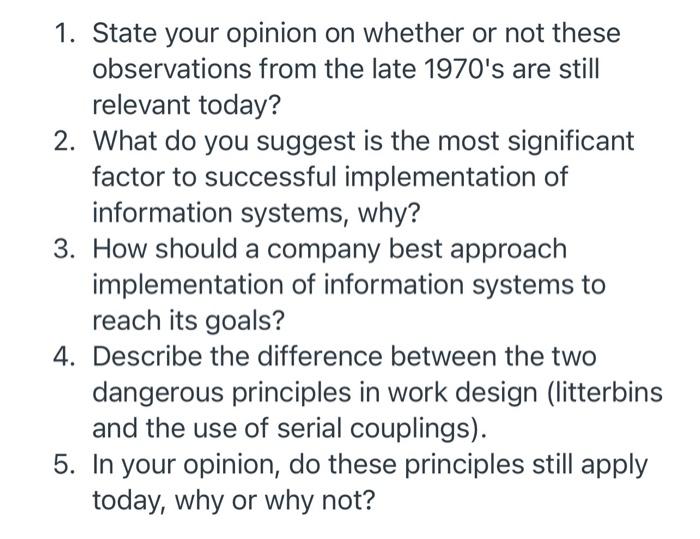
PITFALLS IN THE DESIGN AND IMPLEMENTATION OF INFORMATION SYSTEMS Peter Docherty Economic Research Institute at the Stockholm School of Economic, Stockholm, Sweden Abstract. Failure to fulfil end-user goals in systems development can be attributed to shortcomings in both the conduct of the individual project, 2.8. regarding end-user involvement and learning, and the organizational context, e.g. regarding current management values and systes paradigms. End-users' goals can be better fulfilled by parallel efforts to change both project practice and company policies. INTRODUCTION systems development work (see Fig. 1). DEVELOPANTAL CONTEXT DEVELOPMENTAL PRACTICE EXPERIENCE OF DESIGN PROCESS EXPERIENCE OF FOTOSESC SYSTEM Fig. 1. Areas affecting individuals experience of a system in their work situation. Increasing attention is being paid to the comparison of successful and less successful information systems projects (see, for exam ple, Alloway, 1976.a. 1977Docherty and colleagues, 1977: Cinaberg. 1974, 1975 and Zand and Sorensen, 1975). Naturally diffe- rent parties' perceptions of the success of a particular system vary. In this paper ! am concerned with the evaluations of the end-user, f.e. potential pitfalls are those hasards that may jeopodize the fulfilment of the end-users' goals in the design and implementation process. Considering end-user perceptions of success, Docherty and colleagues (1977) have shown it is meaningful to distinguish between their experiences of the implemented information sy- stem (the product or outcome of the develop ment process) and their experiences of the de- sign and implementation process as such. The former experiences may be formulated in terms of social psychological work needs. Important factors in the latter grouping are security of employment and position, and understanding of the development process. possibilities for involvement and participation and possibili- ties for learning and adaption Process expe- riences were shown to colour experiences of the functioning system. Ginzberg (1974) presents a detailed overview of the main factor studies regarding systems development, i.e. studies attempting to identi- fy critical factors influencing system project outcomes. A dozen studies produced a list of over one hundered and forty critical factors ranging from societal factors to individual personality characteristics. I will linit my selt here to factors within the company over which management can exercise influence. These may be broadly grouped into factors or pitfalls related to the organizational context in which systems design and implementation takes place and factors characterizing the conduct of the DANCERS IS THE ORGANIZATIONAL CONTEXT OF SYSTEMS DEVELOPMENT There are four areas in the developmental con text which I would like to exemplity, namely: - management's values, - the prevailing paradigm for technical development, - the organization and control of develop ment work and - the design principles applied to the organization of work in the company. Management's Values Examples of areas in which management's values have a marked influence on the character of the 1177 1178 7. Docherty developent proces are to view of tion collecte ete. this tech fails to its view of the role of diferent group interests and priorities in system develop meet eader spirations and demand for meaningful participation ment. Considering management view of (the enter) M (1976) vey dicates a bront lors The Organisation and Control of Development bers that roughly 80% of personnel desired Lore that their jobs should demand as little of then as possibles should be simple and Development in many companies is easily mastered, and that they are totally nised in accordance with the Tayloristie Interested in participatine permally in the principle of functional specialization which development of information system. Our re- at its worst, can accasion severe dificulties wults from ander weye contre do ta fragmentation, Tabellinger dict this view at se effects suboptimisation Regarding and priorities in system Complex probleme is companies are often dewelopant, Bert and Docherty (1976) yed and broken down into a set of sparate Heters (1974) found that the majority of 1 is that are then allotted to different cal union officials in different service costs, in organisation development panies regard och system develop training and information processing. There at either agente in which walone and management interests are petits diferent educational back- In hamony. On the other hand correla ros valors, sphere of responsibility and often work on the separate from a stoly a successful information system completely folated from acather. It projecte seved conftite of interest to be total for the lovest common ile rather than exception. The majority of conflicts were between agents tor in the Nerarchy for specialiste in such nomic goals and personnels socials A system and organizational dewler went to the managing director (cf. Docherty situation in which peranneleri Berber, 1977.). The original problem advantage to the prevailing view that de has become frented. velopment decisions are to be based on co- monic evaluations and benefit calculation The tendency to fragment problem and the tend to be dominated by easily stable tendency for Individual development depts to rather than sore critically relevant factors functions independent entities leads to (et. Ken, 1974). tendency on the part of both specialists and clients to label or pigeonhole problems and The Prevalling Developers Paradise development projects were in speciali ty: A complex is defined in terms of one of its dimensions and the others receive A traditional paration is the product para little, if my attention to the diam, in which the system interesi part of other specialists than the labelled ment is seen as a product te besmetaller or decimated specialist taotlete the implemented on specific day. These pri picture may well be regarded as called erity to the solution to problem rather than for and sy encroachments into the to how the solution is achieved spheres of responsibility (cf. Docherty The attainment of high productivity and often Herber, 1977.1). Of course it a les como efficiency in the product paradise is achieved that many vital aspects of probles are by the extensive use of experts when fined way of completely fred. It is more best. This expert preach my lead to Como te identity centrale bieation of responsibilities on the part of ral others that relation the client, leaving the expert to get on with However, the approach then adopted to the job. e. esigents may be inadequately Tank these probleme and deal with the defined a followe. Typical example here are the son of and work quentially or in wries. The towelopment proces process analytine sabit nization sale in systemet. The solution of the first probies pad ne consideration is taken carly planning in on te the second group of specialists the project to the future of individuals who will be displaced from their present position add solution to their subisse betate passing it further down the line. The con by the implementation of the systes. perform their feasibility to The specialists in their tun wy adopt the technicians design yste solution. the argintient specialists fitas backroom boys approach and reduce client nization round this systet, at the same time and end-user involvement to alle informe notifying the personnel department of the then exchange at ends of the project. At the number of parts left over, an Interation beginning users provide the specialiste with department can produce brochures on the analyses and formate their solution. Having the vital information they need to make their system and a training department may be performed these in their back they responsibility for producing training pack- *pe for the system were this process can return at the end of the project to present be taken to eat length. Alloway (1976.) and implement their system. Apart from risks describes a cave in with each specialist of understanding, deficiencies in Infoma produced written document containing is lata Design and implementation of Information Systems 1179 solution and this document for the start- rent individuals attach to the different face ing point for the next specialist's contribu tors or to assume that a systes may be re- tion garded as a success if it meets the majority of the demands placed on it by the users - it This is approach to development runs it receives a good average rating on user the very serious risks of the accumulation of criteria. A single negative consequence, how errors and suboptimisation in solution and ever, can cancell out all the positive effects results in the unilateral exclusion or reduce of a system (et. Man and Wilms, 1962). tion in degrees of freedom in the solutions available to specialists contributing in the The dangerous principles in workdesign in later stages of the project. systems implementation are the use of "litter bin and the use of serial couplings. These organisational problems concern the boundary relations between specialists. There Information systems often entail a number of are similar dangers regarding the boundaries routine taske, ... data entry, coding and between ellent and specialists. Yor example, checking transaction forms, checking and an increasing amount of empirical evidence distributing data print outs etc. There is (ef. Dickson and Powers. 1971: Cinders, often a certain reluctance to take on such 1976) show that perhaps the most critical tasks, especially among personnel in higher phase in systems developent is the termina status jobs. An easy solution, acceptable to tion or handover phase when the system be the majority, is to collect these routine com institutionalised in the receiver de tasks in special positions, litterbins. e.. partment. The evidence points to the fact one or two individuals will be responsible that specialists here are in far too much of for data entry, another responsible for check- a hurry to withdraw from the situation. There ing and distributing data print out ist. A are often many critical probles to be solved vicious circle can quickly emerge as these in the institutionalization phase. Purther- Individuals are indispensable to the others more Gisberg evidence indicates that sana in their present roles and thus their possi- Sent scientists are often unaware of the bilities for personal development are seve problems which arise in the termination phase rely circumscribed. and are often under the illusion that their project work has been a success in spite of The information systems often entail dead the fact that it is regarded as a failure by lines which are experienced as a constant the client. This may also explain their re- source of stress. The arranging of tasks in luctance to make unnecessary invest." series of stations can accrevate the prob in training and pretesting in earlier stages len of work deadlines towards the end of the of the development process. The simple ex work chain as there is tendency for people tention of the definition of project to to regard the deadlines for those individuals cover the Institutionalisation and running at the end of the chain, for example these in phase of the systems develop process entering data into the machine, as their own would show that such investments do not con- deadline. Thus the unfortunate enden have stitute additional costs but rather redi virtually no time for completing their work. stribution of costs over the time scale which In addition they have limited opportunities could well result in a reduction in total to participate in tasks involving job develop costs. . In such situation parallel instead of serial coupling should be attempted. It is increasingly common for end-users to be represented in systems project groups. These are often supplied with elastic resources". DANGERS IN THE CONDUCT OF SYSTEMS wly an open Invitation from ment to DEVELOPMENT WORK spend as much time is necessary on project work. However, pressure from their produce Individuals' attitudes towards a system are tion tasks, deficient understanding and sup to a large extent based on their experience port from colleagues and even superiors often of the development process. There are a range leads to less frequent contacts between the of pitfalls which concern much issues as the user representatives and their constituency. terms of reference of the assignent, forms The former run serious risks of becoming for end-user participation and for end-user much an isolated elite in the eyes of per learning and personal development. I will sonnel, a management and the systems spe restrict myself here to the last point which cialists. This problem can be tackled by ear- may be called the personnel development" marking specifie resources for these repres paradio in the systems project. The pitfalls sentative activities. In this area are strongly interrelated and overlap The Organizational Design Principles The first pitfall can be called the hand- over day crash-course in which learning is Lists of social paychotogical factors that organized according to the mass-learning individuals regard as important in their principle not of the more efficient distributed work are used as guidelines in jobdesign in learning principle. End-users are required systems development in some companies. The to learn all the routines relating to the dangers with such lists are to underestimate system in one intensive course - a task much the degree of variation in the weight diffe- more demanding than being required to learn 7. Docherty and use the one attive. Change in a series redistribution in ince and power in these of small stepsretty sproves possibilities Luxus. Unions will be represented in policy for personal adjustment making bodies with the means of neuring that the values and interests are incorporated A second tot or the crash course is that it and expressed in policies, gul delines, codes is orientated to training users in new pro of ethics and other format fra of reference grand behaviour, in standard operating pro for systems work. This would be reflected at cedures, as distinct from facilitating the the project level is a redistribution of re- leaming of new roles and non-programme possibilities in the project group, tenay problem solving behaviour which is associs be expected to play core active roles in de ted with meaningful participation and in fining projects and in deciding on to volt in the development of the system, Systen alternative Specialistes de pected to function more advisors and con A third, and nearly-related facet of the sultants to users (see Fig. 2). crashcourse is that it is in fact a course - an example of school-beh leaming. which, although efficient and necessary in many circumstances, often see the partici- pant a very passive role and entails onty - mited opportunities for teaming by doing" Today's pit- THE DEVELOP- DEVELONE - generating and evaluating experiences. falls which ENTAL - MENTAL This learning wally takes place when the lie TEXT PRACTICE system is in A second pitfall is the 'vipe-the-slate clean pitfall. Radical new solutions in can be dealt POLICY CLIENTS terms of new technologies, tasks and organi tations, sr, of course, necessary in certain with respect-CUENT SPECIALISTS Ively by: AND UNION AND END- circostances but they often occur when more USERS limited changes would suffice to achieve the required results. Our studies have shown that, for example, when introducing a new technology (EDP and through the W RAMES NEW ROLES computers) the adjustment of the worst development OF TERENCE TOR 1 facilitated it the technical system imitates of: W DESIGN the manual work toutes being replaced. This PRINCIPLES O DIVI solution minimine the elashes between the STON OR RE- new technology and the existing social system SPONSIBILI CHANGING COURSE IN SYSTEMS DEVELOP- MENT in the company in the project Group Tig. 2. Complementary change process in the improvement of system developen Tew applications that have been reported to date met more than a few of the social criteria that anders are descanding. The shortcomings may be traced to processual and contextual deficiencies. Technical and legi- slative developments, the Keener insights, demands and aspirations of anders also underline the need to develop our ways of developing systems. If we are to improve our achievesent in sy steme development and to set the new demands placed on the efforts for change must be exerted in parallel in several areas. They must be directed to the what, how and where issos, namely what goals are to be fulfilled by DP-applications in the future, what th- ods, procedures, organization te. are to be used to achieve these and what are the neces sary contextual conditions to facilitate the goal fulfillment. This entails changes at the production and administration levels in the company in actual day-to-day work in systems projects and at the policy level defining the boundaries and puidelines for this work. In Scandinavia current developments external to the individuals company probably entaila REFERENCES Alloway, R. (1976.). Esecutive Summa Tesperary Management Systems Application of continens TGALOG computer hated intormation Systems Stockholm Stockhole School of Economics Institute of International Business Alloway, R.N. (1976.b). AL Inc. A Portfolio of Computer based Information Systems DEVETO OCTO. Stockholm Stockholm School of Economics, Institute of Inter national business. Mers, and Docherty. 1. (1975). Fackliga Strategier en frnderlig situation Stockholm Land A-Counctie Yor for Employee Participation in Companies report No. 14. Dickson, G.W. and Powers, B.E. (1971). MIS Project Management Myths. Opinions and Reality. University of Minesota. 1. State your opinion on whether or not these observations from the late 1970's are still relevant today? 2. What do you suggest is the most significant factor to successful implementation of information systems, why? 3. How should a company best approach implementation of information systems to reach its goals? 4. Describe the difference between the two dangerous principles in work design (litterbins and the use of serial couplings). 5. In your opinion, do these principles still apply today, why or why not









 Study Help