Question: Play From Top Back Play Productivity and Capacity: Practice C ts of output. But how are they different, In terms of what they measure and
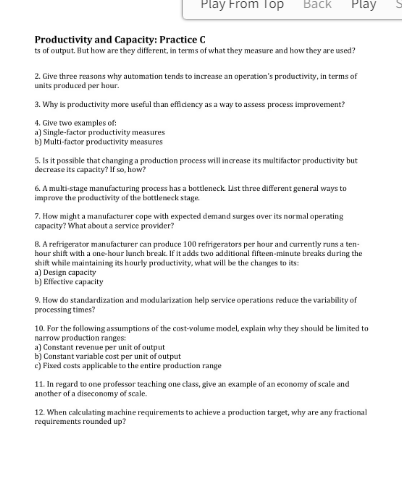
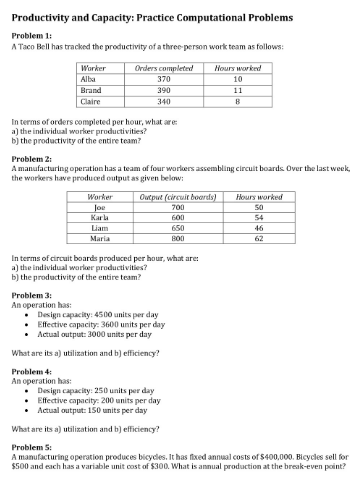
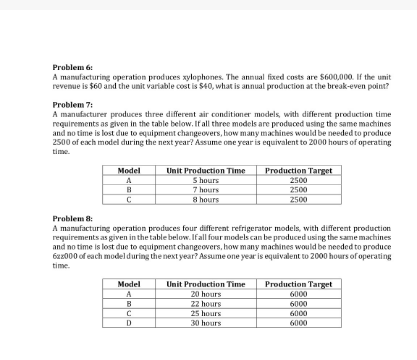
Play From Top Back Play Productivity and Capacity: Practice C ts of output. But how are they different, In terms of what they measure and how they are used? 2. Give three reasons why automation tends to increase an operation's productivity, in terms of units produced per hour. 3. Why is productivity more useful than efficiency as a way to assess process improvement? 4. Give two examples of a) Single-factor productivity measures bj Multi-factor productivity measures 5. Is it possible that changing a production process will increase its multifactor productivity but decrease its capacity? If so, how? & A multi-stage manufacturing process has a bottleneck List three different general ways to improve the productivity of the bottleneck stage 7. How might a manufacturer cope with expected demand surges over its normal operating capacity? What about a service provider? B A refrigerator manufacturer can produce 10 0 refrigerators per hour and currently runs a ten- hour shift with a one-hour lunch break. If it adds two additional fifteen minute breaks during the shift while maintaining its hourly productivity, what will be the changes to its: a] Design capacity b] Effective capacity 9. How do standardization and modularization help service operations reduce the variability of processing times? 10. For the following assumptions of the cost-volume model, explain why they should be limited to narrow production ranges a] Constant revenue per unit of output b] Constant variable cost per unit of output c) Fixed costs applicable to the entire production range 11. In regard to one professor teaching one class, give an example of an economy of scale and another of a diseconomy of scale. 12. When calculating machine requirements to achieve a production target, why are any fractional requirements rounded up?Productivity and Capacity: Practice Computational Problems Problem 1: A Taco Bell has tracked the productivity of a three-person work team as follows: Worker Orders completed Hours worked Alba 370 10 Brand 390 11 Claire 340 In terms of orders completed per hour, what are: a] the individual worker productivityes? bj the productivity of the entire team? Problem Z: A manufacturing operation has a team of four workers assembling circuit boards. Over the last week, the workers have produced output as given below: Worker Output (circuit boards) Hours worked 700 Karl 54 Liam 650 Maria HOU 62 In terms of circuit boards produced per hour, what are: a ] the individual worker productivityes? b] the productivity of the entire team? Problem 3: An operation has: Design capacity: 4500 units per day Effective capacity: 3600 units per day Actual output: 3000 units per day What are its a) utilization and b] efficiency? Problem 4: An operation has: Design capacity: 250 units per day Effective capacity: 200 units per day Actual output: 150 units per day What are its a) utilization and b] efficiency? Problem S: A manufacturing operation produces bicycles, It has fixed annual costs of $490,090. Bicycles sell for $500 and each has a variable unit cost of $300. What is annual production at the break-even point?Problem 6: A manufacturing operation produces xylophones. The annual fixed costs are $600,000. If the unit revenue is $60 and the unit variable cost is $40, what is annual production at the break-even point? Problem 7: A manufacturer produces three different air conditioner models, with different production time requirements as given in the table below, It all three models are produced using the same machines and no time is lost due to equipment changeovers, how many machines would be needed to produce 2500 of each model during the next year? Assume one year is equivalent to 2000 hours of operating time. Model Unit Production Time Production Target A $ hours 2500 7 hours 2500 C A hours 2500 Problem 8: A manufacturing operation produces four different refrigerator models, with different production requirements as given in the table below. If all four models can be produced using the same machines and no time is lost due to equipment changeovers, how many machines would be needed to produce 62200 0 of each model during the next year? Assume one year is equivalent to 2090 hours of operating time- Model Unit Production Time Production Target A 20 hours ZZ hours 5000 C 25 hours 6000 30 hours 6000
Step by Step Solution
There are 3 Steps involved in it
1 Expert Approved Answer
Step: 1 Unlock
Question Has Been Solved by an Expert!
Get step-by-step solutions from verified subject matter experts
Step: 2 Unlock
Step: 3 Unlock
Students Have Also Explored These Related Mathematics Questions!









 Study Help