







Question: ple , solve case study exercises1.2.3.4.5 with all steps , CASE STUDY INFLATION CONSIDERATIONS FOR STOCK AND BOND INVESTMENTS Background Bond purchase: If he purchased
ple , solve case study exercises1.2.3.4.5 with all steps ,
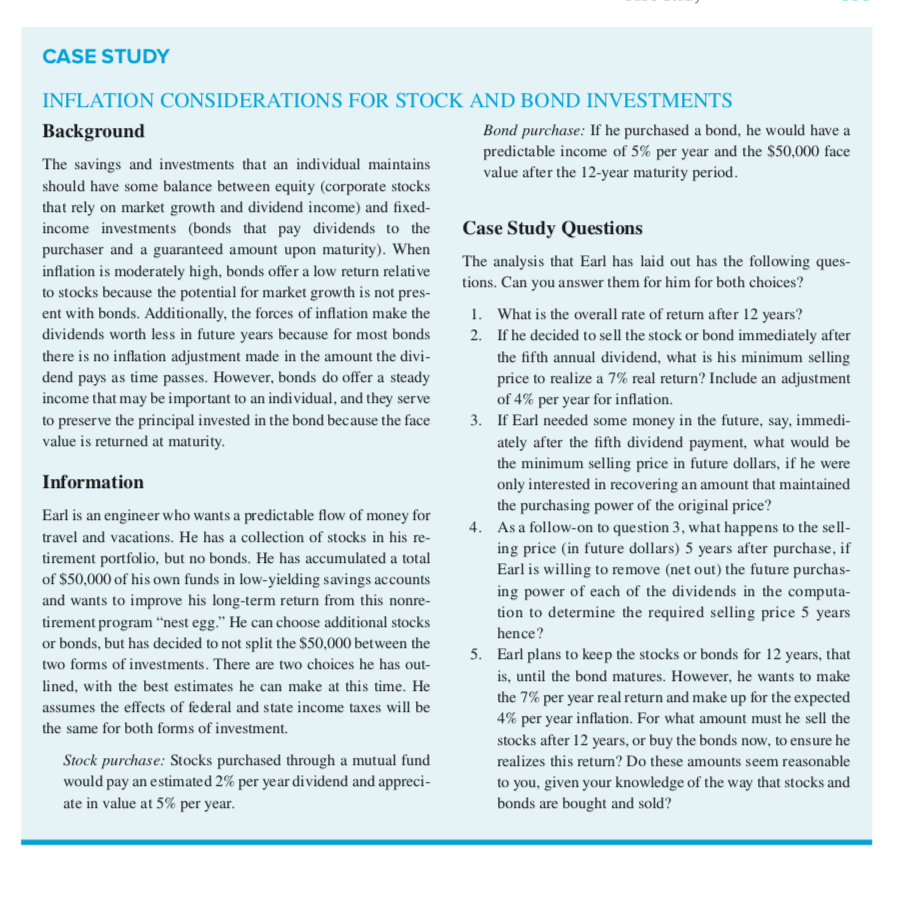
CASE STUDY INFLATION CONSIDERATIONS FOR STOCK AND BOND INVESTMENTS Background Bond purchase: If he purchased a bond, he would have a The savings and investments that an individual maintains predictable income of 5% per year and the $50,000 face value after the 12-year maturity period. should have some balance between equity (corporate stocks that rely on market growth and dividend income) and fixed- income investments (bonds that pay dividends to the Case Study Questions purchaser and a guaranteed amount upon maturity). When inflation is moderately high, bonds offer a low return relative The analysis that Earl has laid out has the following ques- tions. Can you answer them for him for both choices? to stocks because the potential for market growth is not pres- ent with bonds. Additionally, the forces of inflation make the 1. What is the overall rate of return after 12 years? dividends worth less in future years because for most bonds 2. If he decided to sell the stock or bond immediately after there is no inflation adjustment made in the amount the divi the fifth annual dividend, what is his minimum selling dend pays as time passes. However, bonds do offer a steady price to realize a 7% real return? Include an adjustment income that may be important to an individual, and they serve of 4% per year for inflation. to preserve the principal invested in the bond because the face 3. If Earl needed some money in the future, say, immedi- value is returned at maturity. ately after the fifth dividend payment, what would be the minimum selling price in future dollars, if he were Information only interested in recovering an amount that maintained Earl is an engineer who wants a predictable flow of money for the purchasing power of the original price? travel and vacations. He has a collection of stocks in his re- 4. As a follow-on to question 3, what happens to the sell- tirement portfolio, but no bonds. He has accumulated a total ing price in future dollars) 5 years after purchase, if Earl is willing to remove (net out) the future purchas- of $50,000 of his own funds in low-yielding savings accounts and wants to improve his long-term return from this nonre- ing power of each of the dividends in the computa- tirement program nest egg." He can choose additional stocks tion to determine the required selling price 5 years hence? or bonds, but has decided to not split the $50,000 between the two forms of investments. There are two choices he has out- 5. Earl plans to keep the stocks or bonds for 12 years, that lined, with the best estimates he can make at this time. He is, until the bond matures. However, he wants to make assumes the effects of federal and state income taxes will be the 7% per year real return and make up for the expected 4% per year inflation. For what amount must he sell the the same for both forms of investment. stocks after 12 years, or buy the bonds now, to ensure he Stock purchase: Stocks purchased through a mutual fund realizes this return? Do these amounts seem reasonable would pay an estimated 2% per year dividend and appreci to you, given your knowledge of the way that stocks and ate in value at 5% per year. bonds are bought and sold? CASE STUDY INFLATION CONSIDERATIONS FOR STOCK AND BOND INVESTMENTS Background Bond purchase: If he purchased a bond, he would have a The savings and investments that an individual maintains predictable income of 5% per year and the $50,000 face value after the 12-year maturity period. should have some balance between equity (corporate stocks that rely on market growth and dividend income) and fixed- income investments (bonds that pay dividends to the Case Study Questions purchaser and a guaranteed amount upon maturity). When inflation is moderately high, bonds offer a low return relative The analysis that Earl has laid out has the following ques- tions. Can you answer them for him for both choices? to stocks because the potential for market growth is not pres- ent with bonds. Additionally, the forces of inflation make the 1. What is the overall rate of return after 12 years? dividends worth less in future years because for most bonds 2. If he decided to sell the stock or bond immediately after there is no inflation adjustment made in the amount the divi the fifth annual dividend, what is his minimum selling dend pays as time passes. However, bonds do offer a steady price to realize a 7% real return? Include an adjustment income that may be important to an individual, and they serve of 4% per year for inflation. to preserve the principal invested in the bond because the face 3. If Earl needed some money in the future, say, immedi- value is returned at maturity. ately after the fifth dividend payment, what would be the minimum selling price in future dollars, if he were Information only interested in recovering an amount that maintained Earl is an engineer who wants a predictable flow of money for the purchasing power of the original price? travel and vacations. He has a collection of stocks in his re- 4. As a follow-on to question 3, what happens to the sell- tirement portfolio, but no bonds. He has accumulated a total ing price in future dollars) 5 years after purchase, if Earl is willing to remove (net out) the future purchas- of $50,000 of his own funds in low-yielding savings accounts and wants to improve his long-term return from this nonre- ing power of each of the dividends in the computa- tirement program nest egg." He can choose additional stocks tion to determine the required selling price 5 years hence? or bonds, but has decided to not split the $50,000 between the two forms of investments. There are two choices he has out- 5. Earl plans to keep the stocks or bonds for 12 years, that lined, with the best estimates he can make at this time. He is, until the bond matures. However, he wants to make assumes the effects of federal and state income taxes will be the 7% per year real return and make up for the expected 4% per year inflation. For what amount must he sell the the same for both forms of investment. stocks after 12 years, or buy the bonds now, to ensure he Stock purchase: Stocks purchased through a mutual fund realizes this return? Do these amounts seem reasonable would pay an estimated 2% per year dividend and appreci to you, given your knowledge of the way that stocks and ate in value at 5% per year. bonds are bought and sold
Step by Step Solution
There are 3 Steps involved in it

Get step-by-step solutions from verified subject matter experts
 Study Help