Question: pleas I want unique answer Question number 2 : -If you think about the three types of commitment -affective, continuance, and normative- which do you
pleas I want unique answer
Question number 2 :
-If you think about the three types of commitment -affective, continuance, and normative- which do you think is most changed among Millennials (or twenty -somethings)? In what way ? ((Min words 150-200))
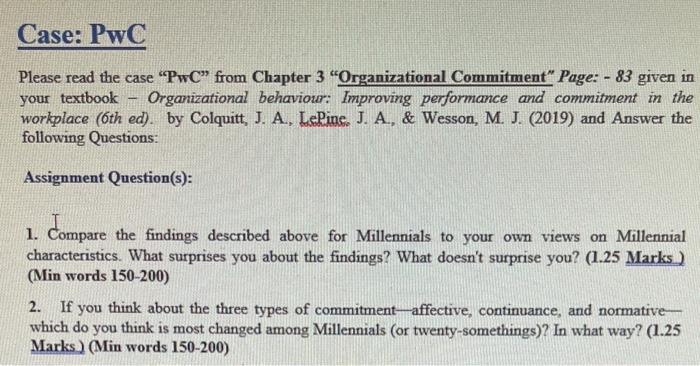
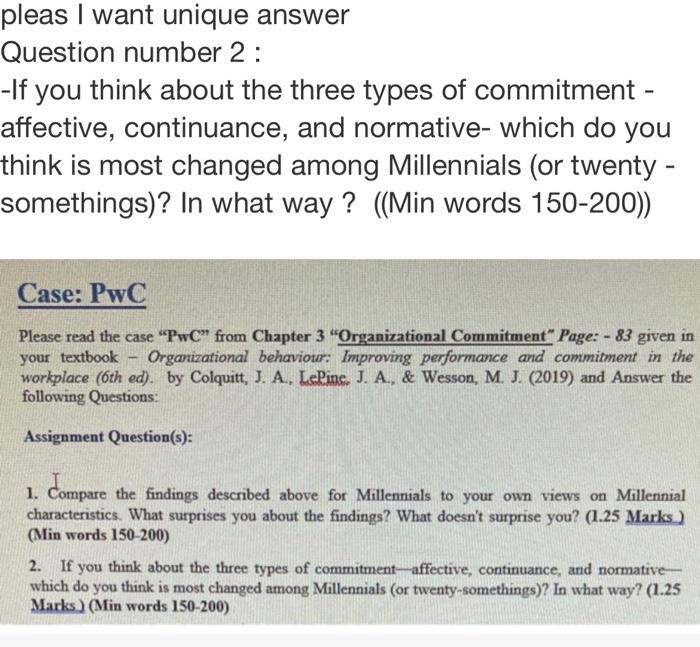
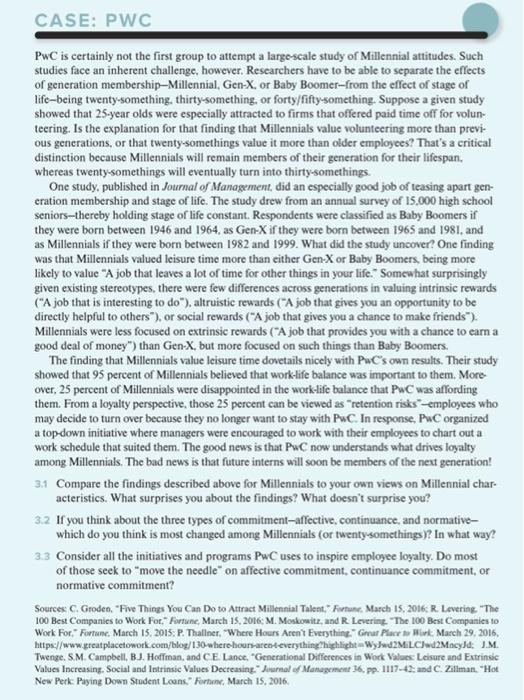
Case: PwC - Please read the case PwC from Chapter 3 "Organizational Commitment" Page: - 83 given in your textbook Organizational behaviour: Improving performance and commitment in the workplace (6th ed). by Colquitt, J. A, LePine, J. A, & Wesson, M. J. (2019) and Answer the following Questions: Assignment Question(s): 1. Compare the findings described above for Millennials to your own views on Millennial characteristics. What surprises you about the findings? What doesn't surprise you? (1.25 Marks) (Min words 150-200) 2. If you think about the three types of commitment-affective, continuance, and normative which do you think is most changed among Millennials (or twenty-somethings)? In what way? (1.25 Marks (Min words 150-200) pleas I want unique answer Question number 2 : -If you think about the three types of commitment - affective, continuance, and normative- which do you think is most changed among Millennials (or twenty - somethings)? In what way? ((Min words 150-200)) Case: PwC - Please read the case "PwC from Chapter 3 "Organizational Commitment" Page: - 83 given in your textbook Organizational behaviour: Improving performance and commitment in the workplace (6th ed). by Colquitt, J. A, LePine, J. A, & Wesson, M J. (2019) and Answer the following Questions: Assignment Question(s): 1. Compare the findings described above for Millennials to your own views on Millennial characteristics. What surprises you about the findings? What doesn't surprise you? (1.25 Marks) (Min words 150-200) 2. If you think about the three types of commitment-affective, continuance, and normative which do you think is most changed among Millennials (or twenty-somethings)? In what way? (1.25 Marks) (Min words 150-200) CASE: PWC PwC is certainly not the first group to attempt a large-scale study of Millennial attitudes. Such studies face an inherent challenge, however. Researchers have to be able to separate the effects of generation membership-Millennial, Gen-X, or Baby Boomer-from the effect of stage of life-being twenty-something, thirty-something, or forty/fifty-something. Suppose a given study showed that 25-year olds were especially attracted to firms that offered paid time off for volun- teering. Is the explanation for that finding that Millennials value volunteering more than previ- ous generations, or that twenty-somethings value it more than older employees? That's a critical distinction because Millennials will remain members of their generation for their lifespan. whereas twenty-somethings will eventually turn into thirty-somethings One study, published in Journal of Management, did an especially good job of teasing apart gen- eration membership and stage of life. The study drew from an annual survey of 15,000 high school seniors--thereby holding stage of life constant. Respondents were classified as Baby Boomers if they were born between 1946 and 1964, as Gen-X if they were born between 1965 and 1981. and as Millennials if they were born between 1982 and 1999. What did the study uncover? One finding was that Millennials valued leisure time more than either Gen-X or Baby Boomers, being more likely to value "A job that leaves a lot of time for other things in your life. Somewhat surprisingly given existing stereotypes, there were few differences across generations in valuing intrinsic rewards ("A job that is interesting to do"), altruistic rewards ("A job that gives you an opportunity to be directly helpful to others"), or social rewards ("A job that gives you a chance to make friends"). Millennials were less focused on extrinsic rewards ("A job that provides you with a chance to earn a good deal of money") than Gen-X, but more focused on such things than Baby Boomers. The finding that Millennials value leisure time dovetails nicely with PwC's own results. Their study showed that 95 percent of Millennials believed that work-life balance was important to them. More over, 25 percent of Millennials were disappointed in the work-life balance that PwC was affording them. From a loyalty perspective, those 25 percent can be viewed as "retention risks-employees who may decide to turn over because they no longer want to stay with PwC. In response, PwC organized a top down initiative where managers were encouraged to work with their employees to chart out a work schedule that suited them. The good news is that PwC now understands what drives loyalty among Millennials. The bad news is that future interns will soon be members of the next generation! 3.1. Compare the findings described above for Millennials to your own views on Millennial char- acteristics. What surprises you about the findings? What doesn't surprise you? 3.2 If you think about the three types of commitment-affective continuance, and normative- which do you think is most changed among Millennials (or twenty-somethings)? In what way? 3.3 Consider all the initiatives and programs PwC uses to inspire employee loyalty. Do most of those seek to move the needle" on affective commitment, continuance commitment, or normative commitment? Sources: C Groden, "Five Things You Can Do to Attract Millennial Talent." Fortune March 15, 2016: R. Levering. "The 100 Best Companies to Work For." Fortune March 15, 2016: M. Moskowitz, and R Levering. "The 100 Best Companies to Work For." Fortune, March 15, 2015: P. Thallner. Where Hours Aren't Everything. Great Place to Work March 29, 2016 https://www.great placetowork.com/blog/130 where hoursarenteverything highlight WyJ2MiLCJwd2Macyjd: J.M. Twenge. S.M. Campbell, B.J. Hoffman, and CE Lance, "Generational Differences in Work Values Leisure and Extrinsic Values Increasing. Social and Intrinsic Values Decreasing." Journal of Management 36. pp. 1117-42. and C. Zillman. "Hot New Perk: Paying Down Student Loans Forne. March 15, 2016









 Study Help