







Question: Please 3-5 P A G E S for C A S E S T U D Y and answer this Questions in Detail (a) the
Please 3-5 P A G E S for C A S E S T U D Y and answer this Questions in Detail
(a) the economic advantages of targeting New Zealand as a major potential inbound market (b) the economic disadvantages of such an approach. (c) be highly satisfying to these visitors in terms of the experiences and services provided (d) maximize the state multiplier effect for Tasmania.
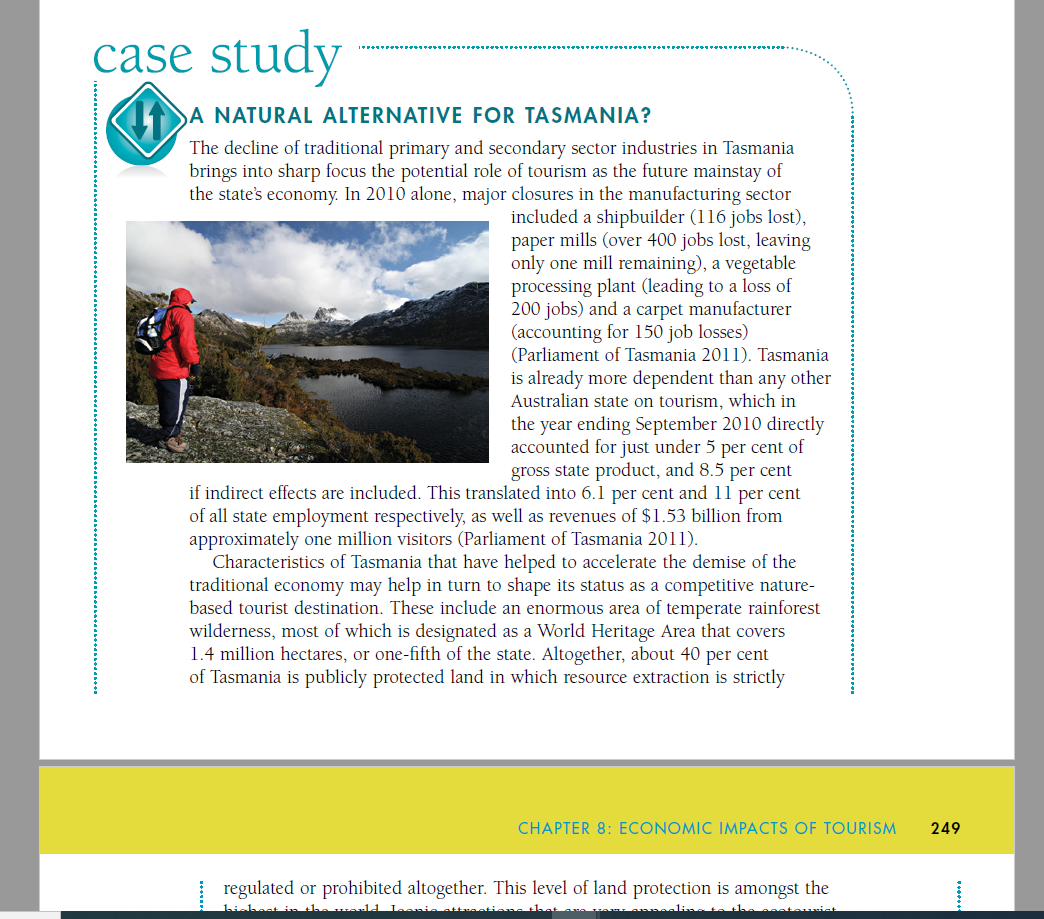
case study 11 A NATURAL ALTERNATIVE FOR TASMANIA? The decline of traditional primary and secondary sector industries in Tasmania brings into sharp focus the potential role of tourism as the future mainstay of the state's economy. In 2010 alone, major closures in the manufacturing sector included a shipbuilder (116 jobs lost), paper mills (over 400 jobs lost, leaving only one mill remaining), a vegetable processing plant (leading to a loss of 200 jobs) and a carpet manufacturer (accounting for 150 job losses) (Parliament of Tasmania 2011). Tasmania is already more dependent than any other Australian state on tourism, which in the year ending September 2010 directly accounted for just under 5 per cent of gross state product, and 8.5 per cent if indirect effects are included. This translated into 6.1 per cent and 11 per cent of all state employment respectively, as well as revenues of $1.53 billion from approximately one million visitors (Parliament of Tasmania 2011). Characteristics of Tasmania that have helped to accelerate the demise of the traditional economy may help in turn to shape its status as a competitive nature- based tourist destination. These include an enormous area of temperate rainforest wilderness, most of which is designated as a World Heritage Area that covers 1.4 million hectares, or one-fifth of the state. Altogether, about 40 per cent of Tasmania is publicly protected land in which resource extraction is strictly CHAPTER 8: ECONOMIC IMPACTS OF TOURISM 249 regulated or prohibited altogether. This level of land protection is amongst the Huilt in the world lene attraction that consistenti regulated or prohibited altogether. This level of land protection is amongst the highest in the world. Iconic attractions that are very appealing to the ecotourist, adventure tourist and backpacker include Cradle Mountain, the Freycinet Peninsula and Cataract Gorge. The isolation imposed by being an island is another contributing factor to the demise of manufacturing and has also been cited as an impediment to tourism development (Parliament of Tasmania 2011). However, if appropriately marketed, insularity can also be presented as a competitive advantage that confers authenticity, uniqueness, pristine air and water, exoticness, and a sense of getting away from the rat-race. A significant pre-1830 European settlement heritage and abundant high-quality fresh food augment the nature-based core of the Tasmanian tourism product and enhance the potential for high-quality and high-yield visitor experiences that are differentiated from other Australian states. Yet, visitation levels have been stagnant in recent years. In addition to the issue of accessibility, one major external impediment has been the persistently high Australian dollar, which has attracted fewer international visitors to Australia while diverting many domestic tourists to relatively cheap international destinations such as Bali and Thailand. Internal problems include a low level of internet use for marketing and booking, variable quality of service provision, and inconsistent and restricted operating hours. All three of these problems are associated with the prevalence of small businesses throughout the state. Of the 2000 private enterprises that comprise the state tourism industry, 85 per cent employ five or fewer people, and more than 70 per cent have an annual turnover of less than $250 000. High industry wages and payroll taxes discourage businesses from hiring more permanent employees (Parliament of Tasmania 2011). There is particular interest in attracting international tourists, who accounted for about 14 per cent of all visitors in the year ending December 2011 (around 150 000 per year) but 18 per cent of expenditures ($254 million). Notably, expenditures per visitor-night are well below domestic levels ($89 versus $205), but the longer stay translates into marginally larger total expenditures ($1696 versus $1649) (Tourism Tasmania 2012). Europe and New Zealand are both regarded as high-yield markets that would be attracted by the nature-based tourism product of Tasmania, but there is also interest in China and other East- Asian countries because of their remarkable growth and potential (Parliament of Tasmania 2011). The unique attributes of Tasmania appear to favour a product development strategy based on the principles of slow tourism and its emphasis on a long stay, and authentic and unique experiences focused on immersion into the local natural environment and lifestyle. In this context, the pattern of small business ownership could be an asset that more closely connects visitors to localStep by Step Solution
There are 3 Steps involved in it
1 Expert Approved Answer
Step: 1 Unlock

Question Has Been Solved by an Expert!
Get step-by-step solutions from verified subject matter experts
Step: 2 Unlock
Step: 3 Unlock
 Study Help