







Question: please actually give me answers for letters A through E and not just some previous answer from chegg. i really would appreciate if you showed
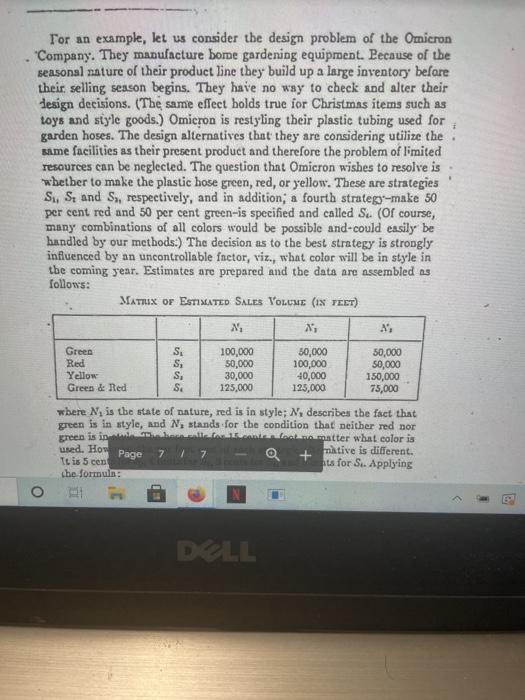
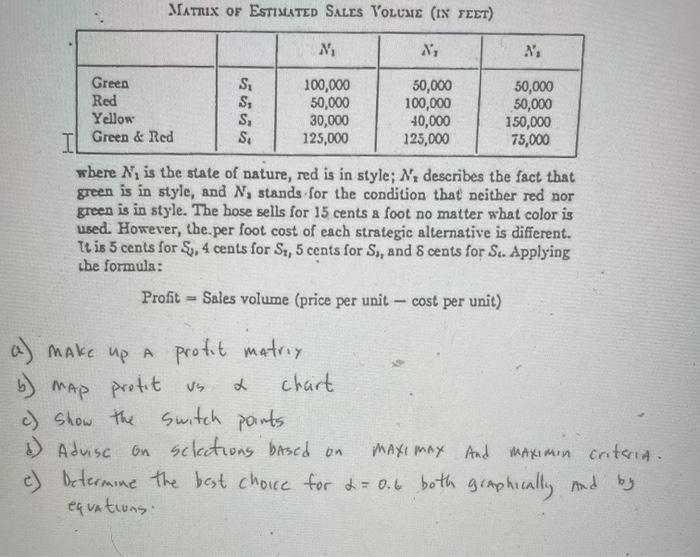
Tor an example, let us consider the design problem of the Omicron *Company. They manufacture bome gardening equipment. Because of the seasonal nature of their product line they build up a large inventory before their selling season begins. They have no way to check and alter their design decisions. (The same effect holds true for Christmas items such as toys and style goods.) Omicron is restyling their plastic tubing used for garden hoses. The design alternatives that they are considering utilize the same facilities as their present product and therefore the problem of limited resources can be neglected. The question that Omicron wishes to resolve is whether to make the plastic hose green, red, or yellow. These are strategies S, S and S, respectively, and in addition, a fourth strategy-make 50 per cent red and 50 per cent green-is specified and called S. (Of course, many combinations of all colors would be possible and could easily be handled by our methods:) The decision as to the best strategy is strongly influenced by an uncontrollable fnctor, viz., what color will be in style in the coming year. Estimates are prepared and the data are assembled as follows: MATRIX or ESTIMATED SALES VOLUME (IX TEET) M X Green S. 100,000 50,000 50,000 Red S, 50,000 100,000 50,000 Yellow S, 30,000 40,000 150,000 Green & Red Si 125,000 125,000 75,000 wbere N, is the state of nature, red is in style; N, describes the fact that green is in style, and N; stands for the condition that neither red nor green is in olmatter what color is used. How Page 7 / 7 mative is different. It is 5 cent ats for Si. Applying che formula: E DOLL MATRIX OF ESTIMATED SALES VOLUME (IN FEET) N 2, Green S. 100,000 50,000 50,000 Red S; 50,000 100,000 50,000 Yellow S, 30,000 40,000 150,000 IL Green & Red Si 125,000 125,000 75,000 wbere N, is the state of nature, red is in style; N= describes the fact that green is in style, and N, stands for the condition that neither red nor green is in style. The hose sells for 15 cents a foot no matter what color is used. However, the.per foot cost of each strategic alternative is different. It is 5 cents for $3,4 cents for S1,5 cents for S., and 6 cents for So. Applying the formula: Profit = Sales volume (price per unit - cost per unit) 6) MAP L a) make up A protit matrix protit us chart c) show the switch points & Advise on selections based on MAXIMAX And Maximin criteria. c) Determine the best choice for 2 = 0.6 both graphically and by equations. Tor an example, let us consider the design problem of the Omicron *Company. They manufacture bome gardening equipment. Because of the seasonal nature of their product line they build up a large inventory before their selling season begins. They have no way to check and alter their design decisions. (The same effect holds true for Christmas items such as toys and style goods.) Omicron is restyling their plastic tubing used for garden hoses. The design alternatives that they are considering utilize the same facilities as their present product and therefore the problem of limited resources can be neglected. The question that Omicron wishes to resolve is whether to make the plastic hose green, red, or yellow. These are strategies S, S and S, respectively, and in addition, a fourth strategy-make 50 per cent red and 50 per cent green-is specified and called S. (Of course, many combinations of all colors would be possible and could easily be handled by our methods:) The decision as to the best strategy is strongly influenced by an uncontrollable fnctor, viz., what color will be in style in the coming year. Estimates are prepared and the data are assembled as follows: MATRIX or ESTIMATED SALES VOLUME (IX TEET) M X Green S. 100,000 50,000 50,000 Red S, 50,000 100,000 50,000 Yellow S, 30,000 40,000 150,000 Green & Red Si 125,000 125,000 75,000 wbere N, is the state of nature, red is in style; N, describes the fact that green is in style, and N; stands for the condition that neither red nor green is in olmatter what color is used. How Page 7 / 7 mative is different. It is 5 cent ats for Si. Applying che formula: E DOLL MATRIX OF ESTIMATED SALES VOLUME (IN FEET) N 2, Green S. 100,000 50,000 50,000 Red S; 50,000 100,000 50,000 Yellow S, 30,000 40,000 150,000 IL Green & Red Si 125,000 125,000 75,000 wbere N, is the state of nature, red is in style; N= describes the fact that green is in style, and N, stands for the condition that neither red nor green is in style. The hose sells for 15 cents a foot no matter what color is used. However, the.per foot cost of each strategic alternative is different. It is 5 cents for $3,4 cents for S1,5 cents for S., and 6 cents for So. Applying the formula: Profit = Sales volume (price per unit - cost per unit) 6) MAP L a) make up A protit matrix protit us chart c) show the switch points & Advise on selections based on MAXIMAX And Maximin criteria. c) Determine the best choice for 2 = 0.6 both graphically and by equations
Step by Step Solution
There are 3 Steps involved in it

Get step-by-step solutions from verified subject matter experts
 Study Help