







Question: please again answer only b & c. i have answers for part a. (a) (4 pts.) Suppose you purchase a wireless router and connect it
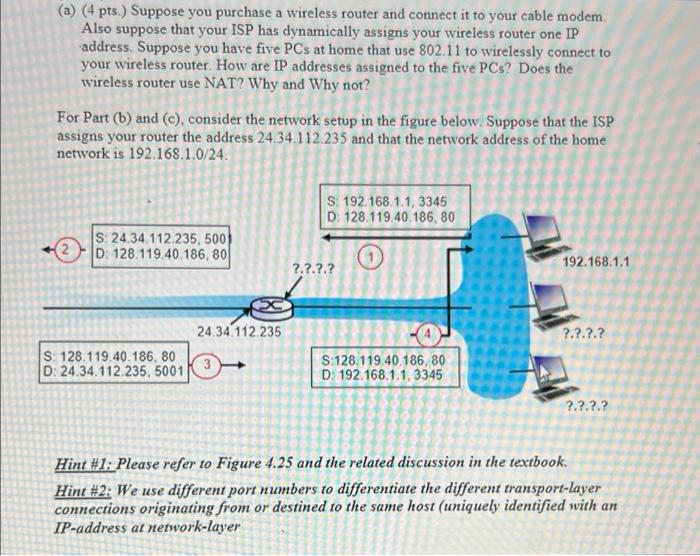
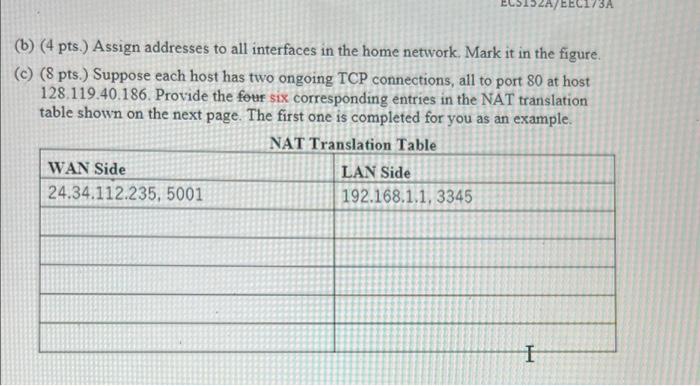
(a) (4 pts.) Suppose you purchase a wireless router and connect it to your cable modem. Also suppose that your ISP has dynamically assigns your wireless router one IP address. Suppose you have five PCs at home that use 802.11 to wirelessly connect to your wireless router. How are IP addresses assigned to the five PCs? Does the wireless router use NAT? Why and Why not? For Part (b) and (c), consider the network setup in the figure below. Suppose that the ISP assigns your router the address 24.34.112.235 and that the network address of the home network is 192.168.1.0/24. S 192.168.1.1, 3345 D: 128.119.40.186, 80 S: 24.34.112.235, 500 D: 128.119.40.186, 80 ?.?.?.? 192.168.1.1 24.34.112.235 ?.?.?.? S. 128.119.40.186. 80 D: 24.34.112.235, 5001 3 S.128.119.40 186, 80 D: 192.168.1.1, 3345 ?.?.?.? Hint #1: Please refer to Figure 4.25 and the related discussion in the textbook. Hint #2: We use different port numbers to differentiate the different transport-layer connections originating from or destined to the same host (uniquely identified with an IP-address at network-layer 5154A/EEC173A (b) (4 pts) Assign addresses to all interfaces in the home network, Mark it in the figure. (c) (8 pts.) Suppose each host has two ongoing TCP connections, all to port 80 at host 128. 119.40.186. Provide the four six corresponding entries in the NAT translation table shown on the next page. The first one is completed for you as an example. NAT Translation Table WAN Side LAN Side 24.34.112.235, 5001 192.168.1.1, 3345
Step by Step Solution
There are 3 Steps involved in it

Get step-by-step solutions from verified subject matter experts
 Study Help