







Question: Please also explanation . Exercise 3.1 We have three observed points (23,41), (67,84), (78, 100). Question: fit them to a linear model: Y = Bo
Please also explanation .
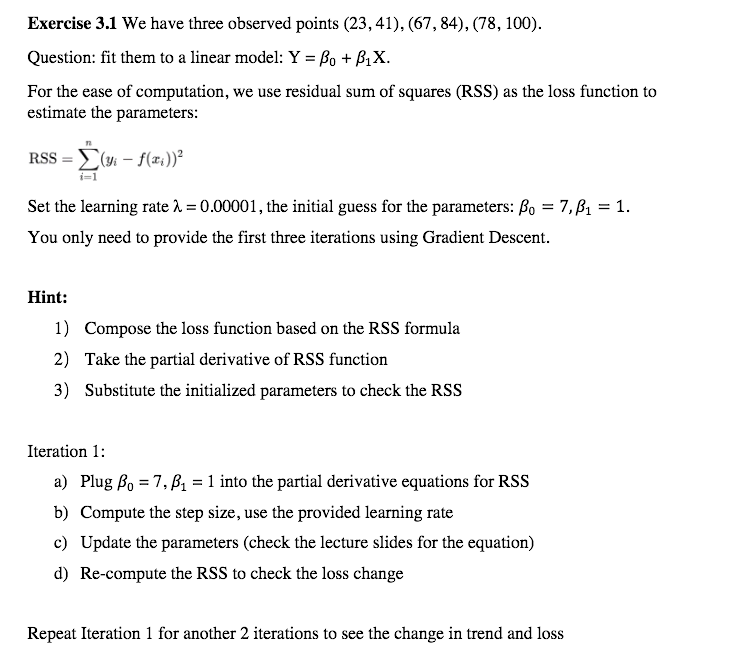
Exercise 3.1 We have three observed points (23,41), (67,84), (78, 100). Question: fit them to a linear model: Y = Bo + B1X. For the ease of computation, we use residual sum of squares (RSS) as the loss function to estimate the parameters: RSS = (4 f(x:)) Set the learning rate 1 = 0.00001, the initial guess for the parameters: Bo = 7, B1 = 1. You only need to provide the first three iterations using Gradient Descent. Hint: 1) Compose the loss function based on the RSS formula 2) Take the partial derivative of RSS function 3) Substitute the initialized parameters to check the RSS Iteration 1: a) Plug Bo = 7,B2 = 1 into the partial derivative equations for RSS b) Compute the step size, use the provided learning rate c) Update the parameters (check the lecture slides for the equation) d) Re-compute the RSS to check the loss change Repeat Iteration 1 for another 2 iterations to see the change in trend and loss Exercise 3.1 We have three observed points (23,41), (67,84), (78, 100). Question: fit them to a linear model: Y = Bo + B1X. For the ease of computation, we use residual sum of squares (RSS) as the loss function to estimate the parameters: RSS = (4 f(x:)) Set the learning rate 1 = 0.00001, the initial guess for the parameters: Bo = 7, B1 = 1. You only need to provide the first three iterations using Gradient Descent. Hint: 1) Compose the loss function based on the RSS formula 2) Take the partial derivative of RSS function 3) Substitute the initialized parameters to check the RSS Iteration 1: a) Plug Bo = 7,B2 = 1 into the partial derivative equations for RSS b) Compute the step size, use the provided learning rate c) Update the parameters (check the lecture slides for the equation) d) Re-compute the RSS to check the loss change Repeat Iteration 1 for another 2 iterations to see the change in trend and loss
Step by Step Solution
There are 3 Steps involved in it

Get step-by-step solutions from verified subject matter experts
 Study Help