



Question: please analyze by an academic research the below for strategy : 1 - external analysis including PEST provide macro overview analytics existing use and opprtunities
please
analyze by an academic research the below for strategy :
external analysis including
PEST provide macro overview
analytics existing use and opprtunities for further use
technology big data and analytics
porter's five forces by research
environment scanning
industry and market structure
industry life cycle ILC issues including change trajactory
strategic groups
internal analysis and including :
value chain for a detailed picture of activites and how they fit together
cultural issues and culture web
stakeholder mapping
value systems and how value chain are linked
synergy and how coherent is the organisation as a whole
capability analysis and what is the source of competitive advantge
VRIN analysis
financial analysis based of income statement, cash flow and statement of financial position and all the financial ratios
the SWOT and TOWS analyses, including SW OT NO
comprehensive strategy statement for a future strategic plan and execution using a strategic options configurator including set out, aim, tactic, direction method, competitive stance, strategic groups and the AS to review and evaluate options
all answers must be well described with details and in a research form and provide all the source of the information
list all the sources and websites that you will use in harvard citation form
Challenges for Nissan Motor
Corporation
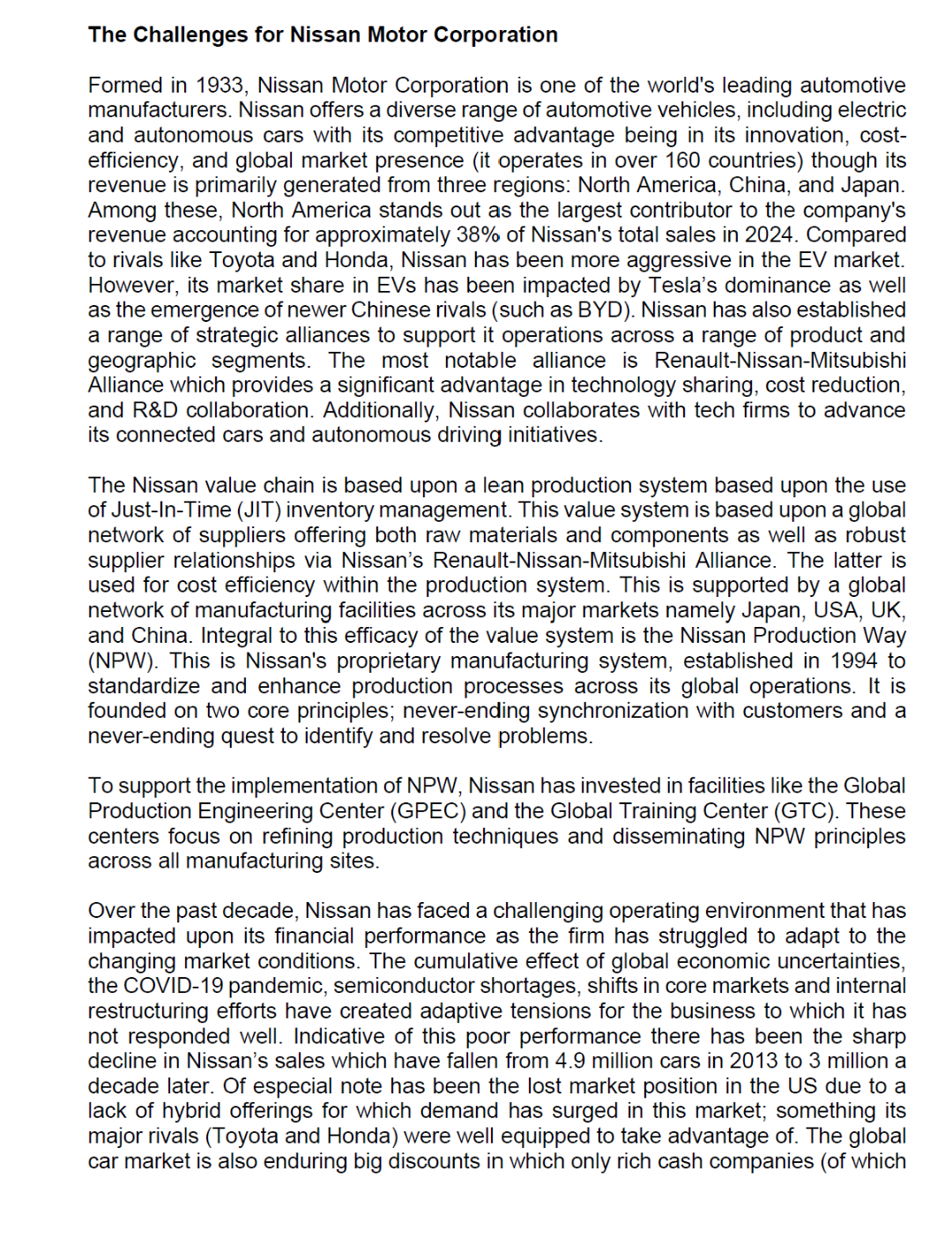
Formed in Nissan Motor Corporation is one of the world's leading automotive manufacturers. Nissan offers a diverse range of automotive vehicles, including electric and autonomous cars with its competitive advantage being in its innovation, costefficiency and global market presence it operates in over countries though its revenue is primarily generated from three regions: North America, China, and Japan. Among these, North America stands out as the largest contributor to the company's revenue accounting for approximately of Nissan's total sales in Compared to rivals like Toyota and Honda, Nissan has been more aggressive in the EV market. However, its market share in EVs has been impacted by Tesla's dominance as well as the emergence of newer Chinese rivals such as BYD Nissan has also established a range of strategic alliances to support it operations across a range of product and geographic segments. The most notable alliance is RenaultNissanMitsubishi Alliance which provides a significant advantage in technology sharing, cost reduction, and R&D collaboration. Additionally, Nissan collaborates with tech firms to advance its connected cars and autonomous driving initiatives.
The Nissan value chain is based upon a lean production system based upon the use of JustInTime JIT inventory management. This value system is based upon a global network of suppliers offering both raw materials and components as well as robust supplier relationships via Nissan's RenaultNissanMitsubishi Alliance. The latter is used for cost efficiency within the production system. This is supported by a global network of manufacturing facilities across its major markets namely Japan, USA, UK and China. Integral to this efficacy of the value system is the Nissan Production Way NPW This is Nissan's proprietary manufacturing system, established in to standardize and enhance production processes across its global operations. It is founded on two core principles; neverending synchronization with customers and a neverending quest to identify and resolve problems.
To support the implementation of NPW Nissan has invested in facilities like the Global Production Engineering Center GPEC and the Global Training Center GTC These centers focus on refining production techniques and disseminating NPW principles across all manufacturing sites.
Over the past decade, Nissan has faced a challenging operating environment that has impacted upon its financial performance as the firm has struggled to adapt to the changing market conditions. The cumulative effect of global economic uncertainties, the COVID pandemic, semiconductor shortages, shifts in core markets and internal restructuring efforts have created adaptive tensions for the business to which it has not responded well. Indicative of this poor performance there has been the sharp decline in Nissan's sales which have fallen from million cars in to million a decade later. Of especial note has been the lost market position in the US due to a lack of hybrid offerings for which demand has surged in this market; something its major rivals Toyota and Honda were well equipped to take advantage of The global car market is also enduring big discounts in which only rich cash companies of which
Nissan is not one can survive. Furthermore, Nissan has also lost market share in Asia where sales have halved in a decade This was especially notable in China where the emergence of cheaper Chinese competitors most notably as mentioned in the EV sector have intensified the competitive threat to the business. There does seem little evidence of any immediate reversal of future for the business as in the six months to September Nissan's profit fell by over with annual profit down by This was against an already underperforming financial performance visvis its peers.
By late Nissan was facing a 'make or break' year as it faced increased competition and declining sales against what was seen as a very fragmented Japanese automotive sector. Nissan's continued and sustained decline meant that it needed to consider all options for corporate turnaround. This was compounded by Renault running down its investment in the business which created the need for Nissan to find a replacement investor. In the short term, Nissan undertook a series of restructuring measures to enhance its balance sheet through cutting production by reducing its workforce by and reducing its stake in Mitsubishi.
The longerterm response was a proposed $ billion merger between Nissan and Honda which was proposed in December to create the world's third largest car maker. The merger was motivated by the combined challenge of seeking to cope with overcapacity within the EV market; an ar
Step by Step Solution
There are 3 Steps involved in it
1 Expert Approved Answer
Step: 1 Unlock

Question Has Been Solved by an Expert!
Get step-by-step solutions from verified subject matter experts
Step: 2 Unlock
Step: 3 Unlock