







Question: please answer 100% correctly, and type the answer Pointers and recursive type definitions complicate the algorithm for determining structural equivalence of types. Consider, for example,
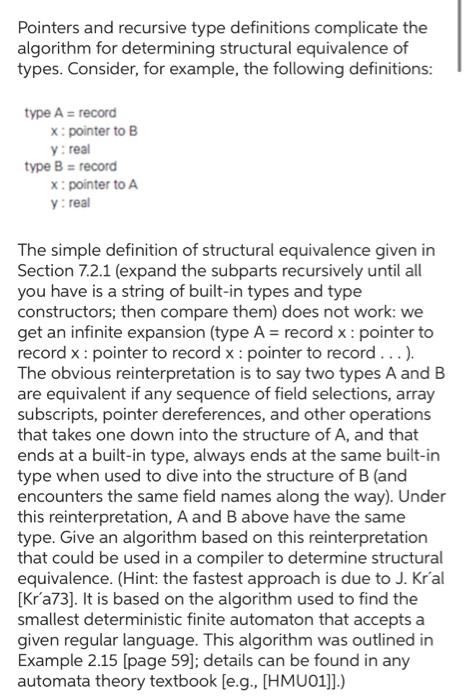
Pointers and recursive type definitions complicate the algorithm for determining structural equivalence of types. Consider, for example, the following definitions: type A= record x : pointer to B y : real type B= record x : pointer to A y : real The simple definition of structural equivalence given in Section 7.2.1 (expand the subparts recursively until all you have is a string of built-in types and type constructors; then compare them) does not work: we get an infinite expansion (type A= record x : pointer to record x : pointer to record x : pointer to record...). The obvious reinterpretation is to say two types A and B are equivalent if any sequence of field selections, array subscripts, pointer dereferences, and other operations that takes one down into the structure of A, and that ends at a built-in type, always ends at the same built-in type when used to dive into the structure of B (and encounters the same field names along the way). Under this reinterpretation, A and B above have the same type. Give an algorithm based on this reinterpretation that could be used in a compiler to determine structural equivalence. (Hint: the fastest approach is due to J. Kr'al [Kr'a73]. It is based on the algorithm used to find the smallest deterministic finite automaton that accepts a given regular language. This algorithm was outlined in
Step by Step Solution
There are 3 Steps involved in it

Get step-by-step solutions from verified subject matter experts
 Study Help