



Question: Please answer 2. Agency conflicts between shareholders and creditors Aa Aa While the agency conflicts between managers and shareholders tend to receive the most press,
Please answer
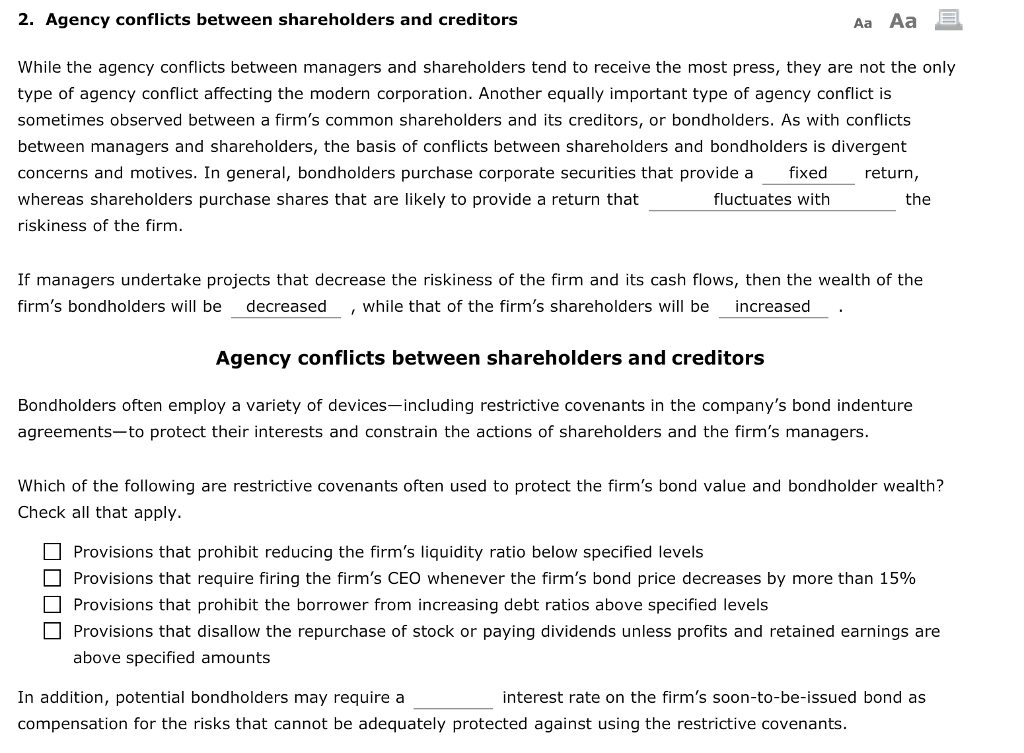
2. Agency conflicts between shareholders and creditors Aa Aa While the agency conflicts between managers and shareholders tend to receive the most press, they are not the only type of agency conflict affecting the modern corporation. Another equally important type of agency conflict is sometimes observed between a firm's common shareholders and its creditors, or bondholders. As with conflicts between managers and shareholders, the basis of conflicts between shareholders and bondholders is divergent concerns and motives. In general, bondholders purchase corporate securities that provide a fixed return whereas shareholders purchase shares that are likely to provide a return that riskiness of the firm fluctuates withh the If managers undertake projects that decrease the riskiness of the firm and its cash flows, then the wealth of the firm's bondholders will be decreased , while that of the firm's shareholders will be increased Agency conflicts between shareholders and creditors Bondholders often employ a variety of devices-including restrictive covenants in the company's bond indenture agreements-to protect their interests and constrain the actions of shareholders and the firm's managers Which of the following are restrictive covenants often used to protect the firm's bond value and bondholder wealth? Check all that apply. Provisions that prohibit reducing the firm's liquidity ratio below specified levels Provisions that require firing the firm's CEO whenever the firm's bond price decreases by more than 15% Provisions that prohibit the borrower from increasing debt ratios above specified levels Provisions that disallow the repurchase of stock or paying dividends unless profits and retained earnings are above specified amounts interest rate on the firm's soon-to-be-issued bond as In addition, potential bondholders may require a compensation for the risks that cannot be adequately protected against using the restrictive covenants
Step by Step Solution
There are 3 Steps involved in it

Get step-by-step solutions from verified subject matter experts