







Question: Please answer #3 Suppose, to begin, that an individual has a state sub-utility function given by: u( i ) = (1/) * e i where
Please answer #3
Suppose, to begin, that an individual has a state sub-utility function given by: u(i) = (1/) * ei where i denotes the income of that individual and > 0. Let 1 denote the probability that the individual is not caught for reckless driving and denote the probability that she is caught.
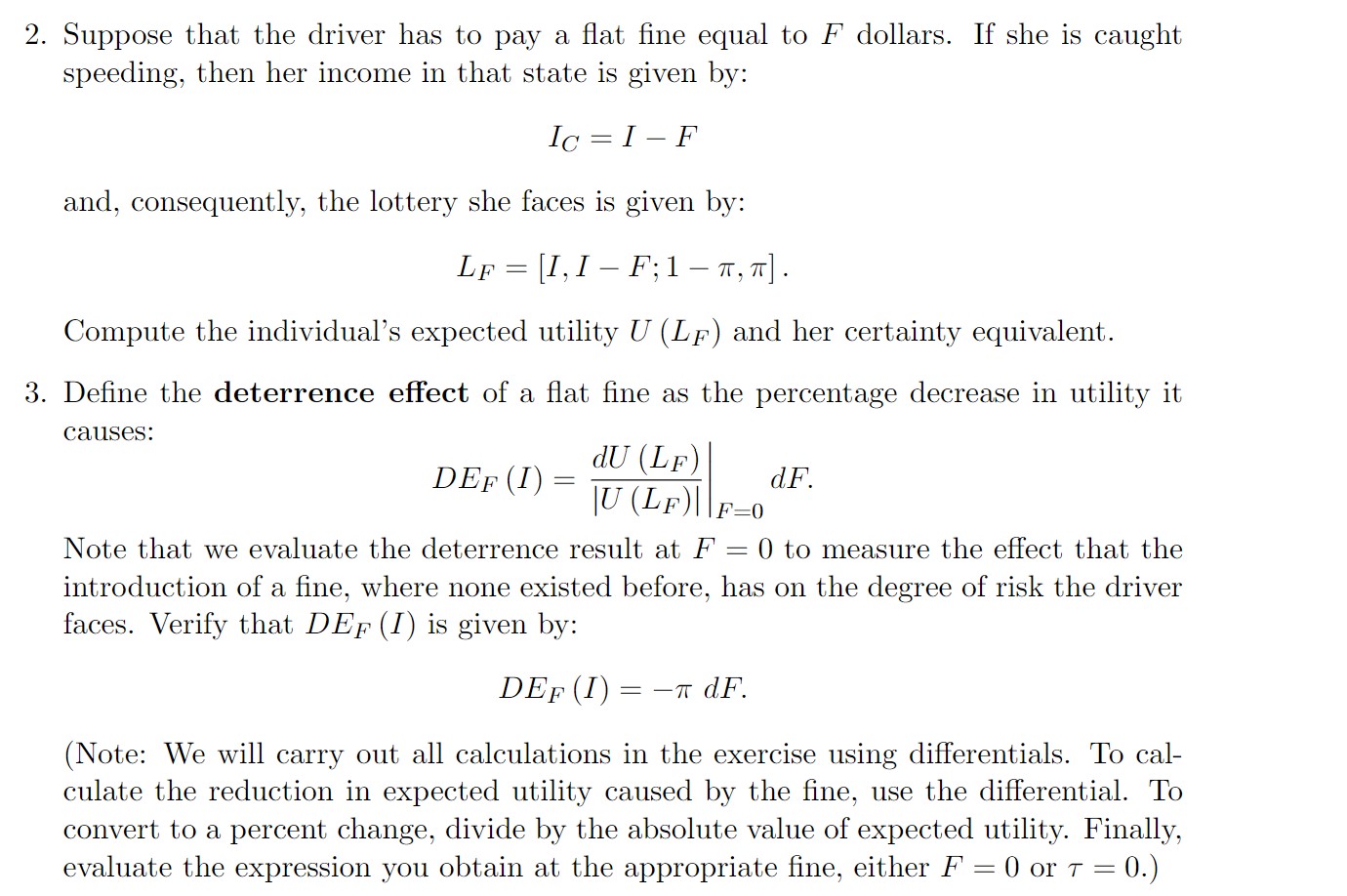
2. Suppose that the driver has to pay a at ne equal to F dollars. If she is caught speeding, then her income in that state is given by: IO = I F and, consequently, the lottery she faces is given by: LF 2 [I,IF;17r,7r]. Compute the individual's expected utility U (L F) and her certainty equivalent. 3. Dene the deterrence effect of a at ne as the percentage decrease in utility it causes: _ dU(LF) DEF (I) _ m F=0dF Note that we evaluate the deterrence result at F = 0 to measure the effect that the introduction of a ne, Where none existed before, has on the degree of risk the driver faces. Verify that DEF (I) is given by: DEF (I) = 7r dF. (Note: We will carry out all calculations in the exercise using differentials. To cal culate the reduction in expected utility caused by the ne, use the differential. To convert to a percent change, divide by the absolute value of expected utility. Finally, evaluate the expression you obtain at the appropriate ne, either F = 0 or 1' = 0.)
Step by Step Solution
There are 3 Steps involved in it

Get step-by-step solutions from verified subject matter experts
 Study Help