







Question: Please answer #39 b). You can do this by hand, or preferably in MATLAB. 39) We are now interested in the roots of the cubic
Please answer #39 b). You can do this by hand, or preferably in MATLAB.
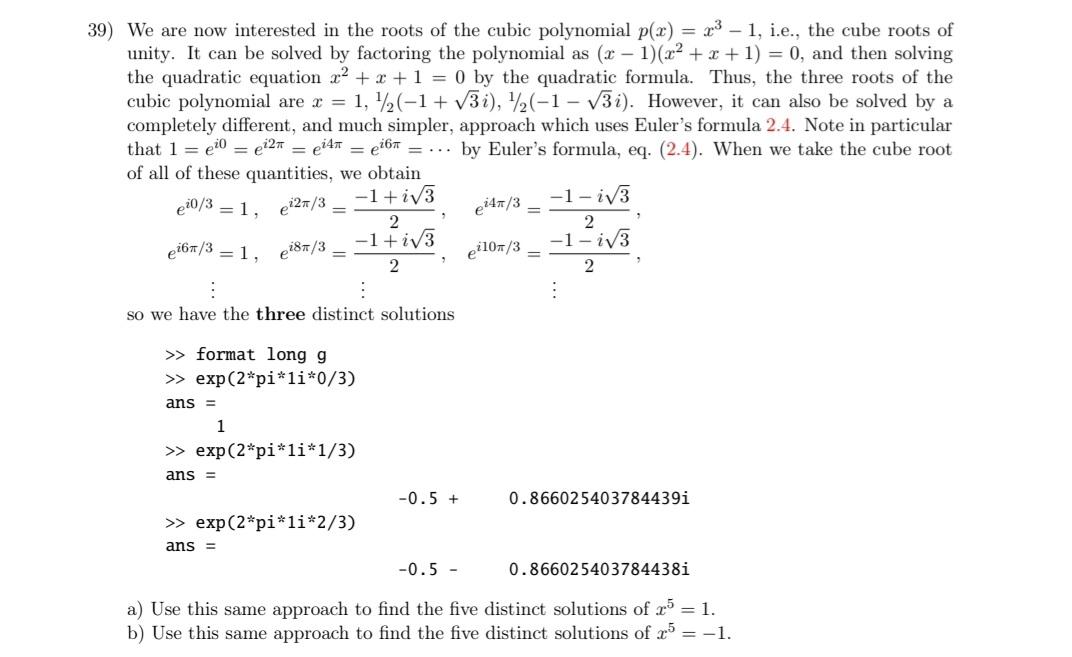
39) We are now interested in the roots of the cubic polynomial p(x) = 73 - 1, i.e., the cube roots of unity. It can be solved by factoring the polynomial as (x - 1)(x2 + x + 1) = 0, and then solving the quadratic equation x + x +1 = 0 by the quadratic formula. Thus, the three roots of the cubic polynomial are x = 1, 42(-1 + V3i), 12(-1 - V3i). However, it can also be solved by a completely different, and much simpler, approach which uses Euler's formula 2.4. Note in particular that 1 = ei0 = ei24 = eitt = ei6A = ... by Euler's formula, eq. (2.4). When we take the cube root of all of these quantities, we obtain -1-i3 20/3 = 1, 129/3 = -1+iV3 24/3 2 -1 + iv3 16/3 = 1, 38/3 = e1107/3 = -1-13 2 2 2 so we have the three distinct solutions >> format long g >> exp(2*pi*11*0/3) ans = 1 >> exp(2*pi*1i*1/3) ans = -0.5 + 0.866025403784439i >> exp(2*pi*1i*2/3) ans = -0.5 - 0.866025403784438i a) Use this same approach to find the five distinct solutions of 25 = 1. b) Use this same approach to find the five distinct solutions of 25 = -1
Step by Step Solution
There are 3 Steps involved in it

Get step-by-step solutions from verified subject matter experts
 Study Help