







Question: PLEASE ANSWER 4 , 5 , 6 NOT 1 , 2 , 3 Questions ( Answers of these Qs can be included in items (
PLEASE ANSWER NOT
Questions Answers of these Qs can be included in items c and d of the ethical
questions below
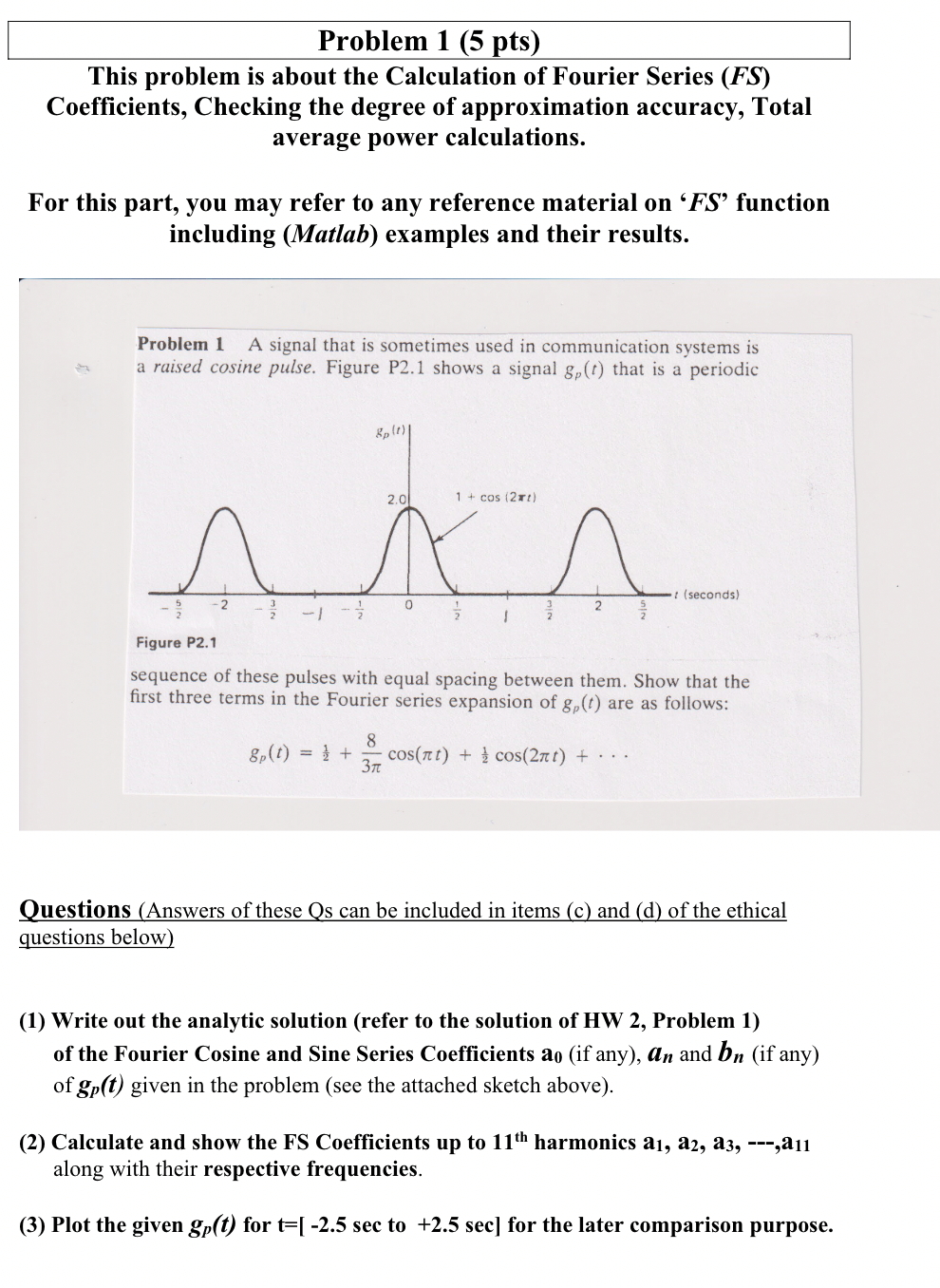
Write out the analytic solution refer to the solution of HW Problem
of the Fourier Cosine and Sine Series Coefficients aif any an and bnif any
of gpt given in the problem see the attached sketch above
Calculate and show the FS Coefficients up to th harmonics aaaa
along with their respective frequencies.
Plot the given gpt for to sec for the later comparison purpose.
Plot the time domain plots for the results of approximation of gpt for cases
respectively for the time duration sec to sec
Cases: Summed up to harmonics, harmonics, harmonics, harmonics, and
harmonics.
Compare with the plot of original gpt for each case above. Then Discuss on the
Accuracy of approximations per the cases of more harmonics added up It can
include discussion and comparison of peak magnitude, time spread or shifting,
overall shape of the plots, etc.
Using the coefficients you found up to harmonics, calculate the total average
power normalized to ohm load per respective cases. Then compare and discuss
on the difference.
Step by Step Solution
There are 3 Steps involved in it
1 Expert Approved Answer
Step: 1 Unlock

Question Has Been Solved by an Expert!
Get step-by-step solutions from verified subject matter experts
Step: 2 Unlock
Step: 3 Unlock
 Study Help