







Question: Please answer #4 and #5 in discussions posts thank you :) FDI in the Indian Retail Sector Historically, the structure of retailing in India was
Please answer #4 and #5 in discussions posts thank you :)
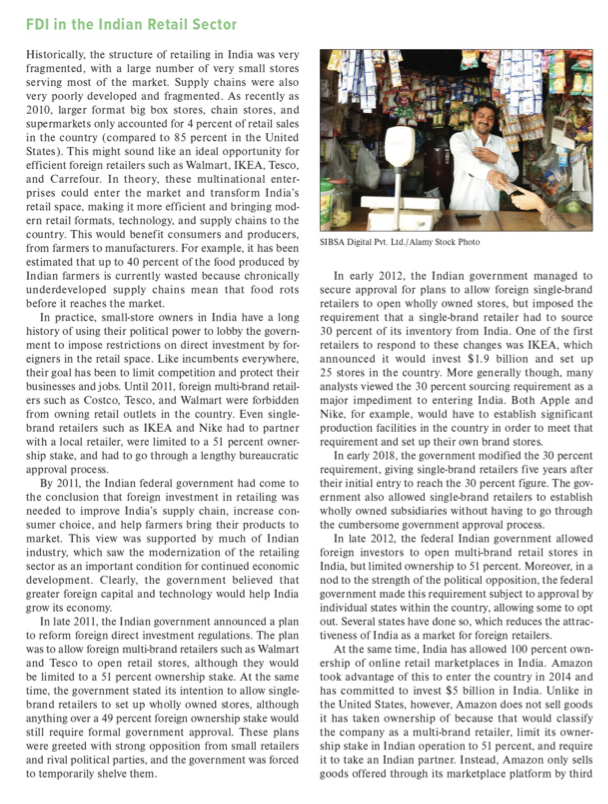
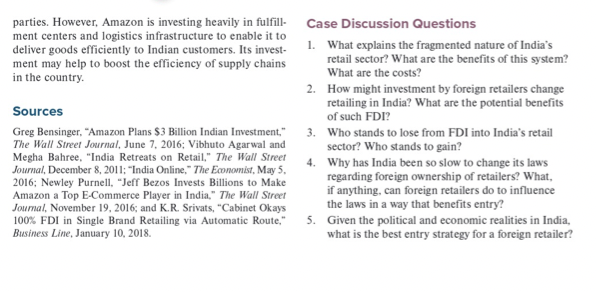
FDI in the Indian Retail Sector Historically, the structure of retailing in India was very fragmented, with a large number of very small stores serving most of the market. Supply chains were also very poorly developed and fragmented. As recently as 2010, larger format big box stores, chain stores, and supermarkets only accounted for 4 percent of retail sales in the country (compared to 85 percent in the United States). This might sound like an ideal opportunity for efficient foreign retailers such as Walmart, IKEA, Tesco, and Carrefour. In theory, these multinational enter- prises could enter the market and transform India's retail space, making it more efficient and bringing mod- ern retail formats, technology, and supply chains to the country. This would benefit consumers and producers, from farmers to manufacturers. For example, it has been SIBSA Digital Pvt. Ltd./Alamy Stock Photo estimated that up to 40 percent of the food produced by Indian farmers is currently wasted because chronically In early 2012, the Indian government managed to underdeveloped supply chains mean that food rots secure approval for plans to allow foreign single-brand before it reaches the market. retailers to open wholly owned stores, but imposed the In practice, small-store owners in India have a long requirement that a single-brand retailer had to source history of using their political power to lobby the govern- 30 percent of its inventory from India. One of the first ment to impose restrictions on direct investment by for retailers to respond to these changes was IKEA, which eigners in the retail space. Like incumbents everywhere, announced it would invest $1.9 billion and set up their goal has been to limit competition and protect their 25 stores in the country. More generally though, many businesses and jobs. Until 2011, foreign multi-brand retail- analysts viewed the 30 percent sourcing requirement as a ers such as Costco, Tesco, and Walmart were forbidden major impediment to entering India. Both Apple and from owning retail outlets in the country. Even single- Nike, for example, would have to establish significant brand retailers such as IKEA and Nike had to partner production facilities in the country in order to meet that with a local retailer, were limited to a 51 percent owner- requirement and set up their own brand stores. ship stake, and had to go through a lengthy bureaucratic In early 2018, the government modified the 30 percent approval process. requirement, giving single-brand retailers five years after By 2011, the Indian federal government had come to their initial entry to reach the 30 percent figure. The gov- the conclusion that foreign investment in retailing was ernment also allowed single-brand retailers to establish needed to improve India's supply chain, increase con- wholly owned subsidiaries without having to go through sumer choice, and help farmers bring their products to the cumbersome government approval process. market. This view was supported by much of Indian In late 2012, the federal Indian government allowed industry, which saw the modernization of the retailing foreign investors to open multi-brand retail stores in sector as an important condition for continued economic India, but limited ownership to 51 percent. Moreover, in a development. Clearly, the government believed that nod to the strength of the political opposition, the federal greater foreign capital and technology would help India government made this requirement subject to approval by grow its economy. individual states within the country, allowing some to opt In late 2011, the Indian government announced a plan out. Several states have done so, which reduces the attrac- to reform foreign direct investment regulations. The plan tiveness of India as a market for foreign retailers. was to allow foreign multi-brand retailers such as Walmart At the same time, India has allowed 100 percent own- and Tesco to open retail stores, although they would ership of online retail marketplaces in India. Amazon be limited to a 51 percent ownership stake. At the same took advantage of this to enter the country in 2014 and time, the government stated its intention to allow single has committed to invest $5 billion in India. Unlike in brand retailers to set up wholly owned stores, although the United States, however, Amazon does not sell goods anything over a 49 percent foreign ownership stake would it has taken ownership of because that would classify still require formal government approval. These plans the company as a multi-brand retailer, limit its owner- were greeted with strong opposition from small retailers ship stake in Indian operation to 51 percent, and require and rival political parties, and the government was forced it to take an Indian partner. Instead, Amazon only sells to temporarily shelve them goods offered through its marketplace platform by third parties. However, Amazon is investing heavily in fulfill Case Discussion Questions ment centers and logistics infrastructure to enable it to deliver goods efficiently to Indian customers. Its invest- 1. What explains the fragmented nature of India's ment may help to boost the efficiency of supply chains retail sector? What are the benefits of this system? in the country. What are the costs? 2. How might investment by foreign retailers change retailing in India? What are the potential benefits Sources of such FDI Greg Bensinger, "Amazon Plans $3 Billion Indian Investment." 3. Who stands to lose from FDI into India's retail The Wall Street Journal, June 7, 2016; Vibhuto Agarwal and sector? Who stands to gain? Megha Bahree, "India Retreats on Retail." The Wall Street Journal, December 8, 2011; "India Online, The Economist, May 5. 4. Why has India been so slow to change its laws 2016; Newley Purnell, "Jeff Bezos Invests Billions to Make regarding foreign ownership of retailers? What Amazon a Top E-Commerce Player in India," The Wall Street if anything, can foreign retailers do to influence Journal, November 19, 2016; and K. R. Srivats, "Cabinet Okays the laws in a way that benefits entry? 100% FDI in Single Brand Retailing via Automatic Route," 5. Given the political and economic realities in India, Business Line, January 10, 2018 what is the best entry strategy for a foreign retailerStep by Step Solution
There are 3 Steps involved in it
1 Expert Approved Answer
Step: 1 Unlock

Question Has Been Solved by an Expert!
Get step-by-step solutions from verified subject matter experts
Step: 2 Unlock
Step: 3 Unlock
 Study Help