







Question: Please answer a & b (a) Consider a vacuum filter shown in figure. This process is part of a waste treatment plant. The sludge enters
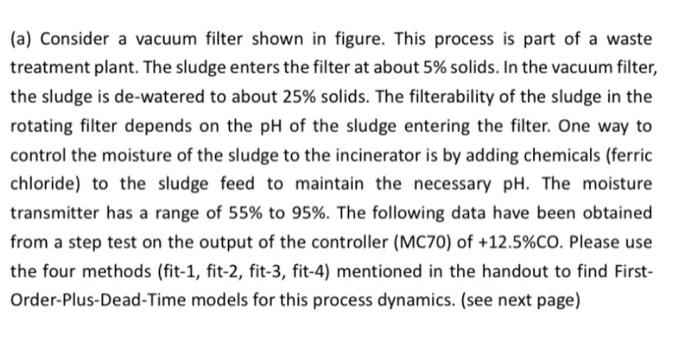
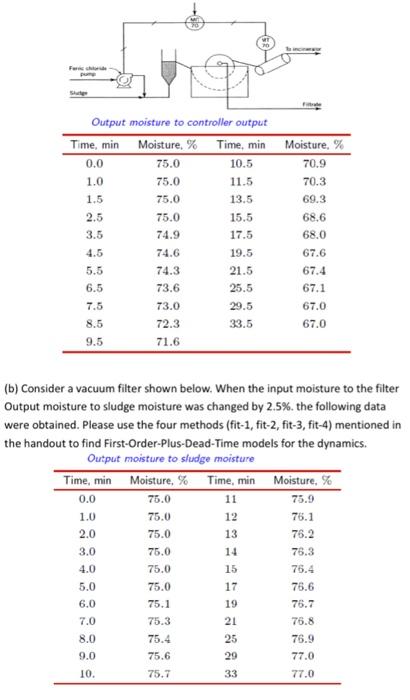
(a) Consider a vacuum filter shown in figure. This process is part of a waste treatment plant. The sludge enters the filter at about 5% solids. In the vacuum filter, the sludge is de-watered to about 25% solids. The filterability of the sludge in the rotating filter depends on the pH of the sludge entering the filter. One way to control the moisture of the sludge to the incinerator is by adding chemicals (ferric chloride) to the sludge feed to maintain the necessary pH. The moisture transmitter has a range of 55% to 95%. The following data have been obtained from a step test on the output of the controller (MC70) of +12.5%CO. Please use the four methods (fit-1, fit-2, fit-3, fit-4) mentioned in the handout to find FirstOrder-Plus-Dead-Time models for this process dynamics. (see next page) Output moisture to controller output (b) Consider a vacuum filter shown below. When the input moisture to the filter Output moisture to sludge moisture was changed by 2.5%. the following data were obtained. Please use the four methods (fit-1, fit-2, fit-3, fit-4) mentioned in the handout to find First-Order-Plus-Dead-Time models for the dynamics. Output moisture to shudge moisture
Step by Step Solution
There are 3 Steps involved in it

Get step-by-step solutions from verified subject matter experts
 Study Help