Question: Please answer a, b, and c. Ignore the question in the problem description. Thank you. A local firm manufactures children's toys. The projected demand over

Please answer a, b, and c. Ignore the question in the problem description. Thank you.
Please answer a, b, and c. Ignore the question in
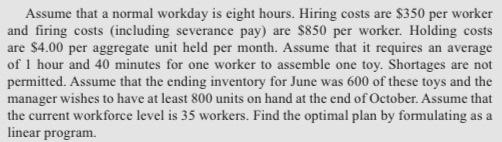
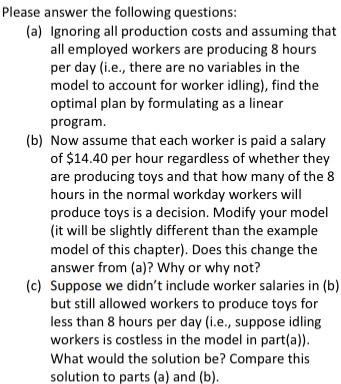
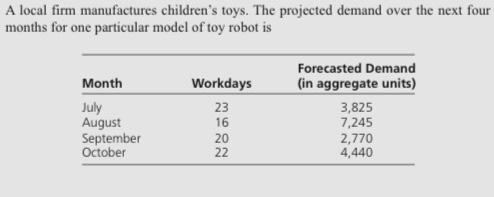
A local firm manufactures children's toys. The projected demand over the next four months for one particular model of toy robot is Assume that a normal workday is eight hours. Hiring costs are $350 per worker and firing costs (including severance pay) are $850 per worker. Holding costs are $4.00 per aggregate unit held per month. Assume that it requires an average of 1 hour and 40 minutes for one worker to assemble one toy. Shortages are not permitted. Assume that the ending inventory for June was 600 of these toys and the manager wishes to have at least 800 units on hand at the end of October. Assume that the current workforce level is 35 workers. Find the optimal plan by formulating as a linear program. lease answer the following questions: (a) Ignoring all production costs and assuming that all employed workers are producing 8 hours per day (i.e., there are no variables in the model to account for worker idling), find the optimal plan by formulating as a linear program. (b) Now assume that each worker is paid a salary of $14.40 per hour regardless of whether they are producing toys and that how many of the 8 hours in the normal workday workers will produce toys is a decision. Modify your model (it will be slightly different than the example model of this chapter). Does this change the answer from (a)? Why or why not? (c) Suppose we didn't include worker salaries in (b) but still allowed workers to produce toys for less than 8 hours per day (i.e., suppose idling workers is costless in the model in part(a)). What would the solution be? Compare this A local firm manufactures children's toys. The projected demand over the next four months for one particular model of toy robot is Assume that a normal workday is eight hours. Hiring costs are $350 per worker and firing costs (including severance pay) are $850 per worker. Holding costs are $4.00 per aggregate unit held per month. Assume that it requires an average of 1 hour and 40 minutes for one worker to assemble one toy. Shortages are not permitted. Assume that the ending inventory for June was 600 of these toys and the manager wishes to have at least 800 units on hand at the end of October. Assume that the current workforce level is 35 workers. Find the optimal plan by formulating as a linear program. lease answer the following questions: (a) Ignoring all production costs and assuming that all employed workers are producing 8 hours per day (i.e., there are no variables in the model to account for worker idling), find the optimal plan by formulating as a linear program. (b) Now assume that each worker is paid a salary of $14.40 per hour regardless of whether they are producing toys and that how many of the 8 hours in the normal workday workers will produce toys is a decision. Modify your model (it will be slightly different than the example model of this chapter). Does this change the answer from (a)? Why or why not? (c) Suppose we didn't include worker salaries in (b) but still allowed workers to produce toys for less than 8 hours per day (i.e., suppose idling workers is costless in the model in part(a)). What would the solution be? Compare this

Step by Step Solution

There are 3 Steps involved in it

1 Expert Approved Answer
Step: 1 Unlock blur-text-image

Question Has Been Solved by an Expert!

Get step-by-step solutions from verified subject matter experts

Step: 2 Unlock
Step: 3 Unlock

Students Have Also Explored These Related General Management Questions!