







Question: Please answer a, b, c and d. Thank you. 1. (16%) A robot has collected data with its sensor. We want to use the data
Please answer a, b, c and d. Thank you.
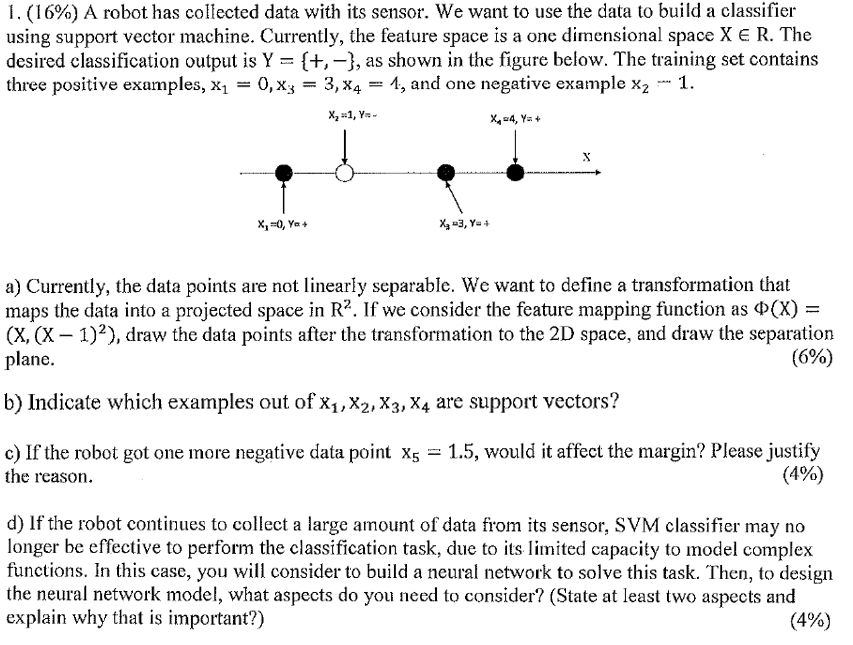
1. (16%) A robot has collected data with its sensor. We want to use the data to build a classifier using support vector machine. Currently, the feature space is a one dimensional space XR. The desired classification output is Y={+,}, as shown in the figure below. The training set contains three positive examples, x1=0,x3=3,x4=1, and one negative example x21. a) Currently, the data points are not linearly separable. We want to define a transformation that maps the data into a projected space in R2. If we consider the feature mapping function as (X)= (X,(X1)2), draw the data points after the transformation to the 2D space, and draw the separation plane. b) Indicate which examples out of x1,x2,x3,x4 are support vectors? c) If the robot got one more negative data point x5=1.5, would it affect the margin? Please justify the reason. d) If the robot continues to collect a large amount of data from its sensor, SVM classifier may no longer be effective to perform the classification task, due to its limited capacity to model complex functions. In this case, you will consider to build a neural network to solve this task. Then, to design the neural network model, what aspects do you need to consider? (State at least two aspects and explain why that is important?)
Step by Step Solution
There are 3 Steps involved in it

Get step-by-step solutions from verified subject matter experts
 Study Help