







Question: Please answer A&B showing all work and steps with boxed answers ! Thank you t/1/2 3.42. The half-life t1/2. of a radioactive species is the
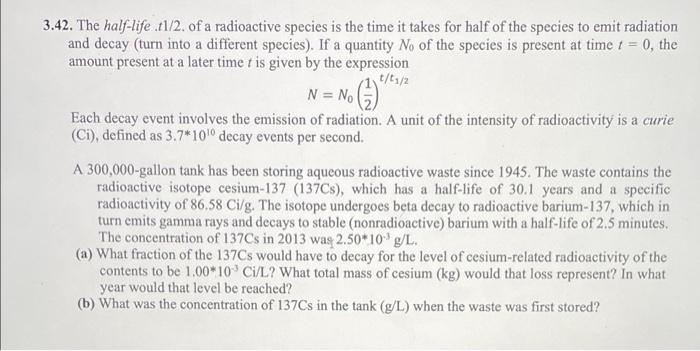
t/1/2 3.42. The half-life t1/2. of a radioactive species is the time it takes for half of the species to emit radiation and decay (turn into a different species). If a quantity No of the species is present at time t = 0, the amount present at a later time t is given by the expression N = No () Each decay event involves the emission of radiation. A unit of the intensity of radioactivity is a curie (Ci), defined as 3.7*10' decay events per second. A 300,000-gallon tank has been storing aqueous radioactive waste since 1945. The waste contains the radioactive isotope cesium-137 (137Cs), which has a half-life of 30.1 years and a specific radioactivity of 86.58 Ci/g. The isotope undergoes beta decay to radioactive barium-137, which in turn emits gamma rays and decays to stable (nonradioactive) barium with a half-life of 2.5 minutes. The concentration of 137Cs in 2013 was 2.50*10 g/L. (a) What fraction of the 137Cs would have to decay for the level of cesium-related radioactivity of the contents to be 1.00*10Ci/L? What total mass of cesium (kg) would that loss represent? In what year would that level be reached? (b) What was the concentration of 137Cs in the tank (g/L) when the waste was first stored
Step by Step Solution
There are 3 Steps involved in it

Get step-by-step solutions from verified subject matter experts
 Study Help