







Question: Please answer according to the marks allocated to this question. Question 1 In finance, January effect is the idea that January is usually a good
 Please answer according to the marks allocated to this question.
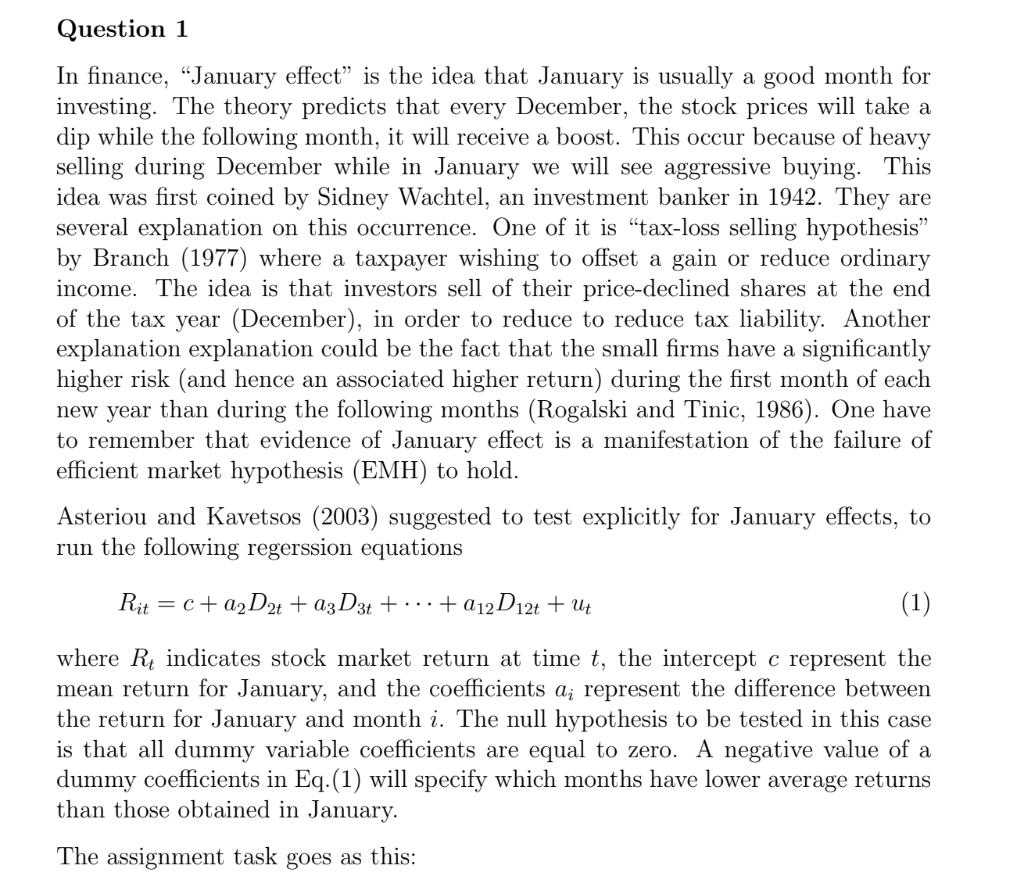
Question 1 In finance, January effect is the idea that January is usually a good month for investing. The theory predicts that every December, the stock prices will take a dip while the following month, it will receive a boost. This occur because of heavy selling during December while in January we will see aggressive buying. This idea was first coined by Sidney Wachtel, an investment banker in 1942. They are several explanation on this occurrence. One of it is tax-loss selling hypothesis by Branch (1977) where a taxpayer wishing to offset a gain or reduce ordinary income. The idea is that investors sell of their price-declined shares at the end of the tax year (December), in order to reduce to reduce tax liability. Another explanation explanation could be the fact that the small firms have a significantly higher risk (and hence an associated higher return) during the first month of each new year than during the following months (Rogalski and Tinic, 1986). One have to remember that evidence of January effect is a manifestation of the failure of efficient market hypothesis (EMH) to hold. Asteriou and Kavetsos (2003) suggested to test explicitly for January effects, to run the following regerssion equations Rit = c + a2D2+ + a3D3+ + ... + (12D12+ + Ut (1) where Rt indicates stock market return at time t, the intercept c represent the mean return for January, and the coefficients a represent the difference between the return for January and month i. The null hypothesis to be tested in this case is that all dummy variable coefficients are equal to zero. A negative value of a dummy coefficients in Eq. (1) will specify which months have lower average returns than those obtained in January. The assignment task goes as this: c) Test the hypothesis of January effect existence in Malaysia's stock market. Interpret the result. (20 marks) Question 1 In finance, January effect is the idea that January is usually a good month for investing. The theory predicts that every December, the stock prices will take a dip while the following month, it will receive a boost. This occur because of heavy selling during December while in January we will see aggressive buying. This idea was first coined by Sidney Wachtel, an investment banker in 1942. They are several explanation on this occurrence. One of it is tax-loss selling hypothesis by Branch (1977) where a taxpayer wishing to offset a gain or reduce ordinary income. The idea is that investors sell of their price-declined shares at the end of the tax year (December), in order to reduce to reduce tax liability. Another explanation explanation could be the fact that the small firms have a significantly higher risk (and hence an associated higher return) during the first month of each new year than during the following months (Rogalski and Tinic, 1986). One have to remember that evidence of January effect is a manifestation of the failure of efficient market hypothesis (EMH) to hold. Asteriou and Kavetsos (2003) suggested to test explicitly for January effects, to run the following regerssion equations Rit = c + a2D2+ + a3D3+ + ... + (12D12+ + Ut (1) where Rt indicates stock market return at time t, the intercept c represent the mean return for January, and the coefficients a represent the difference between the return for January and month i. The null hypothesis to be tested in this case is that all dummy variable coefficients are equal to zero. A negative value of a dummy coefficients in Eq. (1) will specify which months have lower average returns than those obtained in January. The assignment task goes as this: c) Test the hypothesis of January effect existence in Malaysia's stock market. Interpret the result. (20 marks)
Step by Step Solution
There are 3 Steps involved in it

Get step-by-step solutions from verified subject matter experts
 Study Help