







Question: Please answer accurately In the table below you will find simplified consolidated balance sheets for the chartered banking system and the Bank of Canada. Use
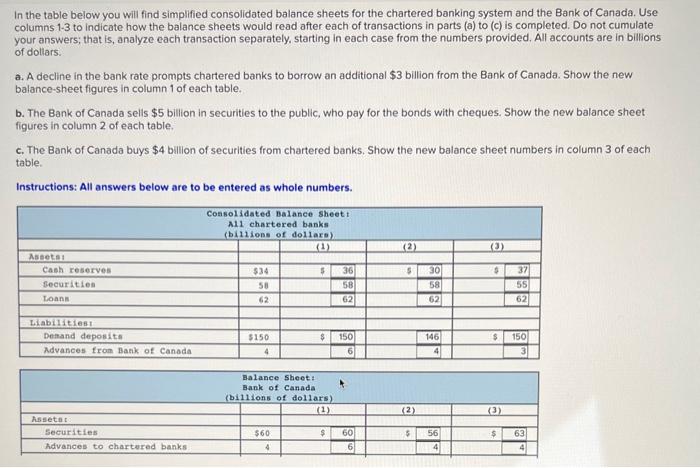
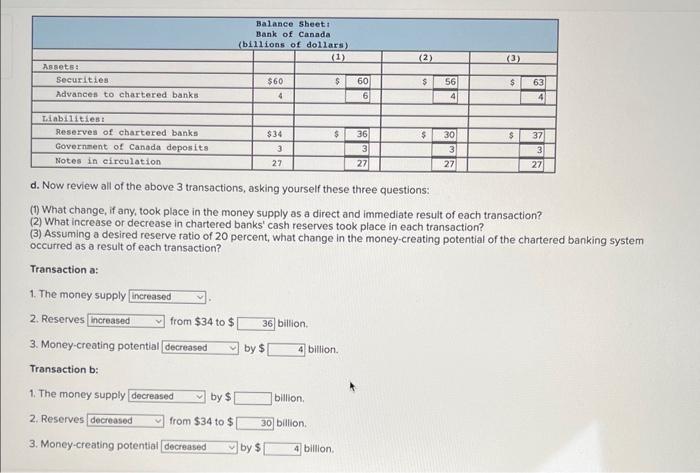
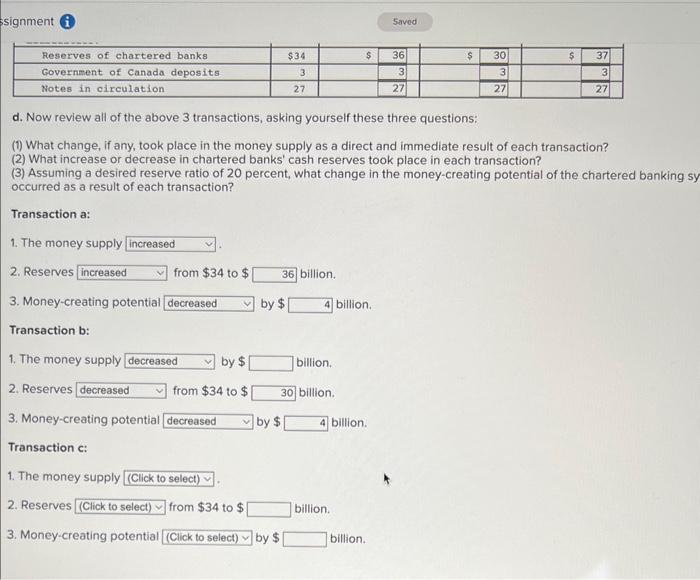
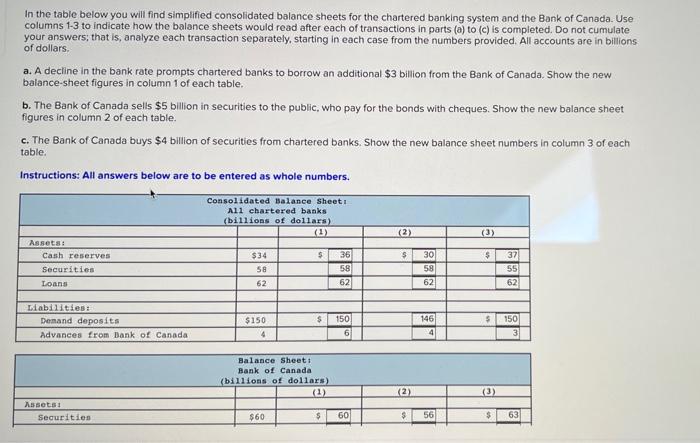
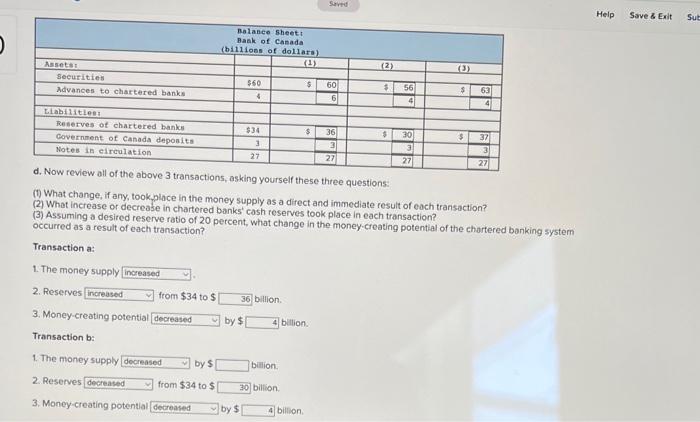
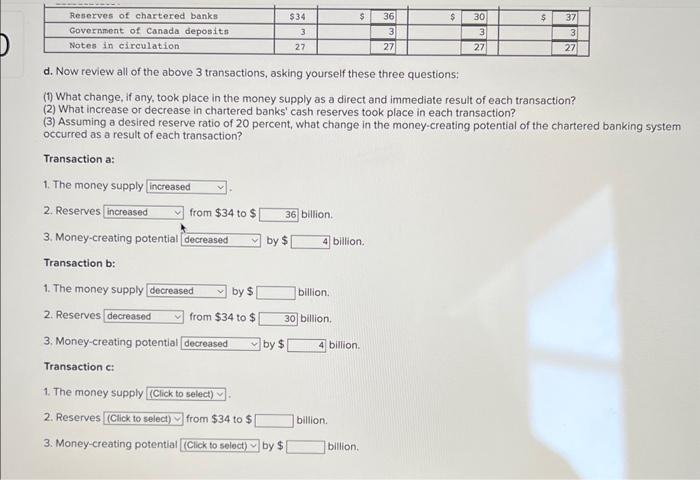
In the table below you will find simplified consolidated balance sheets for the chartered banking system and the Bank of Canada. Use columns 1-3 to indicate how the balance sheets would read after each of transactions in parts (a) to (c) is completed. Do not cumulate your answers; that is, analyze each transaction separately, starting in each case from the numbers provided. All accounts are in billions of dollars. a. A decline in the bank rate prompts chartered banks to borrow an additional $3 billion from the Bank of Canada. Show the new balance-sheet figures in column 1 of each table. b. The Bank of Canada sells $5 billion in securities to the public, who pay for the bonds with cheques. Show the new balance sheet figures in column 2 of each table. c. The Bank of Canada buys $4 billion of securities from chartered banks. Show the new balance sheet numbers in column 3 of each table. Instructions: All answers below are to be entered as whole numbers. d. Now review all of the above 3 transactions, asking yourself these three questions: (1) What change, if any, took place in the money supply as a direct and immediate result of each transaction? (2) What increase or decrease in chartered banks' cash reserves took place in each transaction? (3) Assuming a desired reserve ratio of 20 percent, what change in the money-creating potential of the chartered banking system occurred as a result of each transaction? Transaction a: 1. The money supply 2. Reserves from $34 to $ billion. 3. Money-creating potential by $ bilion. Transaction b: 1. The money supply billion. 2. Reserves from $34 to $ billion. 3. Money-creating potential by $ billion. d. Now review all of the above 3 transactions, asking yourself these three questions: (1) What change, if any, took place in the money supply as a direct and immediate result of each transaction? (2) What increase or decrease in chartered banks' cash reserves took place in each transaction? (3) Assuming a desired reserve ratio of 20 percent, what change in the money-creating potential of the chartered banking sy occurred as a result of each transaction? Transaction a: 1. The money supply 2. Reserves from $34 to $ billion. 3. Money-creating potential by $ billion. Transaction b: 1. The money supply by $ billion. 2. Reserves from $34 to $ billion. 3. Money-creating potential by $ billion. Transaction c: 1. The money supply 2. Reserves from $34 to $ billion. 3. Money-creating potential by $ billion. In the table below you will find simplified consolidated balance sheets for the chartered banking system and the Bank of Canada. Use columns 1-3 to indicate how the balance sheets would read after each of transactions in parts (a) to (c) is completed. Do not cumulate your answers; that is, analyze each transaction separately, starting in each case from the numbers provided. All accounts are in billions of dollars. a. A decline in the bank rate prompts chartered banks to borrow an additional $3 billion from the Bank of Canada. Show the new balance-sheet figures in column 1 of each table. b. The Bank of Canada sells $5 billion in securities to the public, who pay for the bonds with cheques. Show the new balance sheet figures in column 2 of each table. c. The Bank of Canada buys $4 billion of securities from chartered banks. Show the new balance sheet numbers in column 3 of each table. Instructions: All answers below are to be entered as whole numbers. a. Now review all of the above 3 transactions, asking yourself these three questions: (1) What change, if any, took, place in the money supply as a direct and immediate result of each transaction? (2) What increase or decrease in chartered banks' cash reserves took place in each transaction? (3) Assuming a desired reserve ratio of 20 percent, what change in the money-creating potential of the chartered banking systern occurred as a result of each transaction? Transaction a: 1. The money supply 2. Reserves from $34 to $ billion. 3. Money-creating potential by $ billion. Transaction b: 1. The money supply bition. 2. Reserves from $34 to $ bilion. 3. Money creating potential by $ billion. d. Now review all of the above 3 transactions, asking yourself these three questions: (1) What change, if any, took place in the money supply as a direct and immediate result of each transaction? (2) What increase or decrease in chartered banks' cash reserves took place in each transaction? (3) Assuming a desired reserve ratio of 20 percent, what change in the money-creating potential of the chartered banking system occurred as a result of each transaction? Transaction a: 1. The money supply 2. Reserves from $34 to $ billion. 3. Money-creating potential by $ billion. Transaction b: 3. Money-creating potential by $ billion. Transaction c: 1. The money supply 2. Reserves from $34 to $ billion. 3. Money-creating potential by $ billion
Step by Step Solution
There are 3 Steps involved in it

Get step-by-step solutions from verified subject matter experts
 Study Help