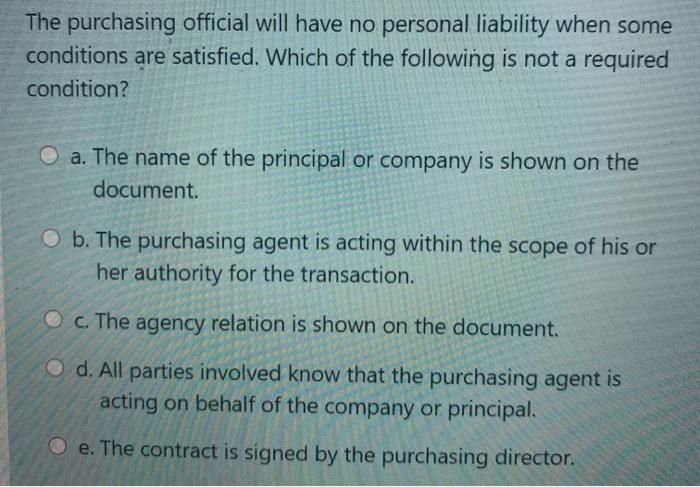
Question: Please answer all 5 Qs! Will thumbs up! Thank you The purchasing official will have no personal liability when some conditions are satisfied. Which of
Please answer all 5 Qs! Will thumbs up! Thank you
Please answer all 5 Qs! Will thumbs up! Thank you Please answer all 5 Qs! Will thumbs up! Thank you
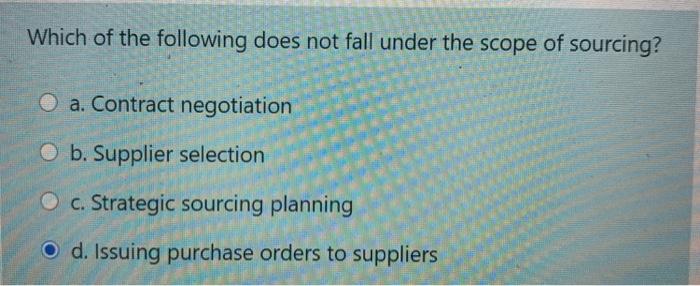
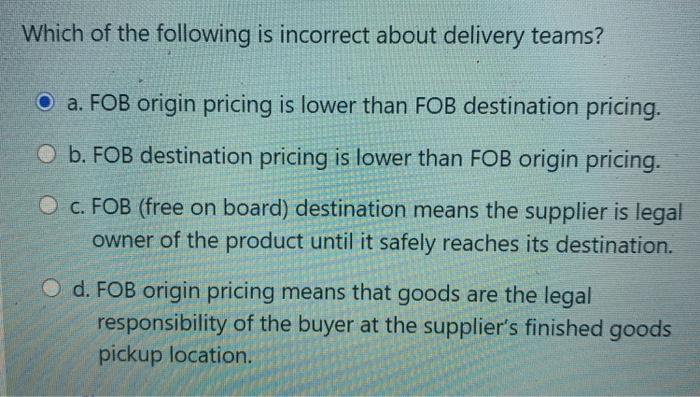
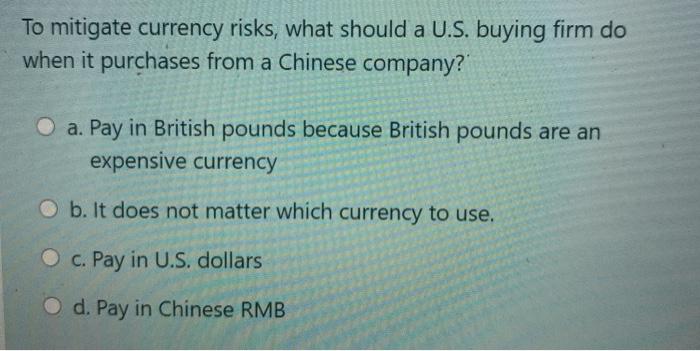
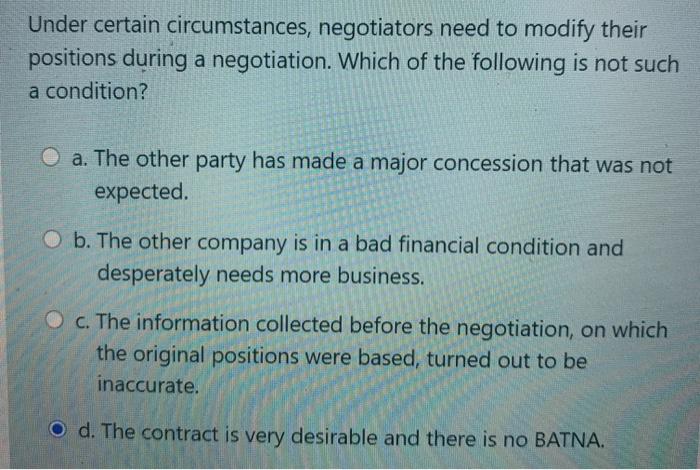
The purchasing official will have no personal liability when some conditions are satisfied. Which of the following is not a required condition? a. The name of the principal or company is shown on the document. O b. The purchasing agent is acting within the scope of his or her authority for the transaction. O c. The agency relation is shown on the document. O d. All parties involved know that the purchasing agent is acting on behalf of the company or principal. O e. The contract is signed by the purchasing director. To mitigate currency risks, what should a U.S. buying firm do when it purchases from a Chinese company? O a. Pay in British pounds because British pounds are an expensive currency b. It does not matter which currency to use. O c. Pay in U.S. dollars O d. Pay in Chinese RMB Under certain circumstances, negotiators need to modify their positions during a negotiation. Which of the following is not such a condition? O a. The other party has made a major concession that was not expected. O b. The other company is in a bad financial condition and desperately needs more business. O c. The information collected before the negotiation, on which the original positions were based, turned out to be inaccurate. O d. The contract is very desirable and there is no BATNA. Which of the following does not fall under the scope of sourcing? O a. Contract negotiation O b. Supplier selection O c. Strategic sourcing planning O d. Issuing purchase orders to suppliers Which of the following is incorrect about delivery teams? O a. FOB origin pricing is lower than FOB destination pricing. O b. FOB destination pricing is lower than FOB origin pricing. O c. FOB (free on board) destination means the supplier is legal owner of the product until it safely reaches its destination. O d. FOB origin pricing means that goods are the legal responsibility of the buyer at the supplier's finished goods pickup location
Step by Step Solution

There are 3 Steps involved in it

1 Expert Approved Answer
Step: 1 Unlock blur-text-image

Question Has Been Solved by an Expert!

Get step-by-step solutions from verified subject matter experts

Step: 2 Unlock
Step: 3 Unlock

Students Have Also Explored These Related General Management Questions!