



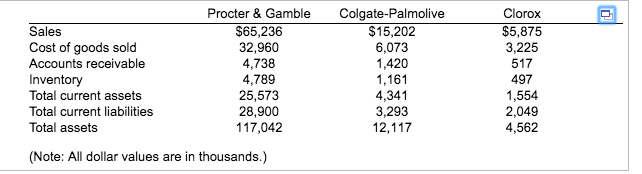
Question: Please answer all a,b,c, and d Procter & Gamble Colgate-Palmolive Clorox $5,875 3,225 517 497 $65,236 32,960 4,738 4,789 25,573 28,900 117,042 Sales $15,202 Cost
 Please answer all a,b,c, and d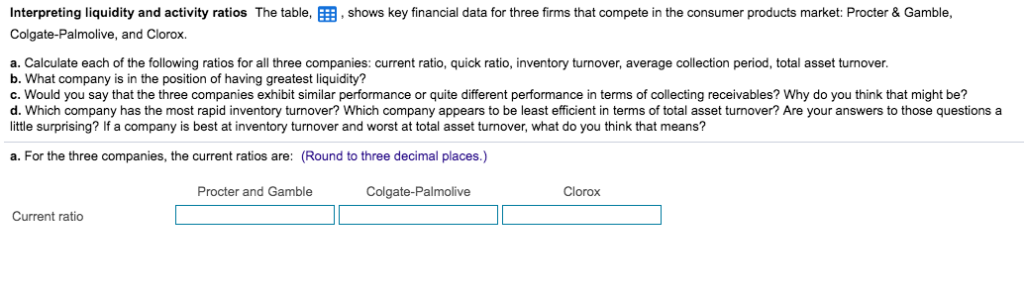
Procter & Gamble Colgate-Palmolive Clorox $5,875 3,225 517 497 $65,236 32,960 4,738 4,789 25,573 28,900 117,042 Sales $15,202 Cost of goods sold 6,073 1,420 1,161 4,341 3,293 12,117 Accounts receivable Inventory 1,554 2,049 4,562 Total current assets Total current liabilities Total assets (Note: All dollar values are in thousands.) Interpreting liquidity and activity ratios The table, EEB, shows key financial data for three firms that compete in the consumer products market: Procter &Gamble, Colgate-Palmolive, and Clorox. a. Calculate each of the following ratios for all three companies: current ratio, quick ratio, inventory turnover, average collection period, total asset turnover b. What company is in the position of having greatest liquidity? c. Would you say that the three companies exhibit similar performance or quite different performance in terms of collecting receivables? Why do you think that might be? d. Which company has the most rapid inventory turnover? Which company appears to be least efficient in terms of total asset turnover? Are your answers to those questions a ittle surprising? If a company is best at inventory turnover and worst at total asset turnover, what do you think that means? a. For the three companies, the current ratios are: (Round to three decimal places.) Procter and Gamble Colgate-Palmolive Clorox Current ratio Procter & Gamble Colgate-Palmolive Clorox $5,875 3,225 517 497 $65,236 32,960 4,738 4,789 25,573 28,900 117,042 Sales $15,202 Cost of goods sold 6,073 1,420 1,161 4,341 3,293 12,117 Accounts receivable Inventory 1,554 2,049 4,562 Total current assets Total current liabilities Total assets (Note: All dollar values are in thousands.) Interpreting liquidity and activity ratios The table, EEB, shows key financial data for three firms that compete in the consumer products market: Procter &Gamble, Colgate-Palmolive, and Clorox. a. Calculate each of the following ratios for all three companies: current ratio, quick ratio, inventory turnover, average collection period, total asset turnover b. What company is in the position of having greatest liquidity? c. Would you say that the three companies exhibit similar performance or quite different performance in terms of collecting receivables? Why do you think that might be? d. Which company has the most rapid inventory turnover? Which company appears to be least efficient in terms of total asset turnover? Are your answers to those questions a ittle surprising? If a company is best at inventory turnover and worst at total asset turnover, what do you think that means? a. For the three companies, the current ratios are: (Round to three decimal places.) Procter and Gamble Colgate-Palmolive Clorox Current ratio
Step by Step Solution
There are 3 Steps involved in it

Get step-by-step solutions from verified subject matter experts