







Question: please answer all! B Question 11 (1 point) Stan is a very dominating, assertive boss. When it comes to conflicts, he only wants to win
please answer all! 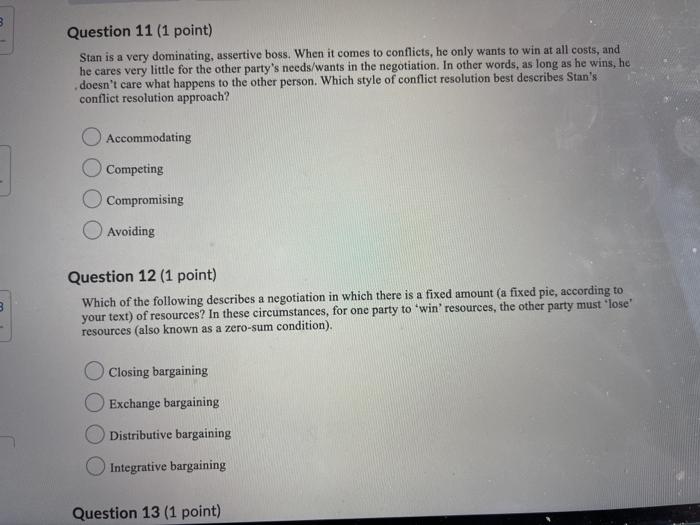
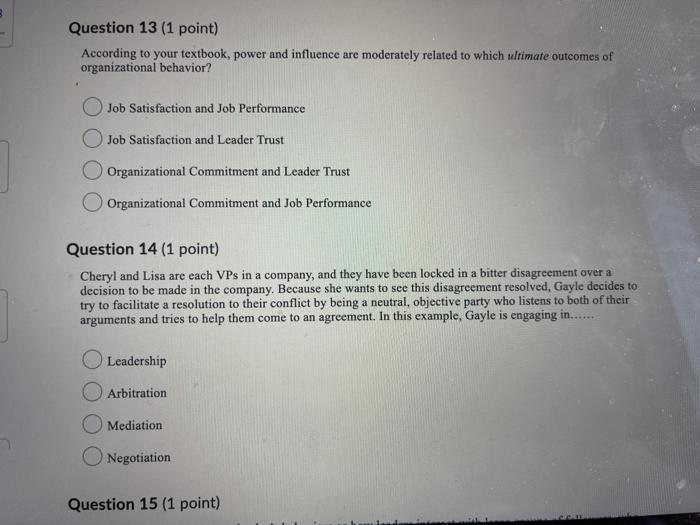
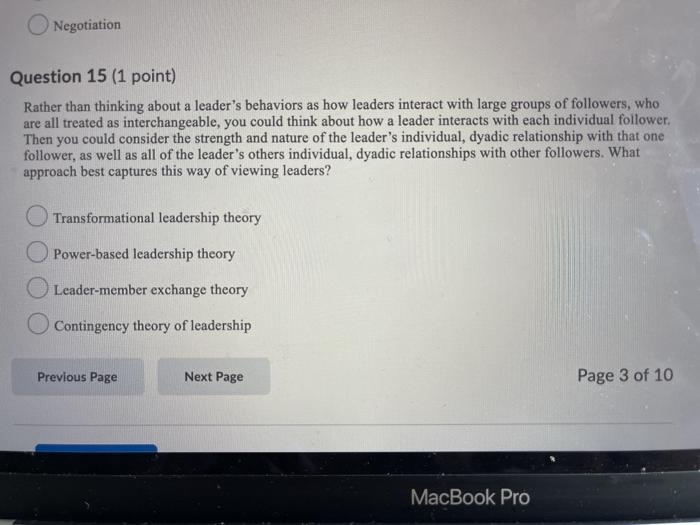
B Question 11 (1 point) Stan is a very dominating, assertive boss. When it comes to conflicts, he only wants to win at all costs, and he cares very little for the other party's needs/wants in the negotiation. In other words, as long as he wins, he doesn't care what happens to the other person. Which style of conflict resolution best describes Stan's conflict resolution approach? Accommodating Competing Compromising Avoiding Question 12 (1 point) Which of the following describes a negotiation in which there is a fixed amount (a fixed pie, according to your text) of resources? In these circumstances, for one party to 'win' resources, the other party must 'lose' resources (also known as a zero-sum condition). Closing bargaining Exchange bargaining Distributive bargaining Integrative bargaining Question 13 (1 point) 3 Question 13 (1 point) According to your textbook, power and influence are moderately related to which ultimate outcomes of organizational behavior? Job Satisfaction and Job Performance Job Satisfaction and Leader Trust Organizational Commitment and Leader Trust Organizational Commitment and Job Performance Question 14 (1 point) Cheryl and Lisa are each VPs in a company, and they have been locked in a bitter disagreement over a decision to be made in the company. Because she wants to see this disagreement resolved, Gayle decides to try to facilitate a resolution to their conflict by being a neutral, objective party who listens to both of their arguments and tries to help them come to an agreement. In this example, Gayle is engaging in...... Leadership Arbitration Mediation Negotiation Question 15 (1 point) Negotiation Question 15 (1 point) Rather than thinking about a leader's behaviors as how leaders interact with large groups of followers, who are all treated as interchangeable, you could think about how a leader interacts with each individual follower Then you could consider the strength and nature of the leader's individual, dyadic relationship with that one follower, as well as all of the leader's others individual, dyadic relationships with other followers. What approach best captures this way of viewing leaders? Transformational leadership theory Power-based leadership theory Leader-member exchange theory Contingency theory of leadership Previous Page Next Page Page 3 of 10 MacBook Pro Step by Step Solution
There are 3 Steps involved in it
1 Expert Approved Answer
Step: 1 Unlock

Question Has Been Solved by an Expert!
Get step-by-step solutions from verified subject matter experts
Step: 2 Unlock
Step: 3 Unlock
 Study Help