



Question: PLEASE ANSWER ALL ELEMENTS OF QUESTION, PLEASE NO HANDWRITING, THANK YOU- I WILL UP-VOTE IF CORRECT The cost of equity using the CAPM approach The
PLEASE ANSWER ALL ELEMENTS OF QUESTION, PLEASE NO HANDWRITING, THANK YOU- I WILL UP-VOTE IF CORRECT
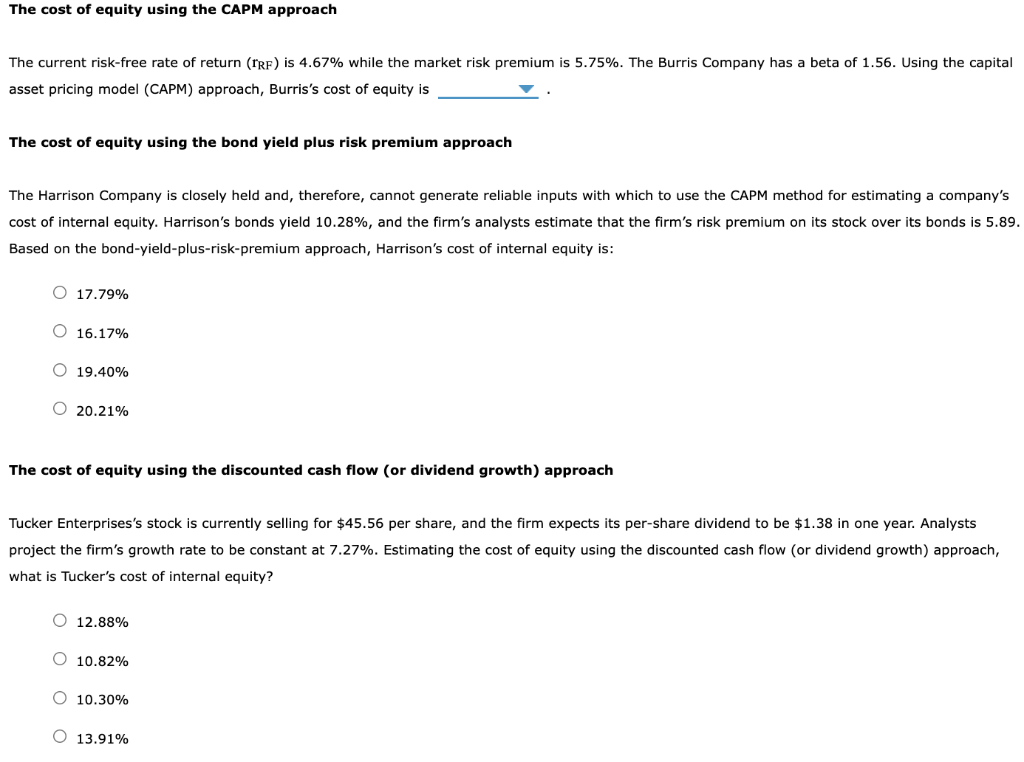
The cost of equity using the CAPM approach The current risk-free rate of return (TRF) is 4.67% while the market risk premium is 5.75%. The Burris Company has a beta of 1.56. Using the capital asset pricing model (CAPM) approach, Burris's cost of equity is The cost of equity using the bond yield plus risk premium approach The Harrison Company is closely held and, therefore, cannot generate reliable inputs with which to use the CAPM method for estimating a company's cost of internal equity. Harrison's bonds yield 10.28%, and the firm's analysts estimate that the firm's risk premium on its stock over its bonds is 5.89. Based on the bond-yield-plus-risk-premium approach, Harrison's cost of internal equity is: O 17.79% O 16.17% O 19.40% 20.21% The cost of equity using the discounted cash flow (or dividend growth) approach Tucker Enterprises's stock is currently selling for $45.56 per share, and the firm expects its per-share dividend to be $1.38 in one year. Analysts project the firm's growth rate to be constant at 7.27%. Estimating the cost of equity using the discounted cash flow (or dividend growth) approach, what is Tucker's cost of internal equity? O 12.88% O 10.82% O 10.30% O 13.91%
Step by Step Solution
There are 3 Steps involved in it

Get step-by-step solutions from verified subject matter experts