







Question: please answer all even if i put the answer in. will like!!! thank you :) SAMANTHA: Good morning, Professor invest-a-Lot. I'd like to welcome you
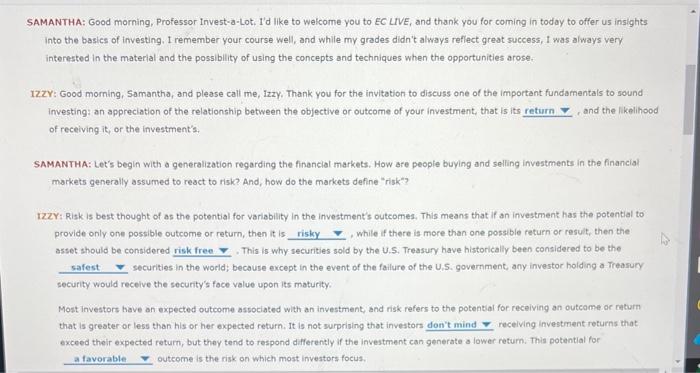
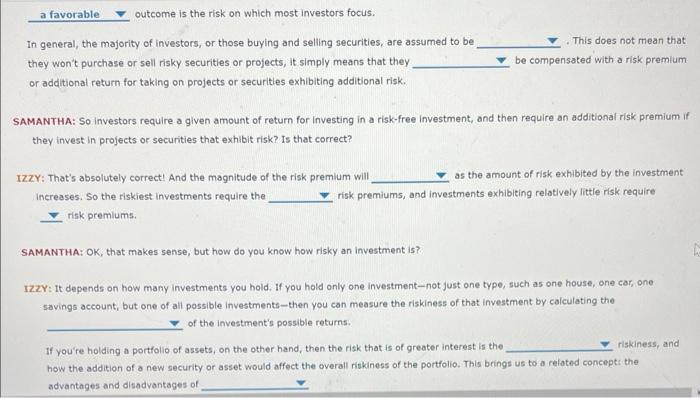
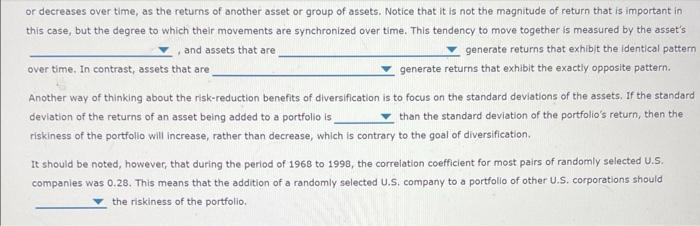
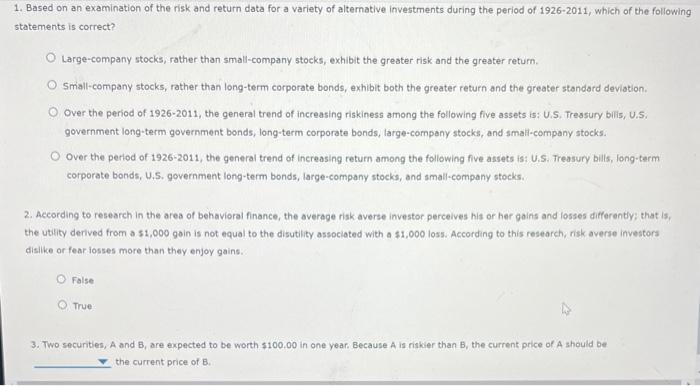
SAMANTHA: Good morning, Professor invest-a-Lot. I'd like to welcome you to EC LIVE, and thank you for coming in today to offer us insights into the basics of investing. I remember your course well, and while my grades didn't always reflect great success, I was always very interested in the material and the possiblity of using the concepts and techniques when the opportunities arose. 12zy: Good moming, Samantha, and please call me, izzy. Thank you for the invitation to discuss one of the important fundamentals to sound investing: an appreciation of the relationship between the objective or outcome of your investment, that is its and the likelihood of receiving it, or the investment's. SAMANTHA: Let's begin with a generalization regarding the finencial markets. How are people buying and selling investments in the financial markets generally assumed to react to risk? And, how do the markets define "risk"? 12zY: Risk is best thought of as the potential for variability in the investment's outcomes. This means that if an investment has the potential to provide only one possible outcome or return, then it is , while if there is more than one possible return or result, then the asset should be considered . This is why securities soid by the U.S. Treasury have historically been considered to be the securities in the world; because except in the event of the failure of the U.5. government, any investor hold ing a Treasury security would recelve the security's face value upon its maturity. Most investors have an expected outcome associated with an investment, and risk refers to the potental for receiving an outcame or raturn that is greater of less than his or her expected return. It is not surprising that investors receiving investment returns that exceed their expected return, but they tend to respond differently if the investment can generate a lower return. This potential for outcome is the risk on which most investors focus. outcome is the risk on which most investors focus. In general, the majority of investors, or those buying and selling securities, are assumed to be This does not mean that they won't purchase or sell risky securities or projects, it simply means that they be compensated with a risk premium or additional return for taking on projects or securitles exhibiting additional risk. SAMANTHA: So investors require a given amount of return for investing in a risk-free investment, and then require an additional risk premium if they invest in projects or securities that exhibit risk? Is that correct? IZZY: That's absolutely correct! And the magnitude of the risk premium will as the amount of risk exhibited by the investment increases. So the riskiest investments require the risk premiums, and investments exhibiting relatively little risk require risk premlums. SAMANTHA: OK, that makes sense, but how do you know how risky an investment is? 1Z2Y: it depends on how many investments you hold. If you hold only one investment-not just one type, such as one house, one car, one savings account, but one of all possible investments-then you can measure the riskiness of that investment by calculating the of the investment's possible returns. If you're holding a portfolio of assets, on the other hand, then the risk that is of greater interest is the riskiness, and how the addition of a new security or asset would affect the overall rikiness of the portfolio. This brings us to a related concepti the advantages and disadvantages of or decreases over time, as the returns of another asset or group of assets. Notice that it is not the magnitude of return that is important in this case, but the degree to which their movements are synchronized over time. This tendency to move together is measured by the asset's , and assets that are. generate returns that exhibit the identical pattern over time. In contrast, assets that are generate returns that exhibit the exactly opposite pattern. Another way of thinking about the risk-reduction benefits of diversification is to focus on the standard deviations of the assets, If the standard deviation of the returns of an asset being added to a portfolio is than the standard deviation of the portfolio's return, then the riskiness of the portfollo will increase, rather than decrease, which is contrary to the goal of diversification. It should be noted, however, that during the period of 1968 to 1998 , the correlation coefficient for most pairs of randomly selected U.S. companies was 0.28. This means that the addition of a randomly selected U.S. company to a portfollo of other U.S. corporations should the riskiness of the portfolio. 1. Based on an examination of the risk and return data for a variety of alternative investments during the period of 19262011, which of the following statements is correct? Large-company stocks, rather than small-company stocks, exhibit the greater risk and the greater return. Small-company stocks, rather than long-term corporate bonds, exhibit both the greater return and the greater standard deviation. Over the period of 1926-2011, the general trend of increasing riskiness among the following five assets is: U.S. Treasury bilis, U.S. government long-term government bonds, long-term corporate bonds, large-company stocks, and small-company stocks. Over the perlod of 1926-2011, the general trend of increasing return among the following five assets is: U.S. Treasury bills, long-term corporate bonds, U.S. government long-term bonds, large-company stocks, and small-company stocks. 2. According to research in the area of behavioral finance, the average risk averse investor perceives his of har gains and losses differently; that is. the utility derived from a \$1,000 goin is not equal to the disutility associated with a \$1,000 loss. According to this research, risk averse investors dislike or fear iosses more than they enjoy gains. False True 3. Two securities, A and B, are expected to be worth $100.00 in one year. Because A is riskier than B, the current price of A should be the current price of B
Step by Step Solution
There are 3 Steps involved in it

Get step-by-step solutions from verified subject matter experts
 Study Help