







Question: Please answer all fill in blanks 1 . Bond valuation The process of bond valuation is based on the fundamental concept that the current price
Please answer all fill in blanks
Bond valuation
The process of bond valuation is based on the fundamental concept that the current price of a security can be determined by calculating the present value of the cash flows that the security will generate in the future.
There is a consistent and predictable relationship between a bonds coupon rate, its par value, a bondholders required return, and the bonds resulting value. Trading at a discount, trading at a premium, and trading at parrefer to particular relationships between a bonds value and its par value. This also results from the relationship between a bonds coupon rate and a bondholders required rate of return.
Remember, a bonds coupon rate partially determines the interestbased return that a bondpay and a bondholders required return reflects the return that a bondholderto receive from a given investment.
The mathematics of bond valuation imply a predictable relationship between the bonds coupon rate, the bondholders required return, the bonds par value, and its value. These relationships can be summarized as follows:
When the bonds coupon rate is equal to the bondholders required return, the bonds value will equal its par value, and the bond will trade at par.When the bonds coupon rate is greater than the bondholders required return, the bonds value will its par value, and the bond will trade at a premium.When the bonds coupon rate is less than the bondholders required return, the bonds value will be less than its par value, and the bond will trade at
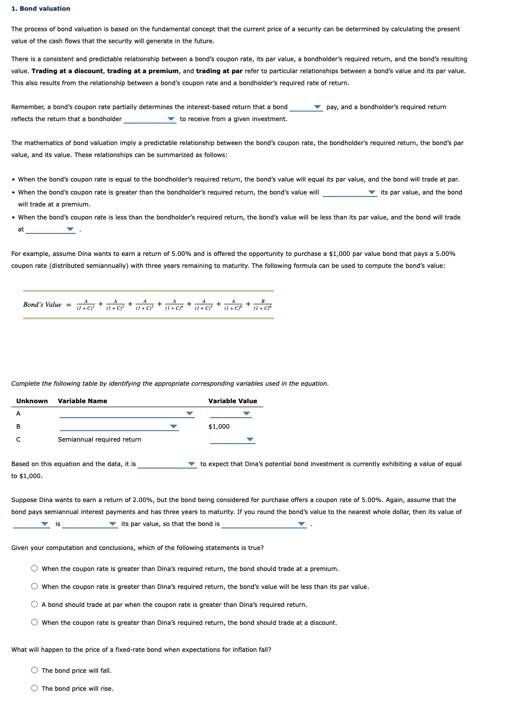
For example, assume Dina wants to earn a return of and is offered the opportunity to purchase a $ par value bond that pays a coupon rate distributed semiannually with three years remaining to maturity. The following formula can be used to compute the bonds value:
BondsValueBondsValueACACACACACACBCACACACACACACBC
Complete the following table by identifying the appropriate corresponding variables used in the equation.
Unknown
Variable Name
Variable Value
AB$CSemiannual required return
Based on this equation and the data, it isto expect that Dinas potential bond investment is currently exhibiting a value of equal to $
Suppose Dina wants to earn a return of but the bond being considered for purchase offers a coupon rate of Again, assume that the bond pays semiannual interest payments and has three years to maturity. If you round the bonds value to the nearest whole dollar, then its value ofisits par value, so that the bond is
Given your computation and conclusions, which of the following statements is true?
When the coupon rate is greater than Dinas required return, the bond should trade at a premium.
When the coupon rate is greater than Dinas required return, the bonds value will be less than its par value.
A bond should trade at par when the coupon rate is greater than Dinas required return.
When the coupon rate is greater than Dinas required return, the bond should trade at a discount.
What will happen to the price of a fixedrate bond when expectations for inflation fall?
The bond price will fall.
The bond price will rise.
Step by Step Solution
There are 3 Steps involved in it
1 Expert Approved Answer
Step: 1 Unlock

Question Has Been Solved by an Expert!
Get step-by-step solutions from verified subject matter experts
Step: 2 Unlock
Step: 3 Unlock
 Study Help