



Question: Please answer all. Introduction. Addition is the most commonly performed arithmetic operation in digital systems. An adder combine two arithmetic operands using the addition rules
Please answer all.
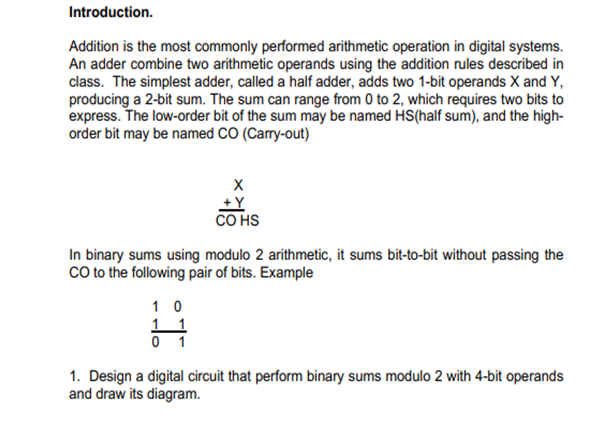
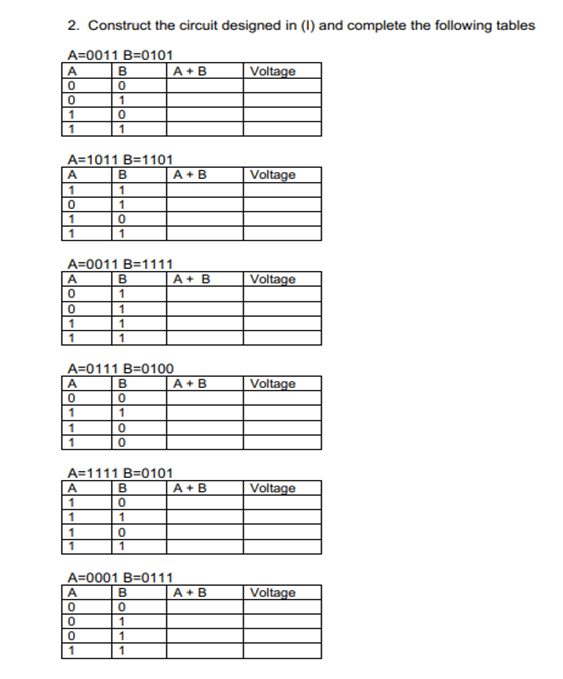
Introduction. Addition is the most commonly performed arithmetic operation in digital systems. An adder combine two arithmetic operands using the addition rules described in class. The simplest adder, called a half adder, adds two 1-bit operands X and Y, producing a 2-bit sum. The sum can range from 0 to 2, which requires two bits to express. The low-order bit of the sum may be named HS(half sum), and the high- order bit may be named CO (Carry-out) CO HS In binary sums using modulo 2 arithmetic, it sums bit-to-bit without passing the CO to the following pair of bits. Example 10 1 1 0 1 1. Design a digital circuit that perform binary sums modulo 2 with 4-bit operands and draw its diagram. 2. Construct the circuit designed in (1) and complete the following tables Voltage lol A=0011 B=0101 A B A+B 0 0 1 1 0 1 1 Voltage A=1011 B=1101 A B A+B 1 1 0 1 1 0 1 1 Voltage A=0011 B-1111 A B A + B 0 1 0 1 1 1 1 1 Voltage A=0111 B=0100 A B A+B 0 0 1 1 1 0 1 0 Voltage A=1111 B=0101 B A+B 1 0 1 1 1 0 1 1 Voltage lololol A=0001 B=0111 A B A+B 0 1 1 1 1
Step by Step Solution
There are 3 Steps involved in it

Get step-by-step solutions from verified subject matter experts