







Question: please answer all multiple choice questions and fill in the colored boxes on the chart! Royal Crown Cola (RC Cola) is an American soda that




please answer all multiple choice questions and fill in the colored boxes on the chart!
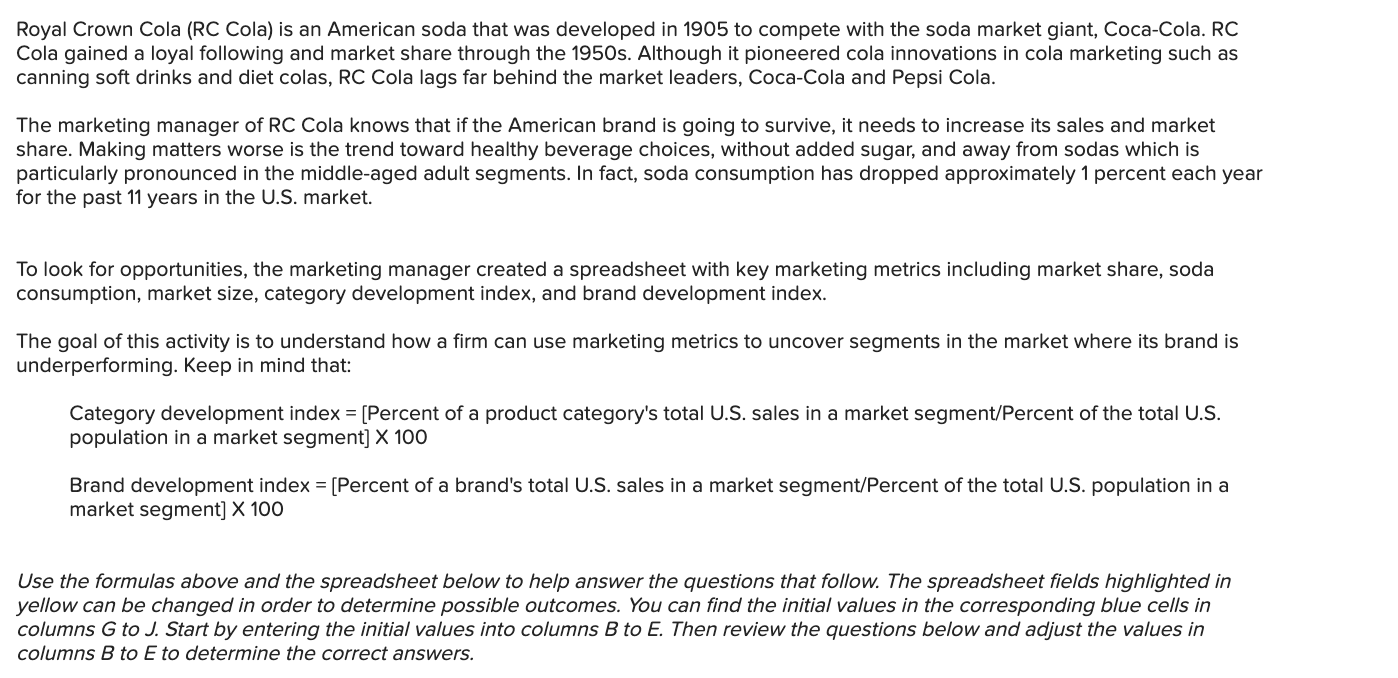
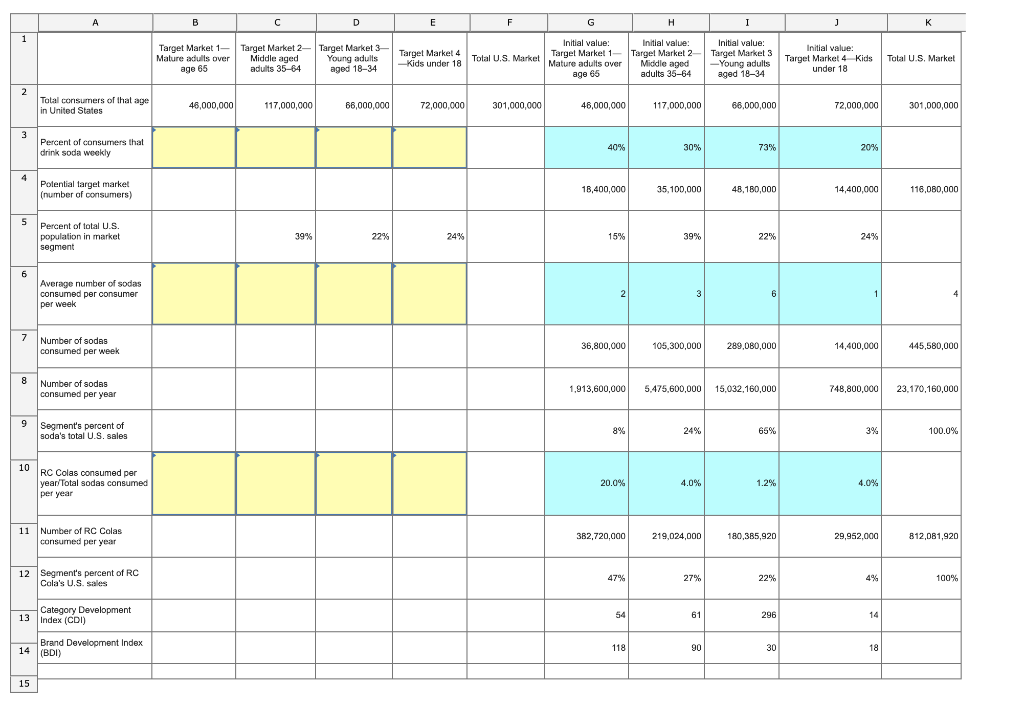
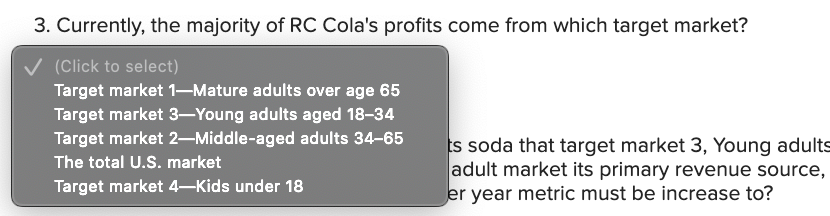
Royal Crown Cola (RC Cola) is an American soda that was developed in 1905 to compete with the soda market giant, Coca-Cola. RC Cola gained a loyal following and market share through the 1950s. Although it pioneered cola innovations in cola marketing such as canning soft drinks and diet colas, RC Cola lags far behind the market leaders, Coca-Cola and Pepsi Cola. The marketing manager of RC Cola knows that if the American brand is going to survive, it needs to increase its sales and market share. Making matters worse is the trend toward healthy beverage choices, without added sugar, and away from sodas which is particularly pronounced in the middle-aged adult segments. In fact, soda consumption has dropped approximately 1 percent each year for the past 11 years in the U.S. market. To look for opportunities, the marketing manager created a spreadsheet with key marketing metrics including market share, soda consumption, market size, category development index, and brand development index. The goal of this activity is to understand how a firm can use marketing metrics to uncover segments in the market where its brand is underperforming. Keep in mind that: Category development index = [Percent of a product category's total U.S. sales in a market segment/Percent of the total U.S. population in a market segment] X 100 Brand development index = [Percent of a brand's total U.S. sales in a market segment/Percent of the total U.S. population in a market segment] X 100 Use the formulas above and the spreadsheet below to help answer the questions that follow. The spreadsheet fields highlighted in yellow can be changed in order to determine possible outcomes. You can find the initial values in the corresponding blue cells in columns G to J. Start by entering the initial values into columns B to E. Then review the questions below and adjust the values in columns B to E to determine the correct answers. A B D E E F F G H 1 J 1 Target Market 1 Mature adults over Target Market 2-Target Market 3- Middle aged Young adults adults 35-64 aged 18-34 Target Market 4 Kids under 18 Initial value Initial value: Initial value: Total U.S. Market Target Market 1 - Target Market 2-Target Market 3 Middle aged --Young adults age 65 adults 35-64 aged 18-34 Total U.S. Market Mature adults over Initial value: Target Market 4 Kids under 18 Total U.S. Market age 65 2 Total consumers of that age in United States 46,000,000 117,000,000 86,000,000 72,000,000 301,000,000 46,000,000 117,000,000 66,000,000 72,000,000 301,000,000 3 Percent of consumers that drink soda weekly 40% 30% 73% 20% 4 Potential target market (number of consumers) 18,400,000 35,100,000 48,180,000 14,400,000 116,080,000 5 5 Percent of total U.S. population in market segment 39% 22% 24% 15% 39% 22% 24% 6 Average number of sodas consumed per consumer per week 2 3 6 1 7 7 Number of sodas consumed per week 36,800,000 105,300,000 289,000,000 14.400.000 445,580,000 8 Number of sodas consumed per year 1,913,600,000 5.475,600,000 15,032,160,000 748,800,000 23,170,160,000 9 Segment's percent of soda's total U.S. sales 8% 24% 65% 3% 100.0% 10 RC Colas consumed per 20.0% 4.0% 1.2% 4.0% year/Total sodas consumed per year E 11 Number of RC Colas consumed per year 382,720,000 219,024,000 180,385,920 29,952,000 812,081,920 12 Segment's percent of RC Cola's U.S. sales 47% 27% 22% 4% 100% Category Development 13 Index (CDI) 54 61 296 14 Brand Development Index 14 (BDI) 118 90 30 18 15 1. Based on the data provided in the above spreadsheet, which target market presents the best opportunity for growth for RC Cola? (Click to select) Target market 1Mature adults over age 65 Target market 2Middle-aged adults 34-65 There is insufficient data in the dashboard to evaluate the market opportunities Target market 4Kids under 18 Target market 3Young adults aged 18-34 tions the recommendation. The CEO continues, "Why would has always been the mature market segment?" How should 2. The marketing manager is called into a meeting with the CEO who questions the recommendation. The CEO continues, "Why would you recommend that we target young adults when our loyal target market has always been the mature market segment?" How should the marketing manager respond to the CEO? (Click to select) The CDI of 296 and BDI of 30 indicate that the young adult market consumes a larger than average quantity of soda, but does not prefer the RC Cola brand. The CDI of 54 and BDI of 118 indicate that the mature market consumes a larger than average quantity of soda, and prefers RC Cola more than the other target markets. The CDI of 54 and BDI of 118 indicate that the mature market consumes a larger than average quantity of soda, but does not prefer RC Cola. The CDI of 296 and BDI of 30 indicate that the young adult market does not consume a larger than average quantity of soda, but does prefer RC Cola over other sodas. The CDI of 296 and BDI of 30 indicate that the young adult market does not consume a larger than average quantity of soda, and does prefer RC Cola over other sodas. 3. Currently, the majority of RC Cola's profits come from which target market? (Click to select) Target market 1Mature adults over age 65 Target market 3Young adults aged 18-34 Target market 2Middle-aged adults 34-65 The total U.S. market Target market 4Kids under 18 s soda that target market 3, Young adults adult market its primary revenue source, er year metric must be increase to? 4. RC Cola wants to increase the amount of its soda that target market 3, Young adults, consumes each year to reduce its reliance on the mature adult market. To make the young adult market its primary revenue source, what is the minimum level the RC Colas consumed per year/Total sodas consumed per year metric must be increase to? (Click to select) 2.20% 3.60% 3.20% 3.00% 2.60% a new soda with no sugar and antiaging benefits. The soda is a big hit with the middle-aged adult market and verall percent of consumers drinking sodas weekly to 35 percent, increases their overall soda consumption to 4 ases RC Colas /Total sodas metric to 6 percent. After the change, which of the following statements is true? 5. RC Cola develops a new soda with no sugar and antiaging benefits. The soda is a big hit with the middle-aged adult market and thus increases the overall percent of consumers drinking sodas weekly to 35 percent, increases their overall soda consumption to 4 per week, and increases RC Colas /Total sodas metric to 6 percent. After the change, which of the following statements is true? (Click to select) Target market 2Middle-aged adults is the second most profitable segment but now drinks more soda per year than any other target. Target market 2Middle-aged adults is now RC Cola's most profitable segment and drinks relatively more RC Cola than any other target market. Target market 2Middle-aged adults is now RC Cola's most profitable segment and drinks more soda per year than any other segment. Target market 2Middle-aged adults is now RC Cola's most profitable segment and is the largest target market in terms of number of consumers. Target market 2Middle-aged adults is the second most profitable segment but drinks relatively more RC Cola than any other segment. Next Royal Crown Cola (RC Cola) is an American soda that was developed in 1905 to compete with the soda market giant, Coca-Cola. RC Cola gained a loyal following and market share through the 1950s. Although it pioneered cola innovations in cola marketing such as canning soft drinks and diet colas, RC Cola lags far behind the market leaders, Coca-Cola and Pepsi Cola. The marketing manager of RC Cola knows that if the American brand is going to survive, it needs to increase its sales and market share. Making matters worse is the trend toward healthy beverage choices, without added sugar, and away from sodas which is particularly pronounced in the middle-aged adult segments. In fact, soda consumption has dropped approximately 1 percent each year for the past 11 years in the U.S. market. To look for opportunities, the marketing manager created a spreadsheet with key marketing metrics including market share, soda consumption, market size, category development index, and brand development index. The goal of this activity is to understand how a firm can use marketing metrics to uncover segments in the market where its brand is underperforming. Keep in mind that: Category development index = [Percent of a product category's total U.S. sales in a market segment/Percent of the total U.S. population in a market segment] X 100 Brand development index = [Percent of a brand's total U.S. sales in a market segment/Percent of the total U.S. population in a market segment] X 100 Use the formulas above and the spreadsheet below to help answer the questions that follow. The spreadsheet fields highlighted in yellow can be changed in order to determine possible outcomes. You can find the initial values in the corresponding blue cells in columns G to J. Start by entering the initial values into columns B to E. Then review the questions below and adjust the values in columns B to E to determine the correct answers. A B D E E F F G H 1 J 1 Target Market 1 Mature adults over Target Market 2-Target Market 3- Middle aged Young adults adults 35-64 aged 18-34 Target Market 4 Kids under 18 Initial value Initial value: Initial value: Total U.S. Market Target Market 1 - Target Market 2-Target Market 3 Middle aged --Young adults age 65 adults 35-64 aged 18-34 Total U.S. Market Mature adults over Initial value: Target Market 4 Kids under 18 Total U.S. Market age 65 2 Total consumers of that age in United States 46,000,000 117,000,000 86,000,000 72,000,000 301,000,000 46,000,000 117,000,000 66,000,000 72,000,000 301,000,000 3 Percent of consumers that drink soda weekly 40% 30% 73% 20% 4 Potential target market (number of consumers) 18,400,000 35,100,000 48,180,000 14,400,000 116,080,000 5 5 Percent of total U.S. population in market segment 39% 22% 24% 15% 39% 22% 24% 6 Average number of sodas consumed per consumer per week 2 3 6 1 7 7 Number of sodas consumed per week 36,800,000 105,300,000 289,000,000 14.400.000 445,580,000 8 Number of sodas consumed per year 1,913,600,000 5.475,600,000 15,032,160,000 748,800,000 23,170,160,000 9 Segment's percent of soda's total U.S. sales 8% 24% 65% 3% 100.0% 10 RC Colas consumed per 20.0% 4.0% 1.2% 4.0% year/Total sodas consumed per year E 11 Number of RC Colas consumed per year 382,720,000 219,024,000 180,385,920 29,952,000 812,081,920 12 Segment's percent of RC Cola's U.S. sales 47% 27% 22% 4% 100% Category Development 13 Index (CDI) 54 61 296 14 Brand Development Index 14 (BDI) 118 90 30 18 15 1. Based on the data provided in the above spreadsheet, which target market presents the best opportunity for growth for RC Cola? (Click to select) Target market 1Mature adults over age 65 Target market 2Middle-aged adults 34-65 There is insufficient data in the dashboard to evaluate the market opportunities Target market 4Kids under 18 Target market 3Young adults aged 18-34 tions the recommendation. The CEO continues, "Why would has always been the mature market segment?" How should 2. The marketing manager is called into a meeting with the CEO who questions the recommendation. The CEO continues, "Why would you recommend that we target young adults when our loyal target market has always been the mature market segment?" How should the marketing manager respond to the CEO? (Click to select) The CDI of 296 and BDI of 30 indicate that the young adult market consumes a larger than average quantity of soda, but does not prefer the RC Cola brand. The CDI of 54 and BDI of 118 indicate that the mature market consumes a larger than average quantity of soda, and prefers RC Cola more than the other target markets. The CDI of 54 and BDI of 118 indicate that the mature market consumes a larger than average quantity of soda, but does not prefer RC Cola. The CDI of 296 and BDI of 30 indicate that the young adult market does not consume a larger than average quantity of soda, but does prefer RC Cola over other sodas. The CDI of 296 and BDI of 30 indicate that the young adult market does not consume a larger than average quantity of soda, and does prefer RC Cola over other sodas. 3. Currently, the majority of RC Cola's profits come from which target market? (Click to select) Target market 1Mature adults over age 65 Target market 3Young adults aged 18-34 Target market 2Middle-aged adults 34-65 The total U.S. market Target market 4Kids under 18 s soda that target market 3, Young adults adult market its primary revenue source, er year metric must be increase to? 4. RC Cola wants to increase the amount of its soda that target market 3, Young adults, consumes each year to reduce its reliance on the mature adult market. To make the young adult market its primary revenue source, what is the minimum level the RC Colas consumed per year/Total sodas consumed per year metric must be increase to? (Click to select) 2.20% 3.60% 3.20% 3.00% 2.60% a new soda with no sugar and antiaging benefits. The soda is a big hit with the middle-aged adult market and verall percent of consumers drinking sodas weekly to 35 percent, increases their overall soda consumption to 4 ases RC Colas /Total sodas metric to 6 percent. After the change, which of the following statements is true? 5. RC Cola develops a new soda with no sugar and antiaging benefits. The soda is a big hit with the middle-aged adult market and thus increases the overall percent of consumers drinking sodas weekly to 35 percent, increases their overall soda consumption to 4 per week, and increases RC Colas /Total sodas metric to 6 percent. After the change, which of the following statements is true? (Click to select) Target market 2Middle-aged adults is the second most profitable segment but now drinks more soda per year than any other target. Target market 2Middle-aged adults is now RC Cola's most profitable segment and drinks relatively more RC Cola than any other target market. Target market 2Middle-aged adults is now RC Cola's most profitable segment and drinks more soda per year than any other segment. Target market 2Middle-aged adults is now RC Cola's most profitable segment and is the largest target market in terms of number of consumers. Target market 2Middle-aged adults is the second most profitable segment but drinks relatively more RC Cola than any other segment. NextStep by Step Solution
There are 3 Steps involved in it
1 Expert Approved Answer
Step: 1 Unlock

Question Has Been Solved by an Expert!
Get step-by-step solutions from verified subject matter experts
Step: 2 Unlock
Step: 3 Unlock
 Study Help