







Question: please answer all options Problem 9-20 (similar to) (Divisional costs of capital and investment decisions) In May of this year, Newcastle Mig. Company's capital investment
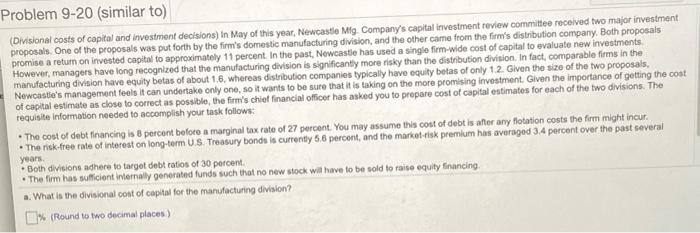
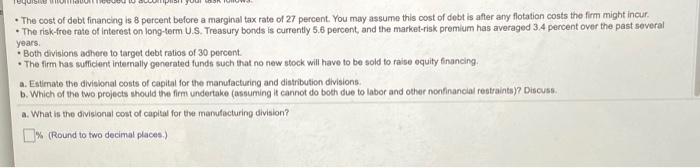
Problem 9-20 (similar to) (Divisional costs of capital and investment decisions) In May of this year, Newcastle Mig. Company's capital investment review committee received two major investment proposals. One of the proposals was put forth by the firm's domestic manufacturing division, and the other came from the firm's distribution company. Both proposals promise a return on invested capital to approximately 11 percent. In the past, Newcastle has used a single firm-wide cost of capital to evaluate new investments However, managers have long recognized that the manufacturing division is significantly more risky than the distribution division. In fact, comparable firms in the manufacturing division have equity betas of about 1.6, whereas distribution companies typically have equity botas of only 1 2. Given the size of the two proposals Newcastle's management feels it can undertake only one, so it wants to be sure that it is taking on the more promising investment. Given the importance of getting the cost of capital estimate as close to correct as possible, the firm's chief financial officer has asked you to prepare cost of capital estimates for each of the two divisions. The requisite Information needed to accomplish your task follows: The cost of debt financing is 8 percent before a marginal tax rate of 27 percent. You may assume this cost of debt is after any flotation costs the firm might incur. The risk-free rate of interest on long-term U.S. Treasury bonds is currently 5.6 percent, and the market-risk premium has averaged 3.4 percent over the past several years Both divisions adhere to target debt ratio of 30 percent. . The firm has sufficient internally generated funds such that no new stock will have to be sold to raise equity financing a. What is the divisional cost of capital for the manufacturing division? % (Round to two decimal places) The cost of debt financing is 8 percent before a marginal tax rate of 27 percent. You may assume this cost of debt is after any flotation costs the firm might incur. The risk-free rate of interest on long-term U.S. Treasury bonds is currently 5.6 percent, and the market-risk premium has averaged 3.4 percent over the past several years . Both divisions adhere to target debt ratios of 30 percent. . The firm has sufficient internally generated funds such that no new stock will have to be sold to raise oquity financing a. Estimate the divisional costs of capital for the manufacturing and distribution divisions b. Which of the two projects should the firm undertake consuming It cannot do both due to labor and other non financial restraints)? Discuss a. What is the divisional cost of capital for the manufacturing division? 1% (Round to two decimal places)
Step by Step Solution
There are 3 Steps involved in it

Get step-by-step solutions from verified subject matter experts
 Study Help