







Question: 5. (Eigenvalue and Eigenfunction) The eigenfunctions of Hermitian Operators are orthonormal (orthogonal and normalizable). a. Prove the eigenfunctions of the Hamiltonian Operator for a
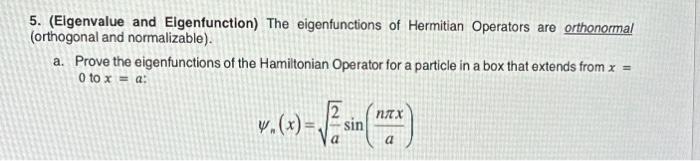
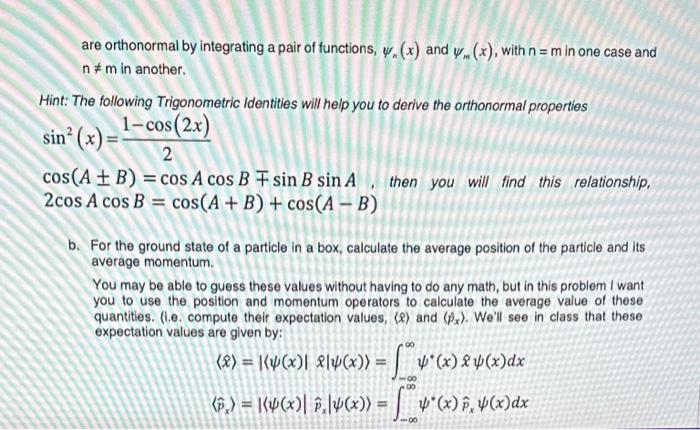
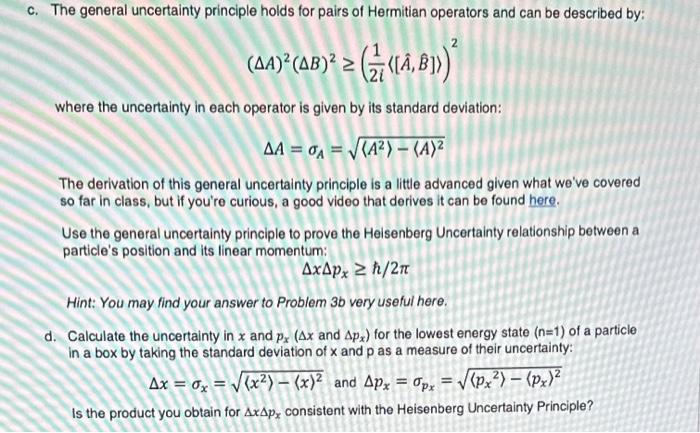
5. (Eigenvalue and Eigenfunction) The eigenfunctions of Hermitian Operators are orthonormal (orthogonal and normalizable). a. Prove the eigenfunctions of the Hamiltonian Operator for a particle in a box that extends from x = 0 to x = a: (x)=sin nx a are orthonormal by integrating a pair of functions, w(x) and y (x), with n = m in one case and nm in another. Hint: The following Trigonometric Identities will help you to derive the orthonormal properties sin(x)=1-cos(2x) 2 cos(A+B)=cos A cos BF sin B sin A, then you will find this relationship, 2cos A cos B = cos(A + B) + cos(A-B) b. For the ground state of a particle in a box, calculate the average position of the particle and its average momentum. You may be able to guess these values without having to do any math, but in this problem I want you to use the position and momentum operators to calculate the average value of these quantities. (i.e. compute their expectation values, (2) and (px). We'll see in class that these expectation values are given by: (x) = \(\(x)] *\*(x)) = [***(x) & y(x)dx 00 00 (B) = P(x)| F|4(x)) = *(x), 4(x)dx c. The general uncertainty principle holds for pairs of Hermitian operators and can be described by: (AA) (AB) (A, B) where the uncertainty in each operator is given by its standard deviation: AA==(A2)-(A)2 The derivation of this general uncertainty principle is a little advanced given what we've covered so far in class, but if you're curious, a good video that derives it can be found here. Use the general uncertainty principle to prove the Heisenberg Uncertainty relationship between a particle's position and its linear momentum: AxApx h/2 Hint: You may find your answer to Problem 3b very useful here. d. Calculate the uncertainty in x and px (Ax and Apx) for the lowest energy state (n=1) of a particle in a box by taking the standard deviation of x and p as a measure of their uncertainty: Ax = x = (x2)-(x)2 and Apx =0px = (px)-(px) Is the product you obtain for AxAp, consistent with the Heisenberg Uncertainty Principle?
Step by Step Solution
There are 3 Steps involved in it
To address this question lets break it down into steps a Prove Orthonormality The eigenfunctions of the Hamiltonian operator for a particle in a box a... View full answer

Get step-by-step solutions from verified subject matter experts
 Study Help