



Question: Please answer all parts in Excel or Minitab, if possible. FULL DATA SET: Y Flu Shot X1 Age X2 HA X3 Gender 0 53 65
 Please answer all parts in Excel or Minitab, if possible.
FULL DATA SET:
Y Flu Shot X1 Age X2 HA X3 Gender
0 53 65 0
0 52 57 1
0 67 60 1
1 76 22 1
0 56 83 0
0 55 58 1
1 51 42 0
0 56 67 1
0 75 55 1
0 64 53 1
0 59 56 1
0 71 65 1
0 62 44 0
0 72 65 0
1 68 57 1
0 68 55 0
0 64 51 0
1 65 63 0
0 53 75 1
0 70 56 1
0 67 66 0
0 49 58 0
0 55 58 0
0 63 58 0
0 64 65 1
0 64 67 0
0 61 78 0
0 57 64 1
0 66 51 0
0 56 66 0
0 68 66 1
0 58 63 0
0 68 49 0
0 66 60 1
0 61 55 1
0 55 73 1
0 72 37 0
1 68 57 1
0 50 71 0
0 54 68 0
0 84 52 1
1 56 50 1
0 48 74 0
0 68 62 0
0 56 69 1
0 67 69 0
0 51 72 0
0 63 61 1
0 66 64 1
0 65 54 1
0 59 52 0
0 71 60 0
0 66 56 0
0 53 58 0
0 54 61 1
0 78 49 1
0 52 67 0
1 68 32 0
0 57 60 0
0 49 70 0
0 52 67 0
0 62 61 1
0 51 59 1
0 53 70 0
0 50 76 1
0 49 74 0
1 71 45 1
0 51 60 1
0 70 54 1
0 56 55 1
0 56 64 1
0 57 51 1
0 67 57 1
0 70 51 0
0 51 68 0
0 73 64 1
0 61 65 1
0 62 69 0
0 65 59 1
0 50 79 1
0 64 50 0
0 59 49 0
0 49 61 0
0 50 71 0
0 60 59 1
0 61 48 0
1 62 48 0
0 51 81 0
0 51 69 1
0 68 50 1
0 50 83 1
0 69 38 1
0 51 58 1
0 62 48 0
0 60 65 1
0 62 49 1
0 59 56 1
0 54 59 0
1 76 45 1
0 51 45 0
0 54 62 1
0 67 59 0
0 65 59 0
1 59 61 1
1 82 46 1
1 80 38 0
0 56 47 0
0 53 57 0
0 77 49 1
0 66 51 1
0 67 53 1
0 81 55 1
1 59 49 1
0 67 56 1
0 58 57 0
1 75 51 0
0 53 58 1
0 81 68 0
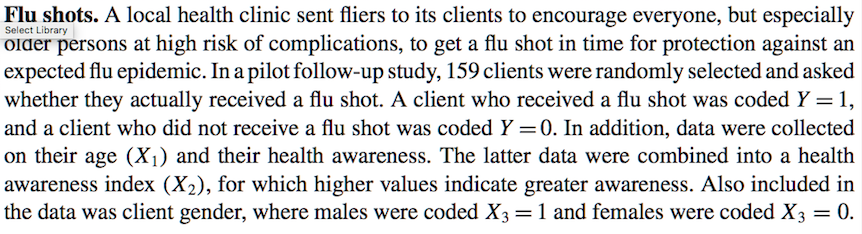
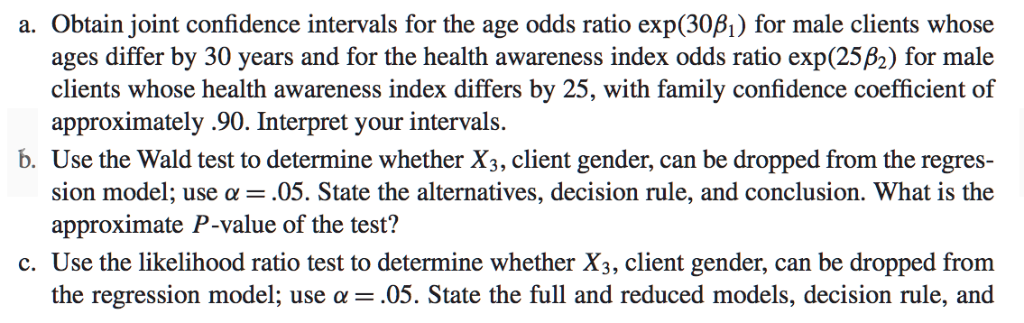
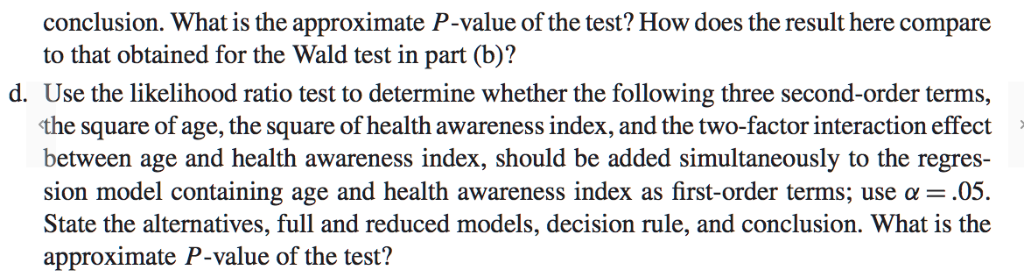
Flu shots. A local health clinic sent fliers to its clients to encourage everyone, but especially olaer persons at high risk of complications, to get a flu shot in time for protection against an expected flu epidemic. In a pilot follow-up study, 159 clients were randomly selected and asked whether they actually received a flu shot. A client who received a flu shot was coded Y - 1 and a client who did not receive a flu shot was coded Y =0. In addition, data were collected on their age (X,) and their health awareness. The latter data were combined into a health awareness index (X2), for which higher values indicate greater awareness. Also included in the data was client gender, where males were coded X3-1 and females were coded X3 - 0. Select Library a. Obtain joint confidence intervals for the age odds ratio exp(30B) for male clients whose ages differ by 30 years and for the health awareness index odds ratio exp(25p2) for male clients whose health awareness index differs by 25, with family confidence coefficient of approximately .90. Interpret your intervals. b. Use the Wald test to determine whether X3, client gender, can be dropped from the regres- sion model; use = .05. State the alternatives, decision rule, and conclusion. What is the approximate P-value of the test? c. Use the likelihood ratio test to determine whether X3, client gender, can be dropped from the regression model; use -.05. State the full and reduced models, decision rule, and conclusion. What is the approximate P-value of the test? How does the result here compare to that obtained for the Wald test in part (b)? d. Use the likelihood ratio test to determine whether the following three second-order terms, the square of age, the square of health awareness index, and the two-factor interaction effect between age and health awareness index, should be added simultaneously to the regres- sion model containing age and health awareness index as first-order terms; use .05. State the alternatives, full and reduced models, decision rule, and conclusion. What is the approximate P-value of the test? Flu shots. A local health clinic sent fliers to its clients to encourage everyone, but especially olaer persons at high risk of complications, to get a flu shot in time for protection against an expected flu epidemic. In a pilot follow-up study, 159 clients were randomly selected and asked whether they actually received a flu shot. A client who received a flu shot was coded Y - 1 and a client who did not receive a flu shot was coded Y =0. In addition, data were collected on their age (X,) and their health awareness. The latter data were combined into a health awareness index (X2), for which higher values indicate greater awareness. Also included in the data was client gender, where males were coded X3-1 and females were coded X3 - 0. Select Library a. Obtain joint confidence intervals for the age odds ratio exp(30B) for male clients whose ages differ by 30 years and for the health awareness index odds ratio exp(25p2) for male clients whose health awareness index differs by 25, with family confidence coefficient of approximately .90. Interpret your intervals. b. Use the Wald test to determine whether X3, client gender, can be dropped from the regres- sion model; use = .05. State the alternatives, decision rule, and conclusion. What is the approximate P-value of the test? c. Use the likelihood ratio test to determine whether X3, client gender, can be dropped from the regression model; use -.05. State the full and reduced models, decision rule, and conclusion. What is the approximate P-value of the test? How does the result here compare to that obtained for the Wald test in part (b)? d. Use the likelihood ratio test to determine whether the following three second-order terms, the square of age, the square of health awareness index, and the two-factor interaction effect between age and health awareness index, should be added simultaneously to the regres- sion model containing age and health awareness index as first-order terms; use .05. State the alternatives, full and reduced models, decision rule, and conclusion. What is the approximate P-value of the test
Step by Step Solution
There are 3 Steps involved in it

Get step-by-step solutions from verified subject matter experts