







Question: please answer all parts to avoid the mistake Your organization has a capital budget of $800,000 dollars. There are five projects that you can fund,
please answer all parts to avoid the mistake
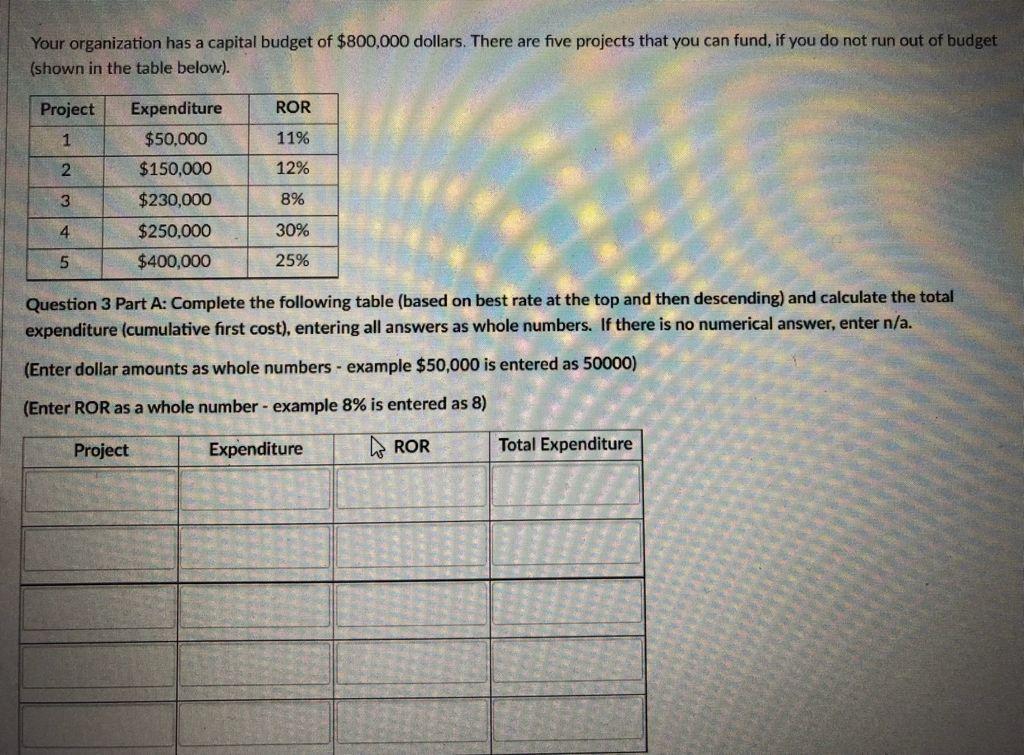
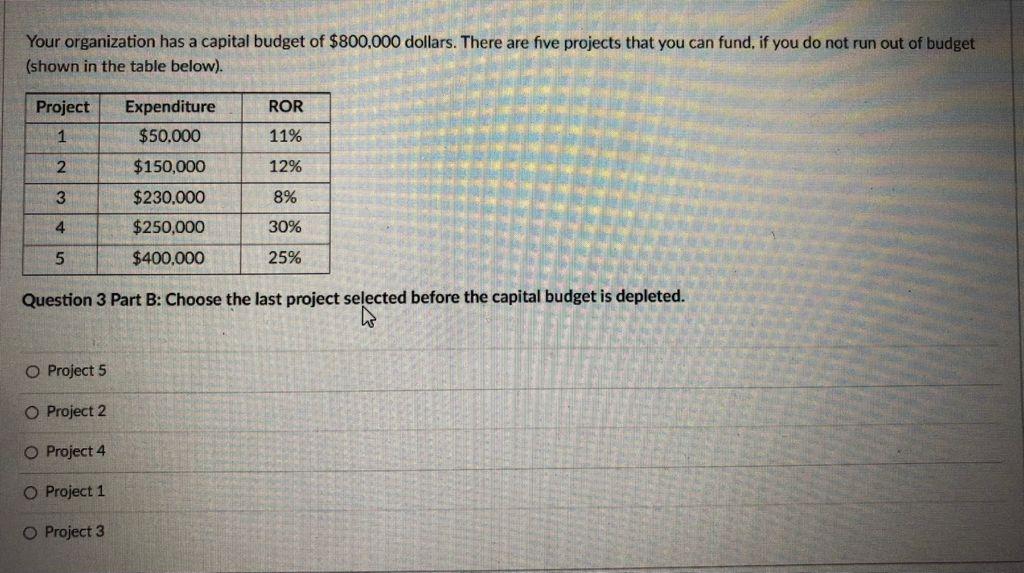
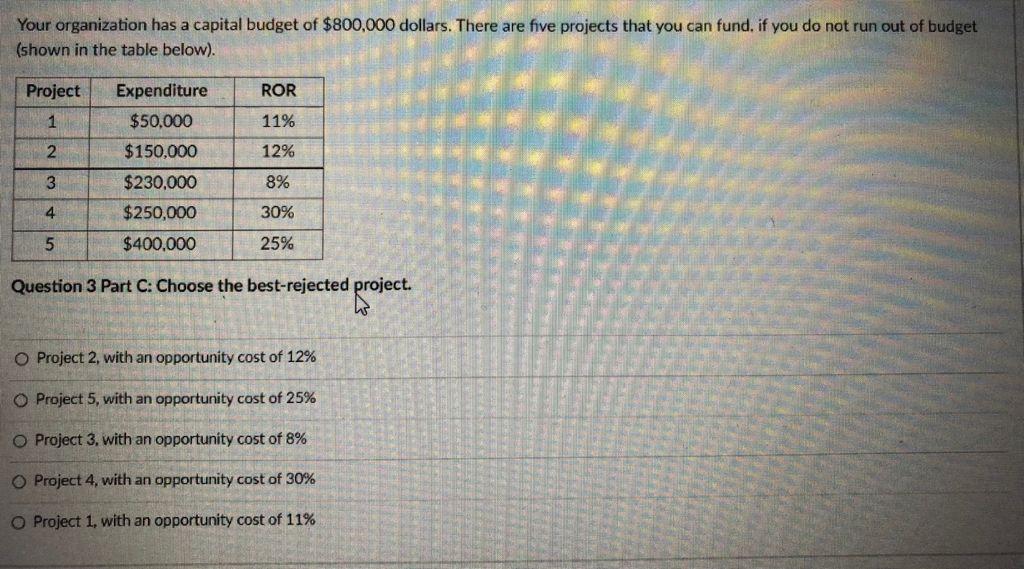
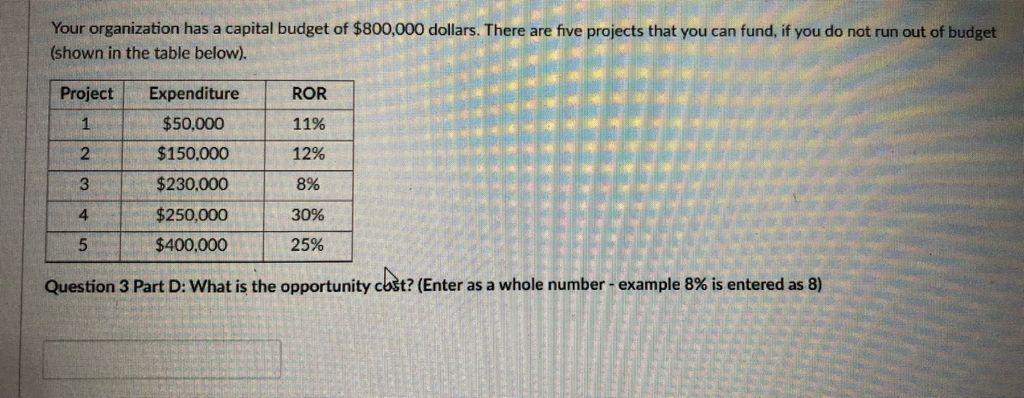
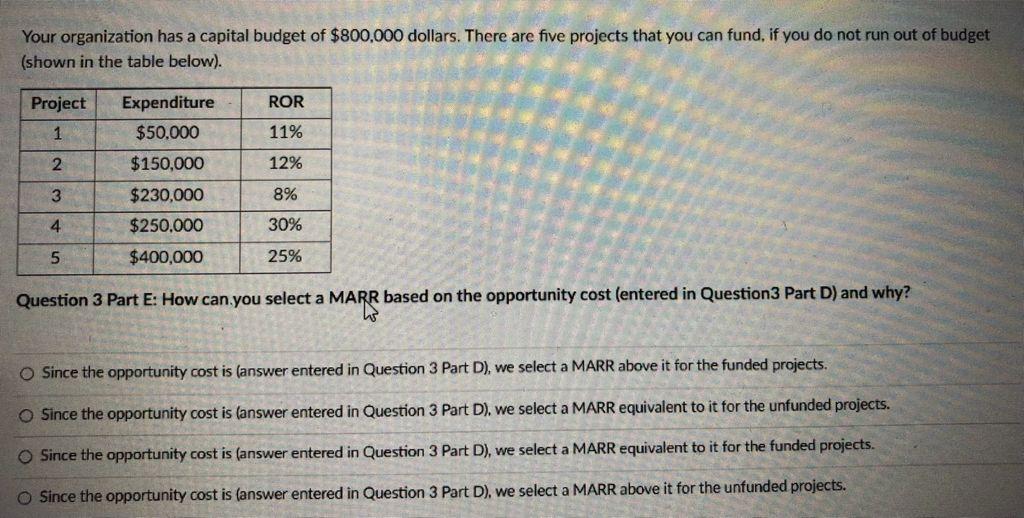
Your organization has a capital budget of $800,000 dollars. There are five projects that you can fund, if you do not run out of budget (shown in the table below). Project ROR 1 11% 2 12% Expenditure $50,000 $150,000 $230,000 $250.000 $400,000 3 8% 4 30% 5 25% Question 3 Part A: Complete the following table (based on best rate at the top and then descending) and calculate the total expenditure (cumulative first cost), entering all answers as whole numbers. If there is no numerical answer, enter n/a. (Enter dollar amounts as whole numbers - example $50,000 is entered as 50000) (Enter ROR as a whole number - example 8% is entered as 8) Project Expenditure A ROR Total Expenditure Your organization has a capital budget of $800,000 dollars. There are five projects that you can fund, if you do not run out of budget (shown in the table below). ROR Project 1 Expenditure $50.000 11% 2 $150,000 12% 3 $230.000 8% 4 $250,000 30% 5 $400,000 25% Question 3 Part B: Choose the last project selected before the capital budget is depleted. O Project 5 O Project 2 O Project 4 O Project 1 O Project 3 Your organization has a capital budget of $800,000 dollars. There are five projects that you can fund, if you do not run out of budget (shown in the table below). ROR Project 1 Expenditure $50,000 $150,000 11% 2 12% 3 8% $230,000 $250,000 4 30% 5 $400,000 25% Question 3 Part C: Choose the best-rejected project. project. O Project 2, with an opportunity cost of 12% O Project 5, with an opportunity cost of 25% O Project 3, with an opportunity cost of 8% Project 4, with an opportunity cost of 30% O Project 1, with an opportunity cost of 11% Your organization has a capital budget of $800,000 dollars. There are five projects that you can fund, if you do not run out of budget (shown in the table below). Project ROR 1 11% 2 Expenditure $50.000 $150.000 $230,000 $250,000 12% 3 8% 4 30% 5 $400.000 25% Question 3 Part D: What is the opportunity cost? (Enter as a whole number - example 8% is entered as 8) Your organization has a capital budget of $800,000 dollars. There are five projects that you can fund, if you do not run out of budget (shown in the table below). Project ROR 1 11% 2 12% Expenditure $50.000 $150,000 $230,000 $250.000 $400,000 3 8% 4 30% 5 25% Question 3 Part E: How can you select a MARR based on the opportunity cost (entered in Question3 Part D) and why? MARRI Since the opportunity cost is (answer entered in Question 3 Part D), we select a MARR above it for the funded projects. Since the opportunity cost is (answer entered in Question 3 Part D), we select a MARR equivalent to it for the unfunded projects. Since the opportunity cost is (answer entered in Question 3 Part D), we select a MARR equivalent to it for the funded projects. O Since the opportunity cost is (answer entered in Question 3 Part D), we select a MARR above it for the unfunded projects
Step by Step Solution
There are 3 Steps involved in it

Get step-by-step solutions from verified subject matter experts
 Study Help