







Question: please answer all parts with work shown! Question (1) (Minimum Variance Frontier with one risk-free asset and one risky asset) (10 points) Suppose there are
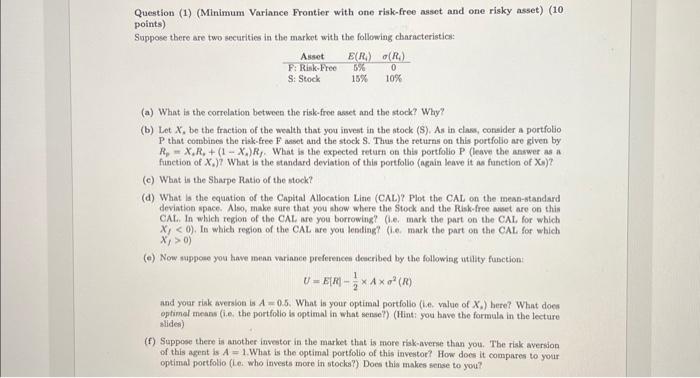
Question (1) (Minimum Variance Frontier with one risk-free asset and one risky asset) (10 points) Suppose there are two securities in the market with the following characteristics: (a) What is the correlation between the risk-free asset and the stock? Why? (b) Let X, be the fraction of the wealth that you invest in the stock (S). As in class, consider a portfolio P that costbines the risk-free F anset and the stock S. Thus the returns on this portfolio are given by Rp=XtRj+(1Xn)Rf. What is the expected return on this portfolio P (leave the answer as a function of X,)? What is the standard deviation of this portfolio (again leave it as funetion of Xs )? (c) What is the Sharpe Ratio of the stock? (d) What is the equation of the Capital Allocation Line (CAL)? Plot the CAL on the mean-standard deviation space. Also, make sare that you show where the Stock and the Risk-free asset are on thin CAL. In which region of the CAL are you borrowing? (1.e. mark the part on the CAL for which xf0) (c) Now suppose you have mean variance preferences described by the followiag utility function: U=E[R]21A2(R) and your risk aversion is A=0.5. What is your optimal portfolio (i.e. value of X, ) bere? What does optimal monan (i.e. the portfolio is optimal in what sense?) (Hint: you have the formula in the lecture stides) (f) Suppose there is another investor in the market that is more risk-avene than you. The risk aversion of this agent is A=1. What is the optimal portfolio of this investor? How does it compares to your optimal portfolio (Le. who invests more in stocks?) Does this makes sense to you
Step by Step Solution
There are 3 Steps involved in it

Get step-by-step solutions from verified subject matter experts
 Study Help