







Question: Please answer all. Q1 (81) (b) (C) (d) (6) An iceberg can be approximated to a cube of pure water ice, density 0.917 g/cm3, with
Please answer all.
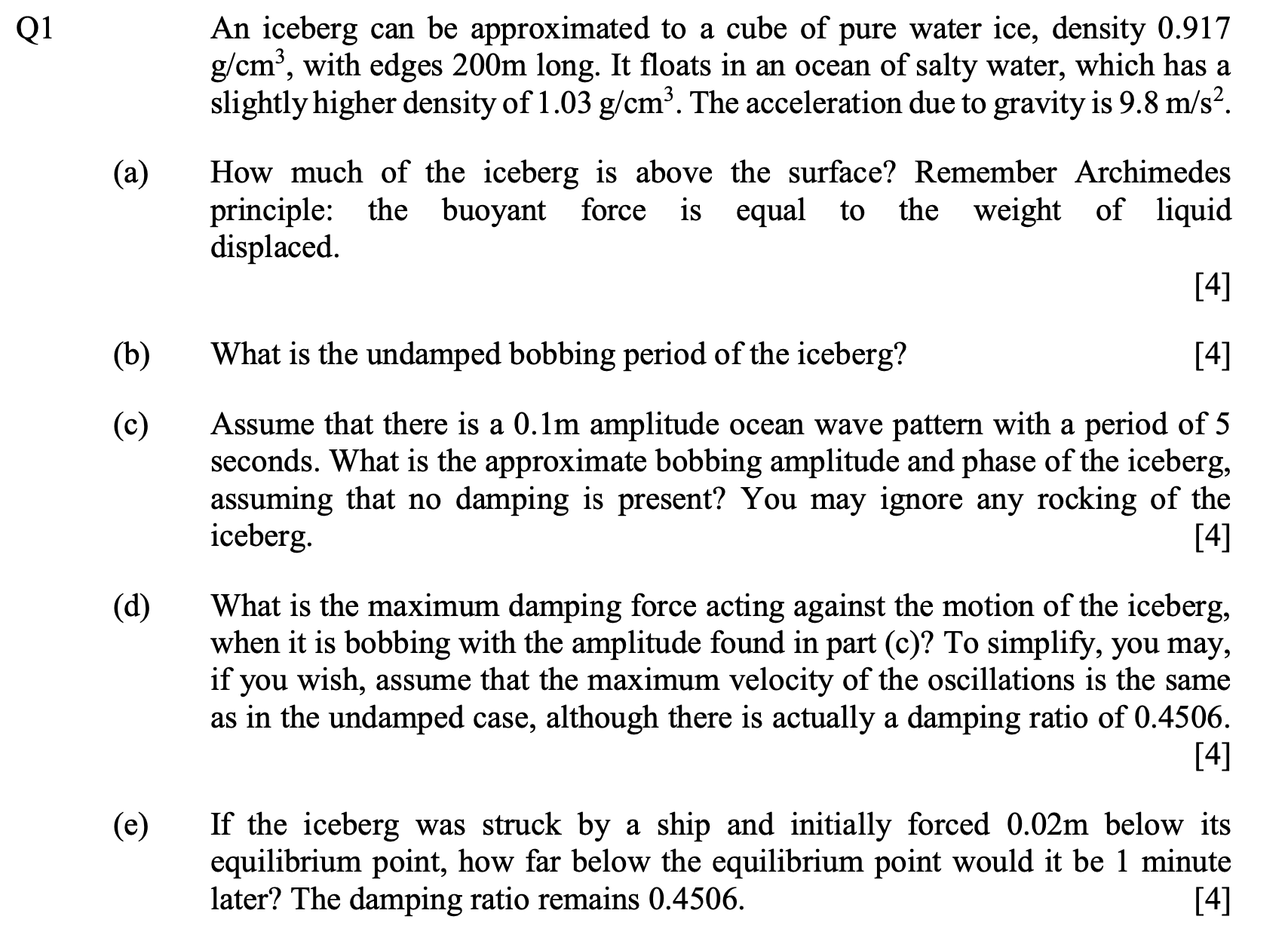
Q1 (81) (b) (C) (d) (6) An iceberg can be approximated to a cube of pure water ice, density 0.917 g/cm3, with edges 200m long. It oats in an ocean of salty water, which has a slightly higher density of 1.03 g/cm3. The acceleration due to gravity is 9.8 m/s2. How much of the iceberg is above the surface? Remember Archimedes principle: the buoyant force is equal to the weight of liquid displaced. [4] What is the undamped bobbing period of the iceberg? [4] Assume that there is a 0.1m amplitude ocean wave pattern with a period of 5 seconds. What is the approximate bobbing amplitude and phase of the iceberg, assuming that no damping is present? You may ignore any rocking of the iceberg. [4] What is the maximum damping force acting against the motion of the iceberg, when it is bobbing with the amplitude found in part (c)? To simplify, you may, if you wish, assume that the maximum velocity of the oscillations is the same as in the undamped case, although there is actually a damping ratio of 0.4506. [4] If the iceberg was struck by a ship and initially forced 0.02m below its equilibrium point, how far below the equilibrium point would it be 1 minute later? The damping ratio remains 0.4506. [4]
Step by Step Solution
There are 3 Steps involved in it

Get step-by-step solutions from verified subject matter experts
 Study Help