



Question: please answer all questions 3. Suppose we are interested in the return to education and estimated the following regression: log(wage)n=0.584+(0.008)0.083educ+(0.005)0.029exper+(0.007)0.032tenure=526,R2=0.186 Suppose that it is known
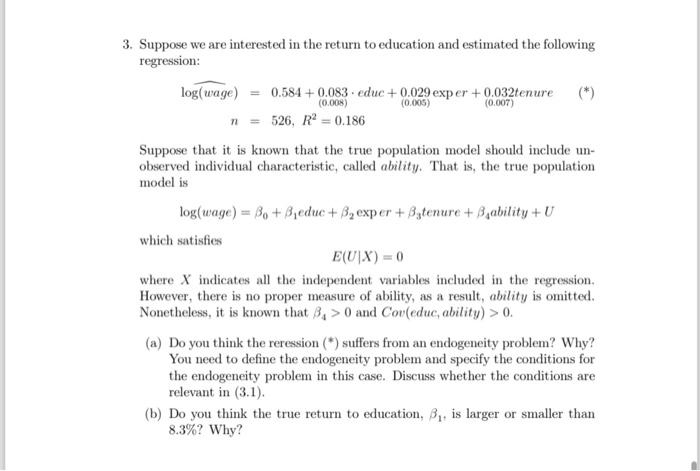
3. Suppose we are interested in the return to education and estimated the following regression: log(wage)n=0.584+(0.008)0.083educ+(0.005)0.029exper+(0.007)0.032tenure=526,R2=0.186 Suppose that it is known that the true population model should include unobserved individual characteristic, called ability. That is, the true population model is log(uage)=0+1educ+2exper+3tenure+4ability+U which satisfies E(UX)=0 where X indicates all the independent variables included in the regression. However, there is no proper measure of ability, as a result, ability is omitted. Nonetheless, it is known that 4>0 and Cov( educ, ability )>0. (a) Do you think the reression (*) suffers from an endogeneity problem? Why? You need to define the endogeneity problem and specify the conditions for the endogeneity problem in this case. Discuss whether the conditions are relevant in (3.1). (b) Do you think the true return to education, 1, is larger or smaller than 8.3% ? Why
Step by Step Solution
There are 3 Steps involved in it

Get step-by-step solutions from verified subject matter experts