







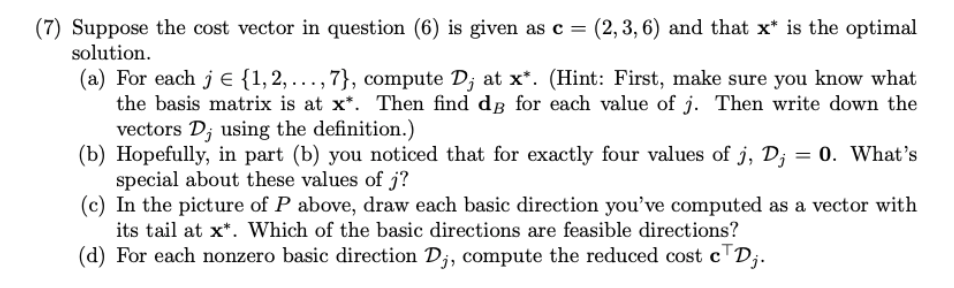
Question: PLEASE ANSWER ALL QUESTIONS (7) Suppose the cost vector in question (6) is given as c = (2, 3, 6) and that x* is the
PLEASE ANSWER ALL QUESTIONS
(7) Suppose the cost vector in question (6) is given as c = (2, 3, 6) and that x* is the optimal solution. (a) For each j {1, 2, ..., 7}, compute D; at x*. (Hint: First, make sure you know what the basis matrix is at x*. Then find dp for each value of j. Then write down the vectors D; using the definition.) (b) Hopefully, in part (b) you noticed that for exactly four values of j, D; = 0. What's special about these values of j? (c) In the picture of P above, draw each basic direction you've computed as a vector with its tail at x*. Which of the basic directions are feasible directions? (d) For each nonzero basic direction Dj, compute the reduced cost cTD;. (7) Suppose the cost vector in question (6) is given as c = (2, 3, 6) and that x* is the optimal solution. (a) For each j {1, 2, ..., 7}, compute D; at x*. (Hint: First, make sure you know what the basis matrix is at x*. Then find dp for each value of j. Then write down the vectors D; using the definition.) (b) Hopefully, in part (b) you noticed that for exactly four values of j, D; = 0. What's special about these values of j? (c) In the picture of P above, draw each basic direction you've computed as a vector with its tail at x*. Which of the basic directions are feasible directions? (d) For each nonzero basic direction Dj, compute the reduced cost cTD
Step by Step Solution
There are 3 Steps involved in it

Get step-by-step solutions from verified subject matter experts
 Study Help