







Question: please answer all questions :) b) What is the IUPAC name of the molecule shown? A) 2-ethyl-5-hexene B) . 5-methyl-1 -heptene C) 3-methyl-6-heptene D) 5
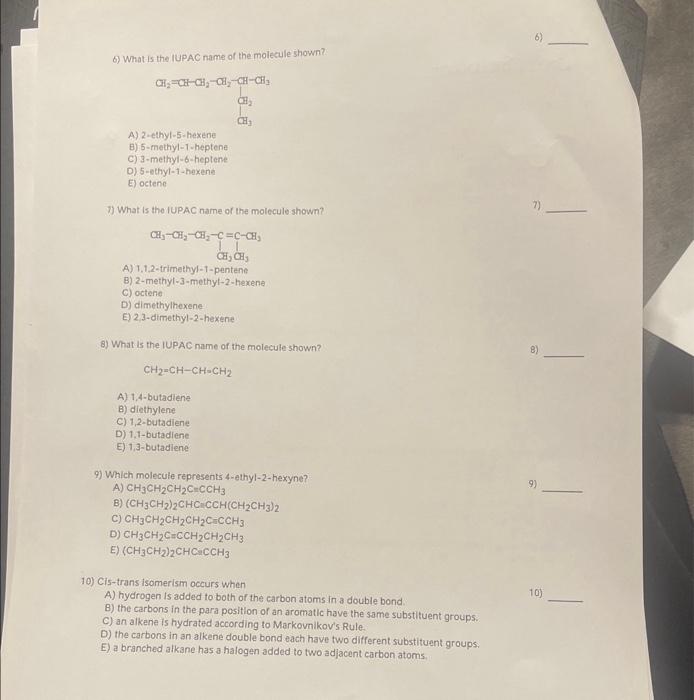
b) What is the IUPAC name of the molecule shown? A) 2-ethyl-5-hexene B) . 5-methyl-1 -heptene C) 3-methyl-6-heptene D) 5 -ethyl-1-hexene E) octene 1) What is the IUPAC name of the molecule shown? 7) A) 1,1.2-trimethyl-1-pentene B) 2-methyl-3-methyl-2-hexene C) actene D) dimethylhexene E) 2,3-dimethyl-2-hexene 8) What is the IUPAC name of the molecule shown? CH2=CHCH=CH2 A) 1,4-butadiene B) diethylene C) 1,2-butadiene D) 1,1-butadiene E) 1,3-butadiene 9) Which molecule represents 4-ethyl-2-hexyne? A) CH3CH2CH2C=CCH3. B) (CH3CH2)2CHCrCCH(CH2CH3)2 C) CH3CH2CH2CH2CaCCH3 D) CH2CH2C=CCH2CH2CH3 E) (CH3CH2)2CHCiCCH3 10) Cis-trans isomerism occurs when A) hydrogen is added to both of the carbon atoms in a double bond. B) B) the carbons in the para position of an aromatic have the same substituent groups. C) an alkene is hydrated according to Markovnikov's Rule. D) the carbons in an alkene double bond each have two different substituent groups. E) a branched alkane has a halogen added to two adjacent carbon atoms
Step by Step Solution
There are 3 Steps involved in it

Get step-by-step solutions from verified subject matter experts
 Study Help